
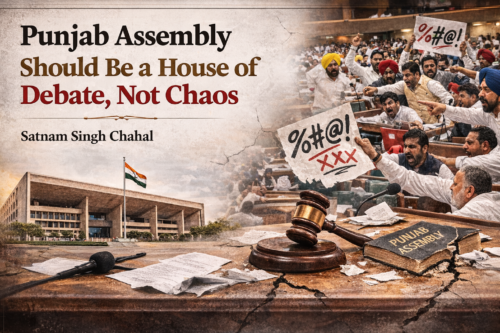
 The Punjab Legislative Assembly is the highest democratic institution of the state, where laws affecting millions of citizens are debated, examined, amended, and ultimately passed. The Constitution envisions the Assembly not as a rubber stamp for the executive but as a forum where elected representatives carefully scrutinize every proposed law before it becomes binding on the people. However, serious concerns arise when the draft of a proposed Act is reportedly handed over to Members of the Legislative Assembly (MLAs) only after the proceedings of the House have already begun.
If legislators receive the text of a Bill only moments before it is introduced, one fundamental question naturally arises: How can they study hundreds of clauses, understand the legal implications, consult experts, seek public opinion, or propose meaningful amendments? Lawmaking is not an examination where students are expected to answer questions without reading the paper. It is a constitutional responsibility requiring careful thought, debate, and informed decision-making.
A Bill often contains complex legal provisions that can affect governance, civil liberties, financial management, agriculture, education, industry, or law and order for years to come. Reading such legislation requires time. MLAs are elected not merely to occupy seats in the Assembly but to protect the interests of the people who sent them there. If they are denied sufficient time to study legislation, they cannot effectively discharge that constitutional duty.
The practice of distributing legislation at the commencement of Assembly proceedings, if followed, undermines the very purpose of legislative debate. Instead of informed discussion, the House risks becoming a place where members simply vote without fully understanding what they are approving. This weakens parliamentary democracy and diminishes public confidence in the legislative process.
The Importance of Debate
Every clause of a Bill deserves examination. Opposition members, treasury benches, and independent legislators often possess different perspectives that can improve legislation. Many landmark laws across democratic nations have become stronger because lawmakers suggested amendments after detailed debate and committee scrutiny.
Without adequate time to study the text, MLAs cannot identify drafting errors, constitutional concerns, financial implications, or unintended consequences. Nor can they seek feedback from lawyers, economists, farmers’ organizations, industry representatives, or civil society groups who may be affected by the proposed law.
The People’s Voice Is Silenced
Every MLA represents thousands, and in many cases lakhs, of citizens. Constituents expect their representatives to speak on their behalf inside the Assembly. If MLAs receive legislation at the last minute, they cannot collect public opinion from their constituencies before participating in debate.
The Assembly is not merely a gathering of political parties; it is the collective voice of Punjab’s people. When legislators are unable to raise concerns because they have not had time to study a Bill, it is ultimately the people whose voices remain unheard.
Timeline of Democratic Expectations
1952 – First Punjab Legislative Assembly
The Assembly was established as a forum for democratic debate where laws would be discussed openly before enactment.
1950s–1990s – Parliamentary Traditions Develop
Successive Assemblies generally followed legislative procedures that emphasized discussion, questioning ministers, committee examination, and opportunities for amendments.
2000–2020 – Growing Demand for Transparency
Across India, civil society organizations increasingly demanded greater transparency in legislative functioning, including advance circulation of Bills and wider public consultation.
2022 – Promise of Transparent Governance
The present government assumed office with commitments to transparency, accountability, and participatory democracy, raising expectations that legislative processes would become more open and consultative.
2026 – Questions Over Legislative Practice
Concerns have emerged that important Bills are sometimes made available to MLAs only as Assembly proceedings commence. Critics argue that this practice limits meaningful debate and reduces the role of elected representatives in the lawmaking process.
Democracy Requires Preparation, Not Blind Approval
A legislature cannot function effectively if lawmakers are expected to approve legislation they have barely had an opportunity to read. Democracy demands informed consent, not hurried endorsement. Governments with comfortable majorities have every constitutional right to introduce legislation, but they also carry the responsibility to ensure that elected representatives receive adequate time to examine every proposal.
Strong governments are not weakened by debate; they are strengthened by it. Laws become more effective when subjected to rigorous scrut