
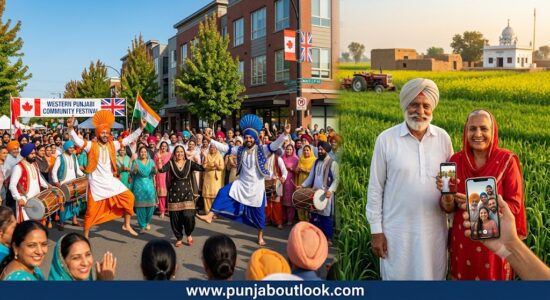
 The Vibrant Life of the Punjabi Community in Western Countries and Their Enduring Bonds in the HomelandThe Punjabi diaspora represents one of the most dynamic and visible South Asian communities in the Western world. With an estimated 3 to 5 million people of Punjabi origin living abroad, significant populations have settled in Canada, the United Kingdom, the United States, Australia, and parts of Western Europe. These communities have built thriving enclaves while preserving their distinctive language, traditions, and social structures. Canada hosts the largest concentration, with approximately 942,000 Punjabis recorded in the 2021 census, making Punjabi one of the fastest-growing languages in the country. Major hubs include Brampton in Ontario (often nicknamed “Mini Punjab”) and Surrey in British Columbia, where Punjabi culture is visibly woven into everyday life through shops, restaurants, gurdwaras, and community events.
In these Western settings, Punjabis have adapted successfully to new environments while maintaining strong internal cohesion. Many work in transportation and trucking, agriculture and farming (particularly in California’s Central Valley and British Columbia), real estate, small businesses, and increasingly in professional fields. Gurdwaras (Sikh temples) and community centers serve as the heart of social life, offering not only religious services but also language classes, cultural programs, and support networks for new immigrants. Festivals such as Vaisakhi (Baisakhi), Lohri, and Nagar Kirtan processions draw thousands, featuring colorful parades, bhangra dancing, and traditional attire. Bhangra music itself evolved in the UK diaspora as a vibrant fusion that later gained global popularity. Families often emphasize close-knit relationships, respect for elders, hospitality, and endogamous marriages within the community, helping preserve identity across generations despite pressures of assimilation.
Political engagement has also grown. In Canada, figures like Jagmeet Singh have risen to national prominence, reflecting the community’s integration and influence. Remittances and philanthropy flow back to Punjab, funding schools, hospitals, and village development, while diaspora networks facilitate business and family connections across borders. Challenges exist generational gaps between first- and second-generation immigrants, occasional tensions over identity or politics, and historical experiences of discrimination but overall, Punjabi communities in the West are seen as entrepreneurial, resilient, and culturally vibrant contributors to multicultural societies.Back in the original homeland, the Punjab region (split between India and Pakistan since the 1947 Partition) reveals deep-rooted social patterns that continue to shape relationships among Punjabis. In Indian Punjab, Sikhs form the majority (around 58%), with Hindus comprising about 38% and smaller Muslim and Christian minorities.
Society remains family-oriented and community-focused, with strong emphasis on biradari (clan or brotherhood networks) that influence social alliances, business dealings, and especially marriages. Joint or extended families are traditional, though nuclear families are becoming more common in urban areas. Warm hospitality, respect for elders, and agricultural roots define daily life. Shared Punjabi identity through language (Gurmukhi script for Sikhs and Hindus), cuisine (sarson da saag, makki di roti), folk dances, and festivals bridges religious lines to a significant degree, even as religious practices and institutions remain distinct.In Pakistani Punjab, the population is overwhelmingly Muslim (over 95%), with small Christian and Hindu minorities. Here too, biradari and social stratification (historically linked to landownership and occupations, such as zamindars and service castes) organize village and family life. Punjabi culture thrives with overlapping elements: similar foods, Sufi-influenced music and poetry, seasonal celebrations, and a strong sense of regional pride.
The 1947 Partition caused immense upheaval, displacing millions and separating families along religious lines, yet a shared “Punjabiyat” (Punjabi cultural essence) persists among many. Cross-border family ties, though limited by geopolitics, remain emotionally significant for those with ancestral roots on both sides.Relationships within the original Punjabi communities are characterized by deep loyalty to family and clan, combined with a broader cultural affinity that transcends religion in many everyday contexts. Caste and religious identities influence social circles and marriage preferences, yet the common language, humor, work ethic, and love for the land foster a sense of unity. In villages, neighbors of different faiths historically cooperated in agriculture and festivals, though political events have sometimes strained these bonds. Today, many Punjabis whether in India or Pakistan maintain transnational connections through diaspora relatives who visit, invest, or send support.Overall, the Punjabi story is one of remarkable continuity amid change.
In Western countries, communities thrive by balancing adaptation with cultural preservation, creating “Mini Punjabs” that feel like home away from home. In the original homeland, relationships remain anchored in family, clan, and shared heritage, shaped by history yet resilient. The diaspora and homeland continue to influence each other through remittances, cultural exchange, visits, and evolving identities, ensuring that Punjabi spirit endures across continents. This blend of tradition and modernity highlights the enduring strength of Punjabi bonds both within their communities abroad and with their roots back home.
Referances:youtube.com, utm.utoronto.ca
Disclaimer: This article and accompanying images are for informational and illustrative purposes only. Some visuals may be AI-generated or digitally enhanced and may not depict actual events or persons. Views expressed are based on publicly available information and analysis.