
 The questions and answers below have been prepared, to the best of the writer’s ability, from the Representation of the People Act 1950, the Election Commission’s own Enumeration Form, published FAQs, and documented field experience. They are offered in the public interest, to help the ordinary voter understand a process that has caused genuine confusion and distress. They are not, and are not intended to be, a substitute for professional legal advice, nor are they meant to confuse any voter, or to interrupt, obstruct, or derail the ongoing Special Intensive Revision in any way. Before acting on anything written here, the reader is strongly urged to consult a qualified legal expert, and separately to approach the Chief Electoral Officer, the Electoral Registration Officer, or the Booth Level Officer concerned, as appropriate. Ultimate responsibility for ensuring that one’s own name appears correctly on the electoral roll rests, as it must, with the voter alone.
Wary voters are voicing doubts, and weighing their choices, at doorsteps across the country as the Special Intensive Revision proceeds. The exercise now under way across Punjab, the Union Territory of Chandigarh, and several other States and Union Territories is, at its statutory core, a simple one. It has, in practice, become a source of considerable anxiety at the doorstep — anxiety this article seeks to reduce, not add to. What follows applies with equal force wherever the SIR is being conducted; the illustrative dates are drawn from Punjab and Chandigarh, but the statutory position and the practical remedies are the same across the country. Section 19 of the Representation of the People Act, 1950 lays down only three conditions for a person to be entitled to registration as a voter, unless disqualified under Section 16.
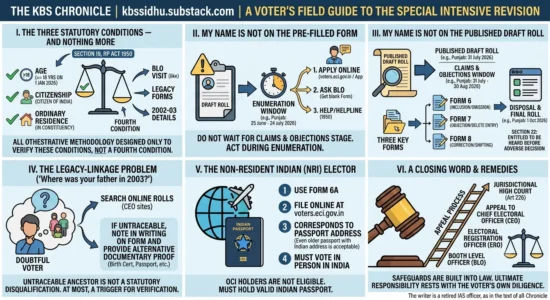
I. The Three Statutory Conditions — and Nothing More
● Age — the person must have attained 18 years of age on the qualifying date (1 January 2026 for the ongoing SIR).
● Citizenship — the person must be a citizen of India.
● Ordinary residence — the person must be ordinarily resident in the constituency concerned.
Everything else — the Enumeration Form, the legacy-linkage columns, the demand for 2002-03 particulars, the Booth Level Officer’s visit — is administrative methodology devised by the Election Commission to verify these three conditions. It is not a fourth statutory condition. Where the methodology and the law appear to pull in different directions, the law must prevail. That principle runs through every answer that follows.
II. My Name Is Not on the Pre-Filled Form the BLO Is Carrying
Should I proactively apply online in Form 6, request a physical form, or simply wait for the draft roll and file a claim then?
Do not wait. Act during the enumeration window itself. In Punjab this runs from 25 June to 24 July 2026, with the draft roll following on 31 July; in Chandigarh the corresponding dates are 15 June to 14 July 2026, with the draft roll on 21 July. Elsewhere in the country the exact dates will vary by State, but the sequence is identical — an enumeration window, followed by a draft roll, followed by Claims and Objections. If a filled and signed Enumeration Form is not collected by the BLO and uploaded before the enumeration period closes, the name will not appear in the draft roll, and a fresh Form 6 will then have to be filed during the Claims and Objections window — an avoidable delay that shifts the burden of proof onto the voter rather than the Electoral Registration Officer.
Three options exist, in order of preference: filling the Enumeration Form online at voters.eci.gov.in or through the Voter Helpline App; asking the BLO directly for a blank physical form if none has been left at the house, since BLOs are required to carry spares; and, as a last resort, approaching the District or Assembly Constituency-level helpdesk, or the Voter Helpline on 1950.
The Claims and Objections stage exists as a safety net for genuine omissions and disputes — it is not meant to be used as the primary channel. Using it as the first resort converts a simple confirmation into a contested claim, within a shorter and more adversarial window.
III. My Name Does Not Appear in the Published Draft Roll — What Now?
The draft roll has come out and I cannot find my name in it. What is the process of claims and objections, and how do I use it?
First, confirm the omission carefully before assuming the worst. Search for the name on voters.eci.gov.in, or on the CEO’s portal for the State concerned, using the EPIC number where available, since a misspelling or a wrong part/serial number is a more common cause of an apparent omission than an actual deletion. In Punjab the draft roll is published on 31 July 2026, with the Claims and Objections window running from 31 July to 30 August 2026; in Chandigarh the corresponding dates are 21 July and 21 July to 20 August 2026. Elsewhere in the country the dates differ, but the sequence — draft roll, followed by a defined claims-and-objections window, followed by disposal and a final roll — is the same everywhere.
Three forms govern this stage, and it is worth knowing which one applies:
● Form 6 — for inclusion of a name omitted from the draft roll, or for a fresh application by someone newly eligible. This is the form to use if your name is simply missing.
● Form 7 — for objection to the inclusion of a name already in the draft roll, typically used where a voter believes another entry is wrongly included (for instance, a deceased or shifted elector, or a suspected duplicate).
● Form 8 — for correction of entries already in the roll, or for transposition of an entry from one constituency to another within the same district, where the name exists but particulars are wrong.
The claim must ordinarily be filed with the Electoral Registration Officer or Assistant Electoral Registration Officer of the constituency, either online at voters.eci.gov.in, through the Voter Helpline App, or physically at the ERO’s office or before the BLO, and should be accompanied by the same category of supporting documents discussed above — Aadhaar, EPIC, and proof of date of birth and ordinary residence, as applicable. A Booth Level Agent, where appointed by a political party, may also flag the omission and assist in filing the claim, and it is good practice to retain the acknowledgement or reference number generated on submission.
Once filed, the claim enters the Notice and Disposal phase — running, in Punjab, from 31 July to 28 September 2026 — during which the ERO is required to examine the claim, and Section 22’s proviso entitles the applicant to be heard before any adverse decision. In practice, this may involve a further request for documents or a personal appearance; the claimant should respond promptly to any such notice, as an unanswered notice can result in the claim being closed for want of response rather than on merits. If the claim is allowed, the name is included in the final roll published on 1 October 2026 in Punjab (22 September 2026 in Chandigarh). If it is rejected, or not disposed of within the window, the remedy lies first in an appeal to the Chief Electoral Officer under Section 24 of the RP Act, and, if that does not resolve the matter, before the jurisdictional High Court under Article 226 of the Constitution — the same two-step remedy that applies to the legacy-linkage disputes discussed above.
One further point deserves emphasis: the Claims and Objections window is not the only opportunity. Electoral rolls are subject to continuous updation even after the final roll is published, and Form 6 can be filed at any time thereafter. But a name included at the claims-and-objections stage, well before the final roll, is far more secure than one added later through continuous updation, since the latter route offers no guarantee of inclusion before the next election is notified.
IV. “Where Was Your Father a Voter in 2003?” — The Legacy-Linkage Problem
I do not have my father’s — or my own — voter particulars from the last Special Intensive Revision of 2002-03. What do I do?
This has proved the single most widespread grievance of the current exercise, reported from Punjab and Chandigarh to Kerala, Rajasthan, and well beyond. It deserves to be answered in two parts: what the law requires, and what can practically be done — and the answer holds good regardless of which State or Union Territory the voter happens to be in.
On the law: the Enumeration Form itself offers four qualifying relatives for legacy linkage — father, mother, grandfather, or grandmother — not the father alone. Field reports from across the country show Booth Level Officers narrowing this to the father only, which reflects a training failure, not a legal requirement. Section 20(3) of the RP Act specifically protects families of service personnel and others in transferable employment whose registration address may not match the family home for entirely lawful reasons. Section 22’s proviso requires a hearing before any name is deleted; a deletion for unresolved legacy linkage without notice and a hearing would not be lawful. An untraceable ancestor is, in short, not one of the three statutory disqualifications — at most it is a trigger for further documentary verification, not an automatic bar.
On practice: search the old rolls first. Most State Chief Electoral Officers — including Punjab and, for Chandigarh, the CEO of Punjab who holds dual charge — have placed the 2002-03 (or, in some States, 2005) rolls online, searchable by name and by relative’s name, though several States offer only non-searchable PDFs, requiring patience. If the record is genuinely untraceable, this should be noted in writing on the Enumeration Form at the time of the BLO’s visit, and the category “neither my name nor my parents’ name exists in the last SIR roll” should be selected, which opens the alternative documentary route. Alternative proof of date and place of birth — a birth certificate, passport, pre-2004 Aadhaar, or LIC/PSU record for those born before 1 July 1987; a combination of self and parental documents for those born between 1 July 1987 and 2 December 2004 — can then be produced in place of legacy linkage. Should a notice follow from the Electoral Registration Officer, it should be answered within the time allowed, with Aadhaar and EPIC attached as proof of identity and residence. If a claim is rejected without a hearing, the remedy lies in an appeal to the Chief Electoral Officer under Section 24, and, failing satisfaction there, before the jurisdictional High Court under Article 226 of the Constitution.
V. The Non-Resident Indian, Temporarily Away or Settled Abroad
How does a Non-Resident Indian, holding a valid Indian passport, get onto the electoral roll? Is there a separate procedure?
Yes. Section 20A of the Representation of the People Act 1950, inserted by the 2010 Amendment, allows an overseas elector to register in the constituency corresponding to the address on the Indian passport, using Form 6A, filed online at voters.eci.gov.in or through the Voter Helpline App, at any time — though filing during the current Claims and Objections window offers the best prospect of inclusion in the final roll, due for publication on 1 October 2026 in Punjab and 22 September 2026 in Chandigarh, with comparable dates applying in other States and Union Territories under revision.
A common misconception may be corrected here: the passport need not show a current Indian address. An older passport bearing an Indian address is acceptable, even where the current one shows a foreign address. It should equally be noted that Overseas Citizen of India cardholders are not eligible under Section 20A — only Indian citizens holding a valid Indian passport who have not acquired foreign citizenship may register as overseas electors; and that present law requires such electors to vote in person in India, there being no postal or proxy facility for NRIs as yet. Those who are only temporarily away — on a posting, assignment, or extended visit — without having shifted their ordinary residence abroad in substance, would generally continue to be covered through the standard family enumeration route, rather than requiring Form 6A at all.
VI. A Closing Word
None of the foregoing is a substitute for the safeguards already built into law: the right to be heard before deletion, the right to appeal to the Chief Electoral Officer, and, ultimately, the jurisdiction of the High Court. Nor is it a substitute for the voter’s own diligence. The Special Intensive Revision will succeed or fail not on the strength of any single article, but on whether every eligible citizen takes the small, timely steps described above — well before the draft roll closes the window.