
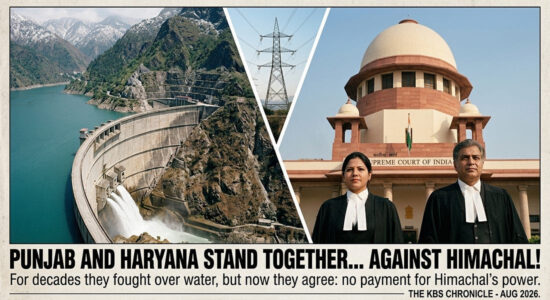
 There is a certain dark irony in the corridors of the Supreme Court this August. Punjab and Haryana — carved out of the composite Punjab with effect from 1 November 1966, and locked ever since in one of India’s most bitter and unending disputes over the waters of the Ravi and the Beas — have, for once, stood shoulder to shoulder. Not in reconciliation with each other, but in a shared reluctance to settle accounts with the third child of that reorganisation: Himachal Pradesh.
It is a measure of how unusual this alignment is that two states which cannot agree on the SYL canal, on riparian rights, on the Bhakra Beas Management Board’s water-sharing formula, or on virtually any downstream consequence of 1966, found themselves effectively on the same side of the table when it came to honouring Himachal’s claim to its rightful share of hydel power from the Bhakra-Nangal and Beas projects. For nearly fifteen years after the Supreme Court settled the question in Himachal’s favour, both plains states quietly sat on the judgment.
An entitlement fixed in 2011, and simply not honoured
The dispute itself has nothing to do with river waters in the canal-diversion sense that dominates Punjab-Haryana headlines. It concerns Section 78 of the Punjab Reorganisation Act, 1966, and the electricity generated by Bhakra-Nangal and the Beas projects — assets built with composite Punjab’s resources before the state was carved three ways.
Himachal Pradesh’s case, filed as an original suit before the Supreme Court, was that as a successor state it was entitled to 7.19 per cent of composite Punjab’s power share, not the token 2.5 per cent plus 15 MW from Dehar it had been fobbed off with for decades. On 27 September 2011, in State of Himachal Pradesh v. Union of India, the Court agreed. It fixed prospective shares at Himachal 7.19 per cent, Punjab 51.80 per cent, Haryana 37.51 per cent and Chandigarh 3.50 per cent, and — critically — held that Himachal was owed the shortfall going back to 1 November 1966, with 6 per cent interest until paid.
Himachal has received its corrected share since November 2011. What it has not received, until now, is the historical arrears: 13,066 million units of electricity that Punjab and Haryana consumed over Himachal’s rightful entitlement across more than four decades. Valued in cash, with interest running since the 1960s and 70s, that figure becomes politically and fiscally uncomfortable for both plains states — which may explain a decade and a half of studied inaction.
It bears emphasis that what is before the Court today is not a fresh cause of action to be weighed on its merits. It is a final and binding decree, already fifteen years old, whose execution has simply not occurred. The suit stood decided in 2011; what has followed since is a long, unedifying record of non-compliance. The Court has not been silent about this. At the hearing on 30 July 2026, before a bench of Chief Justice Surya Kant and Justices Joymalya Bagchi and V. Mohana, it recorded that Himachal and Haryana had agreed in principle to the Centre’s cashless formula while Punjab — through Senior Advocate Nidesh Gupta, objecting to the implied ₹2.50-per-unit valuation — had not. The bench used the occasion to pull up the Punjab government directly, remarking on the state’s history of not following through on judicial decrees, and warned that if Punjab did not fall in line, the Court would proceed to adjudicate the matter on its merits rather than wait indefinitely for a negotiated settlement. That reprimand — delivered barely a fortnight before the present hearing — makes plain the bench regards these proceedings as enforcement of what has already been adjudicated, not a reopening of the question. Punjab is not negotiating from the position of a party weighing an open claim, but of a judgment-debtor being pressed to finally comply.
The Centre’s cashless fix — and Punjab’s discomfort with it
What has forced movement is the Attorney General’s proposed settlement, placed before the Court: instead of a cash payout with compounding interest, Punjab and Haryana would discharge the arrears in kind — supplying Himachal roughly 871 million units annually during lean winter seasons (October–March) for fifteen years, split 58:42 between Punjab and Haryana for Bhakra-Nangal and 60:40 for the Beas projects. In exchange, Himachal would forgo its capital-cost liability of about ₹420.7 crore (Punjab ₹249.2 crore, Haryana ₹171.5 crore), and, more significantly, forgo pressing its cash-plus-6-per-cent-interest claim — the far larger and more punishing alternative the decree entitles it to pursue.
Haryana has agreed in principle. Himachal, understandably keen to see actual power flow rather than fight another decade of valuation litigation, is on board. Punjab alone has hesitated — not on the question of liability, which the 2011 decree settles beyond argument, but on the implied valuation of the power being surrendered, reported in proceedings at around ₹2.50 per unit, which Punjab estimates could cost the state in the region of ₹2,000 crore over the life of the arrangement.
It is worth being precise about what this means politically. Punjab’s objection is not to the principle that Himachal is owed its due — that ship sailed in 2011, and the bench’s own rebuke on 30 July has already foreclosed any suggestion otherwise — but to the price tag attached to finally settling it. The Supreme Court, having watched a decree sit unexecuted for a decade and a half, has made its patience audible: on 12 August, the Attorney General told the Court that Punjab was “very close” to an amicable settlement, an assurance the bench appears inclined to hold Punjab to, rather than entertain any further delay in complying with what is, in law, already a closed question.
What Punjab risks by continuing to hold out
The leverage here does not favour Chandigarh. Should Punjab decline to sign on to the negotiated, cashless, staggered-delivery formula, the more probable consequence is not a better deal but a worse one: the Court moving from facilitation to execution of the decree on its original terms — a cash determination carrying the full weight of 6 per cent interest accrued since the 1960s. Against that backdrop, the AG’s formula, whatever Punjab’s quarrel with the ₹2.50 valuation, is almost certainly the cheaper and more manageable path.
For a state already navigating a fiscally strained BBMB relationship, a contentious groundwater and canal-water landscape with Haryana, and an approaching election cycle in which every rupee of committed expenditure invites scrutiny, an additional ₹2,000 crore obligation — however it is finally priced — is not a small thing to concede. But conceding late, under the execution proceedings of the Apex Court, and on worse terms than the Centre is currently offering, would be smaller still.
The matter is next listed before the Supreme Court on 20 August 2026.