
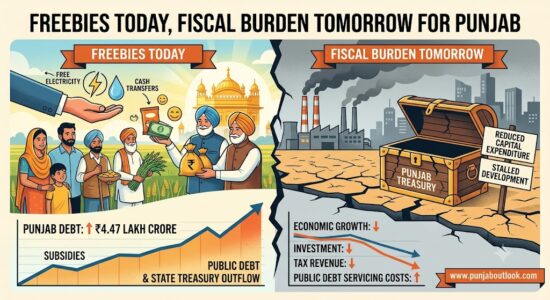
 Punjab, the land that once led India’s economic charge during the Green Revolution, stands at a precarious financial crossroads. In recent years, competitive populism has driven successive state administrations to roll out extensive welfare programs and cash transfers. While these “freebies” offer immediate socio-economic relief to millions of citizens, they are rapidly accelerating a deep fiscal crisis that threatens the state’s long-term developmental blueprint.The blueprint for populist measures in Punjab has grown substantially, handling heavily subsidized or completely free public provisions. Prominent among these is the implementation of 300 units of free monthly electricity for domestic households and entirely free power for the agricultural sector. Furthermore, cash distribution programs including the newly proposed Mukh Mantri Mawan Dhian Satikar Yojana providing up to ₹1,500 monthly to women and subsidized food programs like the Meri Rasoi Scheme add hundreds of crores to the state’s fixed monthly outflows.
According to the Punjab Budget Analysis 2026-27 by PRS India, the cumulative burden of these handouts consumes an overwhelmingly disproportionate slice of Punjab’s annual revenue receipts, with the state power subsidy alone historically tracking above ₹20,000 crore.The mathematical reality of funding immediate consumption over asset creation has left Punjab with one of the most strained debt-to-GSDP (Gross State Domestic Product) ratios in the country. Data reveals that the state’s outstanding liabilities are projected to balloon toward ₹4.47 lakh crore. To bridge the gap between static tax revenues and soaring populist expenditures, the state treasury routinely secures fresh market loans. This net-borrowing position underscores a classic debt trap, where the government is forced to borrow not to build new infrastructure, but simply to pay off the interest of yesterday’s choices.
When a state budget is structurally tilted toward committed expenditures salaries, pensions, interest payments, and welfare subsidies the ultimate casualty is capital outlay. Capital expenditure is the financial engine that builds roads, bridges, modern medical facilities, and high-quality educational institutions. While the 2026–27 budget targets a corrective 76% increase in capital outlay to revive asset creation, the state’s historical underinvestment continues to deter major private industrial investments. Economists point out that in a global economy driven by technology and manufacturing, Punjab cannot rely on the agricultural laurels of the past. Without robust state-backed infrastructure and structural incentives to attract corporations, job generation stalls, forcing the youth to migrate abroad and narrowing the domestic tax base even further.Welfare programs are vital for uplifting vulnerable segments of society, and social security shields marginalized communities from absolute poverty.
However, when welfare turns into structural freebies for all, independent of economic need, it jeopardizes the financial stability of the state. For Punjab to reverse this trajectory, it must transition from consumption-oriented populism to production-oriented governance. This requires rationalizing subsidies to target strictly under-privileged groups, diversifying the economy through information technology and agricultural value-addition, and adhering strictly to fiscal consolidation guidelines. Temporary relief today cannot come at the expense of a bankrupt tomorrow. If Punjab aims to restore its economic dominance, its political leadership must look beyond the immediate electoral horizon and build a sustainable framework where public welfare and fiscal responsibility coexist.
The Structural Deficit and Capital Compromise
The mathematical reality of funding immediate consumption over asset creation has left Punjab with one of the most strained debt-to-GSDP (Gross State Domestic Product) ratios in India. Data from the state’s latest financial statements reveals that outstanding liabilities are projected to balloon toward ₹4.47 lakh crore. To bridge the massive gap between static tax revenues and soaring populist expenditures, the state treasury routinely secures fresh market loans. This creates a classic debt trap where the government borrows not to build new infrastructure, but simply to service the interest of yesterday’s choices.
https://prsindia.org/budgets/states/punjab-budget-analysis-2026-27
When a state budget is structurally tilted toward committed expenditures such as salaries, pensions, interest payments, and welfare subsidies the ultimate casualty is capital outlay. Capital expenditure is the financial engine that builds roads, bridges, modern medical facilities, and high-quality educational institutions. While the current budget targets a corrective increase in capital outlay to revive asset creation, historical underinvestment continues to deter major private industrial investments. Punjab cannot rely entirely on the agricultural laurels of its past; without robust state-backed infrastructure and structural incentives to attract corporations, job generation stalls, forcing the youth to migrate abroad and narrowing the domestic tax base even further.
Welfare programs are undeniably vital for uplifting vulnerable segments of society, and social security shields marginalized communities from absolute poverty. However, when welfare turns into structural freebies distributed universally independent of economic need, it jeopardizes the financial stability of the state. For Punjab to reverse this trajectory, it must transition from consumption-oriented populism to production-oriented governance.Achieving this fiscal discipline requires rationalizing subsidies by restructuring electricity and cash benefits to target strictly underprivileged groups rather than distributing them as blanket universal handouts.Additionally, the state must reclaim its industrial competitiveness by upgrading industrial zones, capitalizing on information technology, and adding value to agricultural produce. Ultimately,temporary electoral relief today cannot come at the expense of a bankrupt tomorrow, and public welfare must coexist with fiscal responsibility.
Disclaimer: This article and accompanying images are for informational and illustrative purposes only. Some visuals may be AI-generated or digitally enhanced and may not depict actual events or persons. Views expressed are based on publicly available information and analysis.