
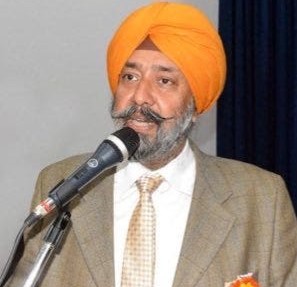
Punjab First Voice has, once again, done what it does best — placed Punjab at the centre of a conversation that most channels are too cautious, or too polarised, to host with any honesty. In an extended interview to Pankaj Kapahi, Captain Amarinder Singh has offered what is easily the most wide-ranging retrospective any former Chief Minister of Punjab has given in recent memory — on the Anandpur Sahib Resolution, Operation Blue Star, the Khalra case, K.P.S. Gill, and the present-day temptation to weaponise old wounds for new elections. Kapahi’s questioning was persistent without being adversarial, and it is that quality — a willingness to let a difficult witness speak at length rather than reduce him to a soundbite — that gives this interview its value. This is a summary of the ground it covered.
I. Origins of the Crisis
Captain Amarinder traces the roots of Punjab’s militancy years to the Anandpur Sahib Resolution and the collapse of successive rounds of Centre-Akali negotiation. He recalls that Indira Gandhi had personally asked him to open a channel with Sant Jarnail Singh Bhindranwale to understand his demands. He believes a settlement was possible but was repeatedly allowed to drift — and he places particular blame on Parkash Singh Badal, whom he accuses of preferring prolonged agitation over resolution, since agitation served Badal’s own political interest. By contrast, he speaks warmly of Gurcharan Singh Tohra as a man who generally kept his word, and of Sant Harchand Singh Longowal as gentle and sincere, though hemmed in by rival Akali factions.
II. Sant Bhindranwale — A Changing Man
He recalls that Bhindranwale was, in the early stages, affectionate toward him and reasonable in private conversation. But as the standoff dragged on without resolution, his position hardened. Captain Amarinder links this same dynamic — prolonged stalemate breeding disillusion with negotiation — to the radicalisation of a section of Sikh youth in that period.
III. Whose Responsibility Was Blue Star?
He refuses to lay the blame at one door. The Centre, the competing Akali factions, Bhindranwale himself, and everyone who let the negotiations drag on, all share responsibility in his account. Had the federal and political questions been resolved in time, he argues, there would have been no occasion for military action at all. He reiterates that he had warned Indira Gandhi he would resign if force were used at Sri Darbar Sahib — and when Blue Star happened, he did leave the Congress, largely alone, though others had spoken of doing the same.
IV. Blue Star versus Black Thunder
Captain Amarinder regards Operation Blue Star as a grave and avoidable error, and holds up Operation Black Thunder as its opposite — a far more intelligent operation that relied on cutting off electricity and water rather than a frontal assault, proving that the same objective could have been achieved without the trauma Blue Star inflicted.
V. The Violence Militancy Inflicted
He insists the period cannot be told through police conduct alone. He recalls the killing of innocent Hindus, attacks on buses and trains, the murder of policemen and their families, and abuses committed by militant groups in the villages — and argues that public sympathy for the militants eroded precisely because of this intimidation of ordinary villagers. Any account, film or otherwise, that foregrounds only state violence while erasing this side of the ledger draws his objection.
VI. Police Excesses — Acknowledged, Not Excused
At the same time, he does not deny that illegal killings occurred, including of innocent young men, and refers to reports of bodies surfacing in canals as far as Rajasthan, where Punjab’s waterways terminate. He names Ajit Singh Sandhu as an officer against whom serious allegations of unlawful killings existed, and says some officers abused the counter-insurgency apparatus for promotions and personal advantage. Yet he resists condemning the Punjab Police wholesale, insisting that a relatively small number committed atrocities while the larger force absorbed heavy casualties in restoring order.
VII. In Defence of K.P.S. Gill
His defence of Gill is unambiguous: a great leader who rebuilt the morale and fighting capacity of a shattered force. He concedes that illegal killings and questionable out-of-turn promotions may have occurred on Gill’s watch, but insists Gill be judged by his leadership through an extraordinary crisis — and singles out Gill’s readiness to own the conduct of his officers as the mark of that leadership. Attacks on Gill’s personal habits, he says, are a distraction from the real question of his professional record.
VIII. Bhai Jaswant Singh Khalra
On this, Captain Amarinder is unequivocal: Khalra should not have been killed. He calls Khalra’s work — documenting unidentified cremations to establish how many had disappeared — legitimate human-rights activity, and his murder senseless. He questions why then Chief Minister Harcharan Singh Brar failed to act if the Chief Minister’s Office was informed in time of the abduction. He is, however, sceptical of extrapolating from a handful of cremation grounds to a statewide figure of 25,000 unidentified victims, and believes such numbers need firmer verification.
IX. Ravneet Singh Bittu’s Figure of 35,000
He dismisses this figure as exaggerated and unsupported, and says Bittu speaks without adequate grounding in the period. Such claims, he warns, risk reviving Hindu-Sikh polarisation and serve no one but extremist and hardline formations on either side.
X. The Film Satluj
Speaking before he had seen it, Captain Amarinder questions the wisdom of telling Khalra’s story in isolation, without the fuller canvas of militancy-era violence. His objection is not a denial of police atrocity but a caution against one-sided narrative — and a recurring question through the interview: what present purpose is served by reopening these wounds now that Punjab has returned to normalcy?
XI. The Politics of Today
He regards any attempt to polarise Punjab along Hindu-Sikh lines as strategically self-defeating — most of all for the BJP, given that a Sikh-majority state cannot be alienated in pursuit of a Hindu consolidation. Inflammatory rhetoric, in his reading, will damage both the Congress and the BJP while strengthening radical and Amritpal Singh-aligned formations, along with hardline Akali elements.
XII. The Larger Message
Stripped to its essentials, the interview asks Punjab to hold several truths together rather than choose between them:
Militants committed grave crimes against civilians.
Police officers, too, committed illegal killings and rights violations.
K.P.S. Gill and the Punjab Police nonetheless played a decisive role in defeating terrorism.
Bhai Jaswant Singh Khalra’s work was legitimate, and his killing indefensible.
Political leadership across the spectrum failed to close a settlement before the crisis escalated.
Today’s politicians should not mine exaggerated figures or selective history to reopen Hindu-Sikh division.
Captain Amarinder’s account is, in the end, neither a whitewash of the police nor a purely rights-centred reading of the period. It presents Punjab’s militancy years as a violent breakdown in which militants, rogue policemen and political leaders of every hue share the blame — and closes with a plea that the state’s hard-won peace not be put at risk by selective or inflammatory retellings of its past