
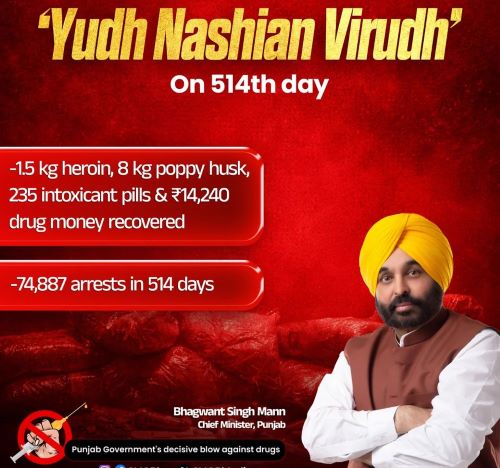
 Punjab has been struggling with the drug menace for more than two decades. Every government has promised to eradicate narcotics, and every new administration has launched campaigns with different names and strategies. The present government’s “Yudh Nashian Virudh” (War Against Drugs) campaign was introduced to break the drug supply chain, taking strict action against smugglers, rehabilitating addicts, and making Punjab drug-free.
More than a year after the campaign began, police continue to announce recoveries of large quantities of heroin, opium, synthetic drugs and other narcotics. These recoveries are often presented as major achievements. However, they have also led many people to ask an important question: If such huge quantities of drugs are still being seized, does it mean the drug network remains as active as ever?
The campaign officially began on March 1, 2025, with the government promising a comprehensive fight against drugs. Since then, Punjab Police have conducted thousands of raids, registered numerous cases under the NDPS Act, arrested alleged smugglers and claimed record recoveries of heroin and other narcotics. Authorities have also targeted hawala networks, attached properties of accused smugglers and expanded de-addiction programmes across the state.
The government maintains that these large recoveries demonstrate that law enforcement agencies are successfully intercepting drug consignments before they reach the streets. According to official figures, thousands of alleged smugglers have been arrested and tens of thousands of people suffering from addiction have received treatment through rehabilitation centres. From the government’s perspective, these statistics reflect an aggressive crackdown on the drug trade.
At the same time, critics argue that the continuous recovery of huge quantities of heroin and opium raises difficult questions. If hundreds of kilograms of narcotics continue to be seized regularly, where are these drugs coming from? How are they repeatedly entering Punjab? More importantly, if these are only the consignments that are intercepted, how many more escape detection?
Many observers believe that the true success of an anti-drug campaign should not be measured only by the number of arrests or the quantity of drugs seized. Instead, it should be reflected in a visible decline in drug availability, fewer overdose deaths, lower addiction rates among young people, and the dismantling of organised trafficking networks.
The issue is particularly serious because Punjab continues to remain one of the country’s major routes for heroin trafficking. This means that despite repeated crackdowns, the challenge has not disappeared. Every major seizure is both a success for law enforcement and a reminder of the scale of the drug problem that still exists.
Drug addiction cannot be eliminated through enforcement alone. Experts have consistently stressed that Punjab needs stronger border security, intelligence-based policing, faster convictions in drug-related cases, financial action against organised crime, better rehabilitation facilities and greater employment opportunities for recovering addicts. Unless both the supply of drugs and the demand for them are addressed together, lasting success will remain difficult.
Ultimately, the debate over the “Yudh Nashian Virudh” campaign is not about questioning the efforts of the police or security agencies. It is about assessing whether the campaign is producing long-term results. Large recoveries may indicate effective policing, but they also show that significant quantities of illegal drugs are still attempting to enter Punjab.
The real victory against drugs will come not when record-breaking seizures are announced, but when such recoveries become increasingly rare because trafficking networks have been dismantled, addiction has declined, and Punjab’s youth can look forward to a healthier and safer future.
Disclaimer: This article and accompanying images are for informational and illustrative purposes only. Some visuals may be AI-generated or digitally enhanced and may not depict actual events or persons.Views expressed are based on publicly available information and analysis.