
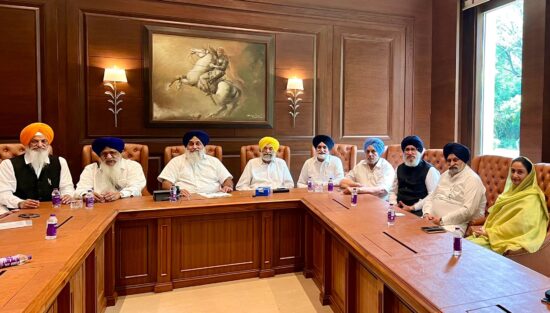
 A gambit, in the game it is named for, is a deliberate sacrifice of a piece early on, made in the hope of a stronger position later. On August 8, a day after its President Sukhbir Singh Badal called on the Prime Minister in Delhi — a meeting on which the party kept a studied silence, and which the political grapevine has since read as the first courtesy of a patch-up with a former ally — the Shiromani Akali Dal’s senior leadership gathered in Chandigarh and made just such a sacrifice: it declared support for the Women’s Reservation Bill’s immediate implementation, and for delimitation conducted on the basis of a uniform increase in seats for every state, reversing a position it had held only four months earlier. The framing was unmistakably devotional rather than merely political — an invocation of the Sikh Gurus’ teachings on the dignity and equality of women, with the SGPC’s own provision for women’s representation offered as precedent and proof of sincerity. Women’s empowerment, packaged this way, is difficult for anyone to oppose. That, of course, is rather the point of packaging. The question a gambit always raises is what piece has actually been given up, and what the player expects to win in return.
II. The Piece Sacrificed
Strip away the packaging and the arithmetic is almost comically small. The SAD holds one seat in the Lok Sabha — Bathinda, held by Harsimrat Kaur Badal — and none at all in the Rajya Sabha. A resolution from a party of this size alters no division and moves no whip; Parliament’s numbers on a two-thirds constitutional amendment remain exactly what they were the previous evening. Read only as a vote, August 8 changed nothing.
Read as a signal, it changed a great deal. With the 2027 Punjab Assembly election approaching and the SAD searching for relevance after successive electoral reverses, a public alignment with the Centre’s position — arrived at the day after a meeting with the Prime Minister that the party would not describe — was always going to be read as an overture, not an act of legislative consequence. The resolution’s audience was never the Lok Sabha. It was Punjab.
III. What Was Actually Endorsed
The more interesting question is not whether the SAD’s support counts, but what precisely it has chosen to support. The party’s statement was specific: it backed “the proposal which was put up by Govt of India at the floor of the house of uniform increase of 50% of seats of all states.” That is a deliberate formulation, and a revealing one, because it is not the same proposal the SAD itself voted against in April.
The Constitution (131st Amendment) Bill and the Delimitation Bill, 2026, as introduced in the Lok Sabha on April 16 by Law Minister Arjun Ram Meghwal, proposed to raise the states’ allocation in the Lok Sabha from 543 to 815 seats, with a further 35 seats for the Union territories, and delimitation to proceed on the 2011 census. The SAD opposed that Bill then, describing it as discriminatory to Punjab on the ground that the state would see only a marginal seat increase while others gained substantially more. The Bill fell short of the two-thirds majority required and was withdrawn — the subject, as it happens, of this column’s own analysis in these pages four months ago.
What the SAD has now endorsed is a different mechanism altogether: not population-proportionate redistribution on 2011 figures, but a flat, uniform 50 per cent addition to every state’s existing tally, preserving each state’s current percentage share of the House. Home Minister Amit Shah has cited this formulation on the floor — the southern states’ combined 129 seats rising to 195, their share of the total holding at roughly 24 per cent. Applied with the same arithmetic to Punjab, 13 seats out of 543 (2.39 per cent) becomes 20 seats out of 815 — the same 2.39 per cent, undisturbed.
IV. Floor Speech and Fine Print
Here the file requires closer reading than the resolution invited. The Bill as actually tabled does not deliver a flat uniform increase; it delivers population-proportionate delimitation on the 2011 census, within an expanded House. These are not the same arithmetic. PRS Legislative Research’s own analysis of the introduced text shows Tamil Nadu’s seats falling from 39 to 32 and Kerala’s from 20 to 15 if the states’ allocation were held constant — a contraction masked, but not eliminated, once that allocation is expanded to 815, because relative share still moves north even as absolute numbers rise for everyone. Congress’s P Chidambaram made the same point from the opposition benches in blunter terms: on strict current-population redistribution within the existing allocation, the five southern states would fall from 129 seats to 103.
The “uniform 50 per cent, share preserved” assurance that the SAD has now embraced was, in other words, an oral characterisation of the Bill’s likely aggregate effect — repeated with evident sincerity by the Home Minister, but never written into the text of the Constitution (131st Amendment) Bill itself. A promise made from the Treasury benches is not thereby a promise codified in Article 81. That distinction was the precise shortcoming this column identified when the Bill fell in April: the absence of a constitutional floor, and the failure to translate a parliamentary assurance into parliamentary text. Four months on, the shortcoming is unchanged; only the SAD’s position on it has moved.
V. The Word the Tweet Avoids
Read the resolution’s own text a second time and a smaller, more precise silence appears within the larger one. The SAD asked for “a fair and equitable Delimitation that ensures equal representation to all States.” Not proportionate representation. Not the preservation of existing share. Equal representation — a phrase that, taken at its word, would mean identical seat counts for Punjab and Uttar Pradesh, which is neither what the SAD wants nor what any version of the Bill on offer proposes. What the party evidently means, going by the sentence that immediately follows about a uniform 50 per cent increase, is proportional preservation. But it never says so, and the distinction is not pedantry. Section IV has already shown that the Bill as actually tabled in April does not preserve proportion; it reallocates on 2011 census population, which is precisely why Punjab’s own projected numbers range from 18 to 20 depending on which mechanism prevails. A resolution seeking to bind the government to the share-preserving formula needed to name that formula — “proportion,” “existing percentage share,” “2.39 per cent” — and demand it be written into the Bill’s operative text, not left to a Minister’s arithmetic on the floor. Instead the SAD borrowed the government’s own vocabulary of reassurance, imprecision and all, and presented the borrowing as a demand.
VI. Punjab’s Own Numbers
Within Punjab, the numbers already in circulation illustrate the gap between assurance and arithmetic. Partap Singh Bajwa, Leader of the Opposition in the Punjab Assembly, has placed the state’s likely tally at approximately 18 seats — a rise in absolute terms, but a fall in proportional terms, from 2.39 per cent to roughly 2.12 per cent. That is the 2011-census, population-proportionate outcome, working off the same 815-seat state allocation. It sits a full two seats below the 20 that a genuinely uniform 50 per cent increase would deliver on the identical 815-seat base. The difference between 18 and 20 seats, on one and the same proposed House, is not a rounding error. It is the difference between the Bill the SAD opposed in April and the Bill the SAD says it now supports — and nothing in the public record yet confirms which of the two Punjab will actually receive.
VII. The Clock Does Not Wait for Speeches
None of this would matter urgently if the underlying legislation were settled. It is not. The Monsoon Session, which ran from July 20 to August 13, came and went without the Delimitation Bill returning to the floor at all — held back amid disruptions over the NEET-UG paper leak, the Jantar Mantar student protests, the Ram Temple theft controversy and a Union Education Minister’s resignation, with the Foreign Contribution Bill parked in a Joint Committee alongside it. There is talk, still unconfirmed, of a special session before the month is out. There is no enacted law.
That inaction has a cost, and it is not evenly distributed across time. Article 82’s freeze on Lok Sabha seat shares — in place since the Constitution (42nd Amendment) Act, 1976, and extended in 2001 — lifts automatically once the figures of the first census taken after 2026 are published, realistically between 2029 and 2031. No further parliamentary action is required for that to happen; none is required to prevent it either, save a constitutional amendment enacted before the figures appear. If the interval between now and then produces no amendment carrying a state-wise floor, Punjab’s seat count on that date will be set by pure population proportionality under the unamended Article 81(2)(a) — a formula more austere toward slow-growing states than either scenario now on the table. The SAD’s resolution, whatever its arithmetic weight in Parliament, has at least named the right subject. What it cannot do is substitute for the Bill that alone can fix Punjab’s number before the freeze lifts of its own accord.
VIII. Reservation Rides on Top, Not Against
One clarification is owed to the public discourse, since the Women’s Reservation Bill and the seat-count debate are routinely, and wrongly, treated as competing claims on the same fixed pool. They are not. Article 334A ties the one-third reservation for women to whichever delimitation follows the first post-2026 census, whatever that delimitation’s total turns out to be. Reservation is carved out of the expanded total, not out of Punjab’s present 13. Six of eighteen, or seven of twenty — either way, Punjab’s general seats are not reduced by the reservation itself. The genuine question for Punjab is not whether to accept women’s reservation, which the SAD is right to say almost no one opposes in principle. It is which base number — 18, 20, or the harsher figure that pure post-2026 proportionality would deliver — that reservation ends up riding on top of.
IX. Charity Begins at Amritsar
The resolution’s moral anchor is the SGPC, offered as proof that the Akali Dal’s commitment to women’s representation is lived practice, not election-season sentiment: the Shiromani Gurdwara Parbandhak Committee, it says, “has already set an example by providing for women’s reservation in its House.” The claim is true as far as it goes, and it goes less far than the resolution implies. Of the SGPC’s 170 elected seats, 30 are reserved for women — about 17 per cent, against a General House of 191 once nominated members and the ex-officio Jathedars of the five Takhts and the Head Granthi of Sri Harmandir Sahib are counted in. That is roughly half the one-third share the SAD is now demanding for the Lok Sabha.
The SGPC is not a body the Akali Dal merely admires from outside. It is the institution the party has dominated for most of the century since the Sikh Gurdwaras Act, 1925 was enacted, and its current leadership sits comfortably within the Akali fold. The Act itself has been amended before by central notification, under authority Parliament conferred through the Punjab Reorganisation Act, 1966 — women’s reservation in the SGPC’s own House was introduced by exactly that route. Nothing but the will to do so has stood between the SAD and a formal request to raise that reservation from a sixth or so of the House to the one-third it invokes as principle for Parliament. Four months of public advocacy for women’s reservation elsewhere, and no comparable move recorded for the institution it actually runs. An example cited as precedent is not thereby an example being extended.
X. Not Punjab Alone
The stakes described here are Punjab’s, but the mathematics are not Punjab’s alone. Tamil Nadu, Kerala, Telangana, Andhra Pradesh and Karnataka face an identical structural choice, for an identical reason: each controlled its population growth after 1971 more successfully than the demographic majority of the country, and each therefore stands to lose proportional ground under strict post-census proportionality precisely as its absolute seat count rises. The debate that Punjab needs to have with itself is the debate the five southern states have already been having, more loudly, since April. There is no reason for Punjab to have it later, or more quietly.
XI. The Interval, Not the Session
The useful moment for this argument is now — in the interval before any Bill returns to the floor — and not once the text is tabled and the vote is imminent, by which point the debate becomes a division rather than a deliberation. Punjab’s political class, and not the SAD in isolation, would do well to press for one specific outcome in the next iteration of this Bill: a state-wise floor, written into the constitutional text itself rather than assured from the Treasury benches, of the kind the withdrawn 131st Amendment Bill notably lacked — and, closer to home, a Sikh Gurdwaras Act amendment that raises the SGPC’s own women’s reservation to match the standard the party preaches for Parliament. A resolution can signal intent. Only a codified guarantee, in Delhi and in Amritsar alike, can fix the numbers before the clock now running under Article 82 does it first.
Every gambit accepted commits the board to a line of play the side that offered it does not fully control. Sukhbir Badal has made his opening move; what Punjab wins or loses from it will be decided several moves later, on a board the SAD’s one Lok Sabha vote cannot influence at all.