
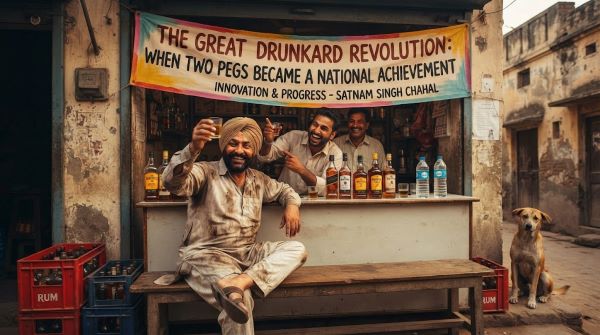
There was a time when a drunkard was considered a problem for the family. Now, apparently, he is an important part of the economy.He buys the bottle. The bottle pays tax. The government collects revenue. The shopkeeper smiles. The drunkard goes home. His wife looks at him. The children disappear into another room. Everyone has contributed to the nation.Except the drunkard. He has contributed the headache. In fact, the modern drunkard has become a highly educated professional. He knows exactly which bottle gives him the biggest “value for money,” which shop stays open late, which friend is willing to lend him ₹500, and most importantly—how to convince everybody that he is not drunk.
“I am perfectly normal,” he announces while holding the wall for emotional support. His friend looks at him.
“Then why are you hugging the wall?”
“I am not hugging it. I am checking its construction quality.”
That is the confidence alcohol provides.A sober man walks straight.A drunk man walks in a direction he personally believes is straight.The road may disagree.The traffic police may disagree.The electricity pole may strongly disagree.But the drunkard remains confident.
“I know where I am going.”
Nobody else knows.Including him.Every drinking session begins with the same sentence:
“Bas do peg.”
These are perhaps the most dishonest two words in the history of social life.
“Bas do peg.”
The first peg is apparently medicinal.The second is for company.The third is because the first two were lonely.The fourth is because somebody’s birthday is being celebrated.The fifth is because it would be rude to waste the bottle.By the sixth, nobody remembers whose birthday it was.By the seventh, somebody is explaining Punjab politics.By the eighth, the drunkard has solved Punjab’s economic problems.By the ninth, he has solved India’s.
By the tenth, he has solved the United Nations.And by midnight, he is negotiating with a street dog.“Tu meri gal samajh.”The dog walks away.Even the dog has better judgment.
The Family Emergency
The real drama begins when the drunkard arrives home.The door opens.He enters quietly.Or at least he believes he enters quietly.The door sounds like a collapsing building.The shoes land in different rooms.The keys disappear.One sock is found in the kitchen.The other becomes a missing-person case.
Then comes the famous question:
“You’ve been drinking?”
“No.”
“Then why are you walking like that?”
“I am tired.”
“Why are you smelling like alcohol?”
“Someone else was drinking.”
“Who?”
“Everybody.”
There is no further investigation.The wife has seen this episode too many times.The drunkard then attempts diplomacy.
“Don’t be angry. I had only a little.”
“A little?”
“Yes.”
“How much?”
He pauses.This is the most dangerous question of the evening.Because now he has to remember.And memory is the first casualty of the bottle.
The Morning After
Morning arrives like a court summons.The drunkard opens one eye.The head is pounding.The mouth feels like somebody has parked a truck inside it.The phone shows 19 missed calls.There are messages he doesn’t remember sending.
One says:
“Brother, forgive me.”He has no idea what he did.
Another says:
“I love you, brother.”He doesn’t know which brother.
Another says:
“Where are you?”
He doesn’t know.Then he checks his bank account.Suddenly, the headache becomes secondary.
“Who spent this money?”
His own phone provides the evidence.He did.
At 1:43 a.m.
On food.
At 2:17 a.m.
On a ride.
At 2:51 a.m.
On something he cannot identify.The drunkard looks at the transaction history and whispers:
“I need to investigate this matter.”Sir, the investigating officer is you.
The Philosopher of the Liquor Shop
Every neighbourhood has one.A man who becomes a philosopher after three drinks.Before drinking, he is an ordinary person.After drinking, he becomes Aristotle.He discusses friendship.
Politics.
Marriage.
Business.
Religion.
Human nature.
The future of Punjab.
And why nobody understands him.
His favourite sentence:
“Nobody knows what I have suffered.”The shopkeeper looks at him.“Sir, you have suffered nothing. You have been drinking here for four hours.”But the philosopher refuses to accept facts.He has entered the emotional department.He remembers an argument from 2008.A friend who didn’t return ₹2,000 in 2014.A girlfriend who left in 2017.A cousin who didn’t invite him to a wedding.And somehow all of these events are connected to the government.
The Drunkard’s GPS
There is another remarkable phenomenon.A sober person needs GPS to find an unfamiliar place.A drunkard needs GPS to find his own house.
“Where are you?”
“On the way.”
“Where?”
“Near the market.”
“Which market?”
“The market.”
“Send location.”
“Why?”
“Because nobody knows where you are.”“I know exactly where I am.”Then comes the location.It shows him standing 3.7 kilometres away from home.Next to a petrol pump.
At 2:36 a.m.
He calls again.
“I am almost there.”
Almost there?
At this point, even NASA would have trouble calculating the route.
The Great Excuse Factory
The drunkard never runs out of excuses.“I drink because of stress.”“I drink because of friends.”“I drink because of business.”“I drink because of the weather.”“I drink because it is too hot.”“I drink because it is too cold.”“I drink because it is raining.”“I drink because it is not raining.”At some point, even the weather department becomes a suspect.
And then comes the most dangerous statement:
“I can quit whenever I want.”Of course.Everybody can quit.
Tomorrow.
From Monday.
After this bottle.
After the wedding.
After the election.
After the festival.
After the next salary.
After the next peg.
There is always a next peg.
The Economic Genius
Ask a drunkard whether he has money.
“No.”
Ask him why.
“Expenses.”
Ask him what expenses.
“Life.”
But somehow there is always money for another bottle.This is a unique financial system.School fees? Expensive.Electricity bill? Expensive.Medicine? Expensive.Groceries? Expensive.
Bottle?
“Manage ho jayega.”
This is perhaps the only item in the household budget that magically receives emergency funding.And Then Comes the Famous PromiseAfter every disastrous night comes the promise:
“Never again.”
The family hears it.
The neighbours hear it.
The shopkeeper hears it.
Even the street dog has heard it.
The drunkard sits seriously.
“I have learned my lesson.”
Everyone nods.
The next evening, someone asks:
“Tea?”
He says:
“Tea? No, today I am having only one.”And history begins again.Because the problem is not the first peg.The problem is that the first peg has a powerful public-relations department.It always arrives dressed as “just one.”And just one becomes two.Two become four.Four become philosophy.Philosophy becomes an argument.The argument becomes a family meeting.
The family meeting becomes a headache.And the next morning becomes a national day of regret.So perhaps the greatest joke is not that drunkards say foolish things.The greatest joke is that they say the same foolish thing every night and still believe nobody has noticed.
“I am not drunk.”
Yes, sir.
The bottle is drunk.The road is drunk.The chair is drunk.The ceiling fan is drunk.The entire neighbourhood is drunk.Only you are perfectly normal.And somewhere in the corner, the street dog is thinking:
“Thank God I don’t drink.”
Disclaimer: This article and accompanying images are for informational and illustrative purposes only. Some visuals may be AI-generated or digitally enhanced and may not depict actual events or persons.Views expressed are based on publicly available information and analysis