
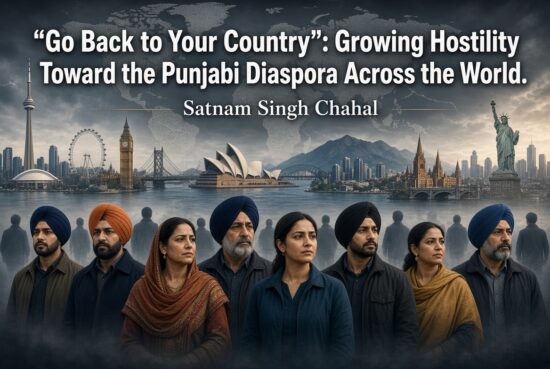
For generations, Punjabis have travelled across the world in search of education, employment, business opportunities and a better future for their families. From Canada and the United Kingdom to Australia, New Zealand, the United States and other countries, the Punjabi diaspora has established businesses, created jobs, paid taxes and become an important part of the societies in which they live.
But a disturbing trend is increasingly being reported by members of the diaspora: “Go back to your country.” For some, these words are shouted in public. For others, they appear in social-media comments, workplaces, neighbourhood disputes or political debates about immigration. Many such incidents never become police complaints or news stories, meaning the publicly documented cases may represent only a fraction of the actual experience.
Canada provides some of the clearest evidence that hostility toward South Asians has increased. Statistics Canada recorded 483 police-reported hate crimes targeting South Asians in 2025, up from 324 in 2024 and 167 in 2021. Statistics Canada cautions that changes in reporting and police identification can influence annual figures, but the increase remains significant.
Research also suggests that a considerable amount of discrimination never reaches the police. A 2025 Environics Institute survey found that four in ten South Asian Canadians reported experiencing discrimination regularly or from time to time because of their ethnicity or race. The same research found substantial levels of reported hate incidents among South Asians.
The problem is not limited to Canada. In Britain, growing political hostility surrounding immigration has contributed to an atmosphere in which some ethnic-minority communities say they feel increasingly threatened. Reuters reported in June 2026 that people of colour in Britain were describing a resurgence of racism associated with increasingly hostile anti-migration politics.
Australia has witnessed similar tensions. Indian and other South Asian communities have faced racist messaging connected to anti-immigration movements, with community leaders warning about online abuse, threats and physical attacks.
For Punjabis, the issue is particularly sensitive because visibility matters. Turbans, beards, Punjabi language, religious symbols, restaurants, trucking businesses and community institutions can make members of the Sikh and wider Punjabi community highly identifiable. A person who has lived in a country for decades—or was even born there—can still be told to “go back” simply because of appearance, religion or ancestry.
The most worrying aspect may be the incidents that never enter official records. A Punjabi worker insulted at work may remain silent because he fears losing his job. A student may ignore racist abuse because she does not want additional problems. A shopkeeper may decide that reporting harassment is pointless. A family may simply tell their children to avoid confrontation.
This creates an important distinction between recorded racism and experienced racism. Police statistics tell us what has been reported and recorded; they cannot automatically tell us how many people experienced discrimination but never reported it.
The World Sikh Organization of Canada’s 2026 national report on anti-Sikh hate illustrates this reporting gap. Based on more than 1,600 survey responses, the organization reported that 70 percent of respondents who experienced hate incidents did not report them, citing reasons including fear, futility or lack of institutional trust.
At the same time, the Punjabi community must avoid treating every disagreement, criticism of immigration policy or demand for immigration reform as racism. Democratic societies have the right to debate immigration numbers, housing, employment, infrastructure and government policy. The line is crossed when criticism of policy becomes hatred of an entire ethnic or religious community.
There is also a danger in allowing political frustration to turn immigrants into convenient scapegoats. Economic pressures such as housing shortages, unemployment, pressure on public services and rising living costs are complex issues. Blaming every problem on South Asians or Punjabis may provide an easy political slogan, but it does not provide a serious solution.
The diaspora should also look inward. Community leaders, political representatives and organisations must encourage newcomers to understand the laws, social norms and responsibilities of their adopted countries. Integration should not mean abandoning Punjabi identity. It should mean contributing to society while proudly maintaining language, culture, faith and heritage.
Governments, meanwhile, have a responsibility to protect citizens, permanent residents, students, workers and newcomers from racial intimidation. Nobody should be told to leave a country simply because of the colour of their skin, religion or ancestry.
The Punjabi diaspora has spent decades building bridges between cultures. It has produced doctors, engineers, entrepreneurs, farmers, truckers, teachers, politicians, scientists and community leaders. Punjabis have contributed billions in taxes, built businesses, employed local workers and participated in civic life across the world.
Therefore, the answer to “Go back to your country” should not be anger or retaliation. It should be a clear reminder:
This is our home too.
For those who are citizens, it is unquestionably their country. For permanent residents, students and workers, they have legal rights and responsibilities that must be respected. And for every immigrant, dignity should never depend upon the colour of their skin or the country from which their parents or grandparents came.
The growing number of reported incidents—and the much larger number that may never be reported—should serve as a warning. The Punjabi diaspora should document genuine incidents, report serious harassment, support victims and demand equal treatment.
At the same time, political leaders must lower the temperature rather than exploit public frustration.
Migration can be debated. Immigration policy can be changed. But racism cannot be normalised.
The Punjabi diaspora did not travel thousands of miles merely to become permanent outsiders. They went abroad to build lives, raise families and contribute. The countries that welcomed them should judge them by their conduct and contribution—not by their surname, turban, skin colour or birthplace.
Disclaimer: This article and accompanying images are for informational and illustrative purposes only. Some visuals may be AI-generated or digitally enhanced and may not depict actual events or persons.Views expressed are based on publicly available information and analysis