
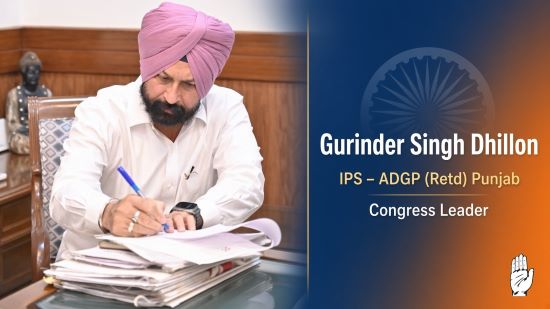
 New Delhi: Senior Congress leader and former IPS officer Gurinder Singh Dhillon has launched a sharp attack over what he describes as repeated compromises with the safety of Delhi’s citizens, alleging that a “nexus among stakeholders” is allowing serious lapses to continue.
In a strongly worded social-media post, Dhillon said that the safety of Delhi residents was being repeatedly compromised and described the alleged conduct as “shameless.” He also tagged Delhi Lieutenant Governor and Chief Minister Rekha Gupta, putting the responsibility for public safety squarely before the constitutional and elected authorities.
Dhillon’s intervention is politically significant because he is not merely making a routine opposition statement. As a former IPS officer, he has direct experience of the functioning of law-enforcement and administrative systems. His allegation therefore raises a wider question about whether Delhi’s public-safety mechanisms are functioning effectively or whether institutional failures are being allowed to continue.
The Bigger Question: Who Is Accountable?
If citizens are being exposed to unsafe buildings, unauthorized construction, inadequate fire-safety arrangements or other preventable hazards, accountability cannot stop at the lowest level of the administrative hierarchy.
The public deserves answers about who approved the structures, who inspected them, who issued clearances, who ignored violations and who failed to act when warnings or complaints were received.
And if Dhillon’s allegation of a “nexus” is to be taken seriously, authorities should investigate whether any officials, private operators, contractors or other stakeholders benefited from regulatory violations.
At the same time, the allegation of a nexus remains an allegation and requires an independent investigation before any individual or agency can be held guilty.
Suspensions Are Not Enough
A familiar pattern often emerges after a serious incident: officials are suspended, inquiries are announced and political statements are exchanged. But the fundamental problem remains unresolved.
Suspending a few officials may provide an immediate response, but it does not answer the more important question—how did the system allow the problem to develop in the first place?
If there was negligence, the entire chain of responsibility must be examined. If there was deliberate collusion, those responsible must face appropriate legal action. And if the problem was simply administrative incompetence, the government must explain why corrective action was not taken earlier.
Delhi Government Under Pressure
Dhillon’s criticism also creates a political challenge for the Delhi government. The administration cannot simply dismiss the allegations as opposition politics.
The Lieutenant Governor and the Chief Minister should make the facts public.
How many complaints were received? How many inspections were conducted? How many buildings were found violating safety norms? How many were ordered to close? How many officials faced disciplinary action? And, most importantly, how many prosecutions actually followed?
Transparency would be the strongest answer to allegations of a nexus.
Public Safety Cannot Become Political Football