
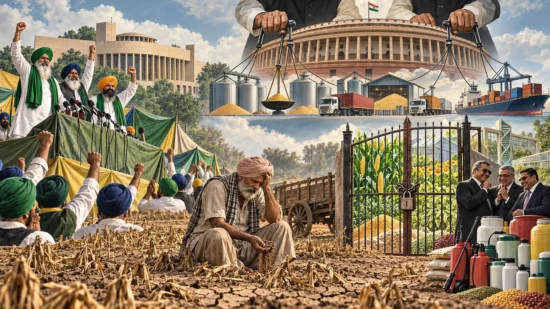
 The seven-day farmers’ protest at the Mohali–Chandigarh border has ended. The Punjab Government has given a written assurance that a special session of the Vidhan Sabha will be convened within one month. Resolutions will be passed against the old water-sharing agreements, Sections 78, 79 and 80 of the Punjab Reorganisation Act, the Dam Safety Act and the Draft Seeds Bill, 2025. These resolutions will then be sent to the Union Government.
Farmer leader Balbir Singh Rajewal has described it as a “historic victory”. From the point of view of the organisations, it may certainly be a victory. The government was forced to negotiate, give a written assurance and promise a special Assembly session. The protest was lifted only after these commitments were made. (The Tribune)
But from the point of view of farming, what exactly has been won?
Not one rupee has yet been added to the price of a crop. The farmer’s crushing debt has not reduced. No new market has opened. No modern technology has reached his field. The government’s immediate crisis has passed, the dharna has been lifted and the organisations have received their certificate of victory. The farmer has gone back to his field, standing alone in the same old, rigid and loss-making agricultural system.
This may be a victory for the unions. It is certainly not yet a victory for farming.
Agriculture is a State subject—but is it really?
This episode has once again exposed the strange and deeply damaging constitutional arrangement governing Indian agriculture.
Entry 14 of the State List in the Seventh Schedule of the Constitution declares agriculture to be a State subject. This line has been repeated so loudly and so frequently that it has almost become a slogan.
But it is only half the truth.
The farmer may grow the crop under a State government, but almost every important economic decision affecting that crop is controlled by the Centre. MSP is announced by the Union Government. CACP is a central body. The Food Corporation of India and the National Food Security Act operate under the Centre. Imports, exports, buffer stocks, interstate trade, free-trade agreements and price controls are also largely controlled from Delhi.
Even Entries 26 and 27 of the State List, dealing with trade, commerce, production, supply and distribution, are subject to Entry 33 of the Concurrent List. Foreign trade and interstate trade fall under Entries 41 and 42 of the Union List, while price control falls under Entry 34 of the Concurrent List.
The result is a beautifully convenient arrangement for governments. Throw the ball of responsibility in others’ court.

Punjab will grow the crop. Punjab’s precious groundwater will be exhausted. Punjab’s fertile soil will absorb the chemicals. Punjab’s environment will suffer, and Punjab’s farmer will take the loan. But Delhi will decide whether the crop can be exported, whether cheaper imports will be allowed, whether stock limits will be imposed and what price support will be announced.
So, in reality, how is agriculture a State subject?
To keep harping on this one constitutional entry, while ignoring all the powerful controls surrounding it, is not merely a misconception. It has become a convenient political hoax. This was also used as the main leverage during the 2020 agitation—the Centre was told that it could not legislate because agriculture was a State subject. The actual constitutional picture is far more complicated and far less comfortable.
The responsibility lies with the states. The real economic power lies largely with the Centre. Until this serious ambiguity is removed, Indian farmers can never become genuinely prosperous.
A protected law, but an unprotected farmer
The Essential Commodities Act, 1955 makes this contradiction even more severe. It gives the Union Government wide powers over the production, supply, distribution, storage, transportation and trade of agricultural commodities.
More importantly, the Essential Commodities Act was placed in the Ninth Schedule of the Constitution as Item 126. The protection of the Ninth Schedule is no longer absolute after later Supreme Court judgments, but challenging a law placed there remains far more difficult.
Look at the cruel irony. A law that can restrict the farmer’s market enjoys special constitutional protection. The farmer’s income enjoys no such protection.
The government can restrict storage, stop exports, allow imports and interfere with trade. The farmer has no equally powerful constitutional right to a remunerative price or a free market.
Why are farmers’ organisations not fighting this bigger battle?
Resolutions that Punjab cannot enforce
Almost every major demand on which the Punjab Government has promised an Assembly resolution actually concerns the Centre.
The old water-sharing arrangements have to be reconsidered by the Centre. Sections 78, 79 and 80 of the Punjab Reorganisation Act can be changed by Parliament. The Dam Safety Act is a central law. The Draft Seeds Bill is a central proposal. MSP, import-export policy and free-trade agreements also fall largely within the Union Government’s domain.
The Punjab Vidhan Sabha can pass strong, angry and unanimous resolutions. But those resolutions will not be legally binding upon the Centre. They can be sent to Delhi, where they may quietly enter another government file.
Punjab has direct authority over comparatively fewer matters: the State Advised Price for sugarcane, payment of sugarcane arrears, cooperative sugar mills, canal infrastructure, state-level debt relief, agricultural extension and markets operating under state law.
These are the areas where direct and measurable action is possible. A resolution on a central law may generate impressive headlines, but it does not change that law.
The dangerous demand to repeal the Seeds Bill
The most worrying demand is the withdrawal of the Draft Seeds Bill, 2025.
In November 2025, I wrote in “A Fresh Start for India’s Farms” that India urgently needs a modern seed law. Farmers must be protected from fake and substandard seeds. Commercial seed must be traceable. Germination and purity standards must be enforceable, and modern research must be allowed to reach the field.
Agriculture in 2026 cannot be governed effectively by a law written in 1966.
The Seeds Bill is still a draft. It is not an enacted law. The Union Government informed the Rajya Sabha that more than 14,000 comments and objections had been received and considered. A meeting is being held by the Union Agriculture Minister on10th September 2026 to discuss the comments and the revision proposed based on these suggestions.
The draft clearly protects the farmer’s right to grow, sow, resow, save, use, exchange, share and sell his farm-produced seed, provided it is not sold under a company’s brand name. A farmer selling or exchanging seed produced on his own farm is also protected from the penal provisions meant for commercial seed businesses. These protections are recorded in the government’s Rajya Sabha reply.
The Bill proposes registration of commercially sold seed varieties, minimum standards for germination and purity, QR-coded packets and traceability throughout the supply chain. Serious and repeated violations can attract a penalty of up to ₹30 lakh and imprisonment of up to three years. Farmers are not being forced to buy seeds from any corporate, they have choice of keep using their own seeds, if they wish to.
If this Bill is simply withdrawn, who will hold the seller of fake seed accountable when an entire crop is destroyed?
The Bill does not force any farmer to buy GM seed or the seed of any particular company. It merely brings new and transgenic varieties within a legal regulatory framework. Strict scientific biosafety approval must remain compulsory, but complete rejection of modern seed technology is not protection. It is deliberate backwardness.
Punjab wants diversification towards pulses, oilseeds, maize and less water-intensive crops. But how will that happen without climate-resilient, pest-resistant and high-yielding seeds? We are willing to import crops grown abroad with biotechnology, but we want to deny the same science to our own farmer. What kind of strange farmer-friendly policy is this?
Denying technology to farmers is like denying modern assault rifle to a Jawan at the border and telling him to fight with a .303.
The pesticide lobby must be smiling
There is another uncomfortable question which must be asked.
Genuine pest-resistant seed technology can substantially reduce the need for repeated pesticide sprays. Punjab has already damaged its rich soil and precious water enough through excessive chemical use. Reducing unnecessary spraying should be welcomed by every genuine well-wisher of the farmer and the society in general.
But who loses when pesticide consumption falls?
The Indian agrochemical sector represents nearly ₹90,000 crore in industry revenue, according to a Crisil assessment reported by The Economic Times. It is a huge, profitable and influential business. No industry happily watches its market disappear.
The biggest commercial loser from successful pest-resistant technology can be the pesticide lobby. When modern seed technology is blocked in the farmer’s name, that lobby has every reason to laugh and celebrate. Such big lobby can easily produce paid mouth pieces to fight their cause.
Every modern seed may not reduce every chemical input, but the central question remains: who benefits from keeping the farmer dependent upon an old, chemical-intensive system?
Certainly not the farmer. Certainly not the society.
Amend the Bill. Do not kill reform.
The Draft Seeds Bill may have weaknesses. Correct them.
Create a simple and time-bound compensation mechanism when defective seed damages a crop. Give states, agricultural universities and genuine farmer representatives a stronger role in registration, testing and regulation. Clearly protect traditional varieties and community seed banks. Keep GM seeds subject to strict, transparent and scientific biosafety clearance.
These are sensible amendments. Demand them forcefully.
But the answer to a weak clause is an amendment, not the murder of the entire reform. If companies are feared, make them more accountable. Do not take away science, technology and choice from the farmer.
The three farm laws were repealed in 2021, and that too was celebrated as a historic victory. They were good or bad, is a separate debate altogether. Five years later, open the farmer’s economic ledger. Has his income substantially increased? Has his debt disappeared? Has he received new markets? Has private investment reached his village?
These are not small questions.
Stopping every reform by calling it a “corporate attack” is very easy. Reviving a stagnant, over-regulated and rapidly deteriorating agricultural economy is much harder.
The real battle
The real battle is not against one Bill. It is against the dangerous constitutional confusion under which agriculture is called a State subject while its markets, prices and trade remain heavily controlled by the Centre.
India needs a comprehensive National Agricultural Policy framed through a genuine Centre–State partnership. Constitutional powers over agricultural production, pricing, procurement and trade must be clearly divided. Authority and responsibility must go together.
The Essential Commodities Act should be removed from the Ninth Schedule. Its use should be exceptional, transparent and strictly time-bound. Farmers need stable policies and predictable markets—not sudden export bans, arbitrary stock limits and cheap imports arriving exactly when domestic prices begin to rise.
Otherwise, the same tired ritual will continue: a dharna, a written assurance, a special Assembly session, a resolution, a file in Delhi—and then another dharna.
This time, the farmers’ organisations may have won. The Punjab Government has certainly obtained temporary relief. But if the final result is that another door to reform has been firmly closed, farming, the farmers have lost once again.