
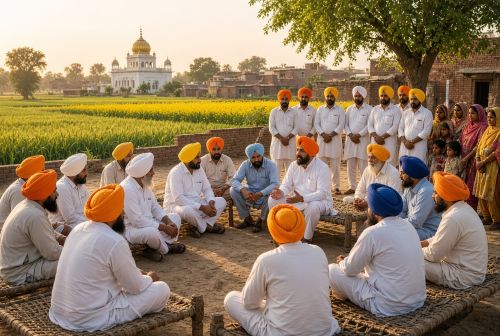
 The Shiromani Akali Dal (SAD), historically dominant in Punjab’s rural Sikh and agrarian belts, is prioritizing the revival of its traditional rural vote bank ahead of the 2027 Assembly elections. After significant setbacks in 2022 and subsequent polls, the party under Sukhbir Singh Badal is leveraging farmer-centric issues, regional yatras, and Panthic identity to consolidate support, particularly in the Malwa region, while addressing erosion caused by AAP’s rise and internal challenges. SAD’s approach centers on positioning itself as the authentic champion of Punjab’s farmers and rural Punjabis, contrasting with AAP’s governance record and BJP’s urban focus. Key elements include aggressive advocacy on farmer distress such as the potato price crisis, hailstorm damage to crops, unseasonal rains, power shortages, and debt burdens on farmers. Sukhbir Badal has demanded compensation for affected farmers and criticized AAP for “ruining” the agricultural economy, while promising to make Punjab power surplus again and implement pro-farmer policies if returned to power.
The ongoing or resumed “Punjab Bachao Yatra” serves as the primary vehicle for rural outreach. Led by Badal, these rallies target rural heartlands like Budhlada in Mansa in the Malwa region, focusing on direct interaction with farmers, demands for youth job reservations for locals under the slogan “Punjab for Punjabis,” law and order concerns, and building anti-incumbency against AAP. The yatra emphasizes grassroots contact across assembly segments and leverages control over gurdwara institutions through SGPC influence along with Panthic narratives to rebuild trust among rural Sikh voters, especially Jat Sikhs. It positions SAD against perceived central overreach and highlights regional issues like water sharing and federal rights. The party places heavy emphasis on the Malwa region, which accounts for a large number of rural seats and has been a traditional stronghold, aiming to regain lost ground from AAP through targeted rallies and farmer support programs, while also working on consolidation in Majha and Doaba areas by blending rural outreach with community-specific appeals.
SAD faces competition from AAP’s welfare schemes that have penetrated rural areas, BJP’s expanding rural ambitions, and internal rifts including rebel factions. The party has shifted toward more urban focus in some planning but remains heavily invested in rural revival
to offset past losses. Alliance possibilities with BJP could amplify reach but risk diluting its independent Panthic image. Overall, SAD’s rural strategy is defensive yet proactive, banking on anti-incumbency against AAP on agriculture and governance failures. Success depends on translating yatra momentum into organizational strength and vote consolidation in key rural pockets. While pockets of recovery are visible in Malwa, broader revival requires overcoming credibility gaps from previous terms and delivering a compelling 2027 vision for distressed farmers in this dynamic political battle.
AAP’s Rural Welfare Schemes in Punjab: Key Pillars of Governance and Electoral Strategy Ahead of 2027
The Aam Aadmi Party government in Punjab under Chief Minister Bhagwant Mann has placed significant emphasis on rural welfare schemes as a cornerstone of its governance model since coming to power in 2022. These initiatives target core agrarian challenges, aiming to provide direct relief to farmers and rural households while addressing infrastructure gaps, health access, and economic support. Free electricity stands out as a flagship program, benefiting over 90% of households with up to 300-600 units monthly and ensuring uninterrupted daytime power supply for agricultural pumps—often cited as eight hours of reliable irrigation electricity for the first time in the state’s history. This has translated into substantial monthly savings for rural families, estimated at Rs 5,000 to Rs 7,000 per household, and has been credited with reducing the financial burden on small and marginal farmers.
Complementing power reforms is extensive rural infrastructure development. The government has undertaken the reconstruction of over 40,000 kilometers of rural link roads with a five-year maintenance guarantee, described as one of the largest such drives in Punjab’s history. Additional efforts include cleaning over 13,000 village ponds, upgrading mandis with covered sheds and solar panels, and improving canal irrigation coverage to reach 78% of fields. Housing support has also been scaled up, with assistance provided to around 76,000 families for pucca homes in four years—including flood-affected households—outpacing previous regimes. These measures are designed to enhance connectivity, water management, and living standards in rural Punjab, directly impacting daily life in villages across Malwa, Majha, and Doaba regions.
In healthcare and social security, the Mukh Mantri Sehat Yojna offers every family up to Rs 10 lakh in cashless treatment, including at private hospitals, supported by nearly 1,000 Aam Aadmi Clinics operational or planned across the state. The recent launch of the Mukh Mantri Mawan Dhian Satkar Yojna provides monthly financial assistance to women—Rs 1,000 generally and Rs 1,500 for Scheduled Caste women—aimed at empowering rural households where women play key roles in agriculture and family economies. Employment generation forms another pillar, with over 65,000 merit-based government jobs and claims of 5.5 lakh additional opportunities through investments, alongside skill and education improvements in rural schools.
These schemes have been aggressively promoted through Jan Sabhas and outreach campaigns, with AAP leaders highlighting them as fulfillment of electoral guarantees and a contrast to previous governments.The strong performance in May 2026 civic polls, including in semi-urban and rural-adjacent areas, has been attributed partly to these welfare measures, helping mitigate anti-incumbency on issues like farmer distress and procurement challenges. However, critics point to ongoing concerns such as crop crises, debt, and fiscal sustainability of subsidies.As 2027 approaches, AAP’s rural strategy continues to focus on consolidating these gains through direct benefit delivery and infrastructure visibility, positioning the party as a performer on ground-level issues despite
competition from Congress, SAD, and BJP in the agrarian heartlands.
Disclaimer: This article and accompanying images are for informational and illustrative purposes only. Some visuals may be AI-generated or digitally enhanced and may not depict actual events or persons. Views expressed are based on publicly available information and analysis