
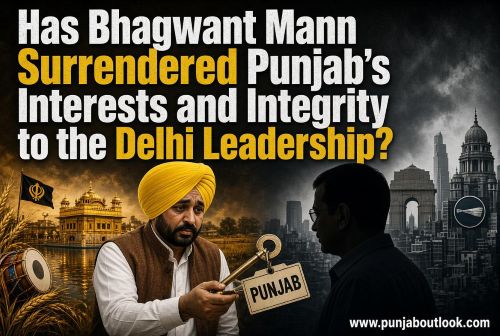
 Punjab did not elect its Chief Minister to act as a silent spectator while political leaders from Delhi increasingly dominate the public debate over the state’s governance. In 2022, the people of Punjab gave the Aam Aadmi Party an overwhelming mandate, electing 92 of the 117 members of the Punjab Legislative Assembly. That mandate carried a clear expectation: Punjab would be governed according to the needs, aspirations and interests of its own people. Today, questions about the influence of Arvind Kejriwal and Manish Sisodia over Punjab’s political and administrative affairs have become an important issue in the state’s democratic debate.
The central question is straightforward: Does Bhagwant Mann exercise the full authority and responsibility of an elected Chief Minister, or has decision-making become increasingly dependent on the AAP leadership in Delhi? This is not simply a dispute between political personalities. It concerns the dignity of Punjab’s elected institutions, the accountability of its government and the right of its people to know who is shaping decisions that affect their future.
The debate intensified after AAP’s defeat in the Delhi Assembly elections in February 2025. Subsequent reporting by The Indian Express and The Wire described the growing presence of Delhi-based AAP leaders in Punjab and unease among some state-level party leaders over their influence. In March 2025, Manish Sisodia was appointed the party’s Punjab in-charge, while Satyendar Jain became co-in-charge. These are documented organisational decisions, but they also raise a legitimate question: where should the boundary lie between a political party’s national leadership and the independent functioning of an elected state government?
Punjab is not merely another administrative unit for a national political party. It has its own history, language, agricultural economy, river-water disputes, border-security concerns and distinct social challenges. Decisions involving farmers, industrial development, public finances, law and order, education and employment must be grounded in Punjab’s realities. Political strategies developed in Delhi cannot automatically be assumed to serve Punjab’s best interests.
The controversy surrounding the Mann government’s land-pooling policy in 2025 illustrates why transparency matters. The proposal faced opposition from farmers and landowners, was amended and was ultimately withdrawn in August after mounting resistance and legal scrutiny. Reporting at the time cited sources who attributed a role in promoting the policy to Delhi-based AAP leaders. Those accounts do not independently establish who made the final government decisions, but they demonstrate why the public deserves a clear explanation of the decision-making process.
The issue is not whether Arvind Kejriwal or Manish Sisodia may offer political advice to their party in Punjab. Senior leaders of any national party are entitled to participate in organisational discussions. The crucial distinction is between party guidance and governmental authority. Advice from party leaders cannot replace the constitutional responsibilities of the Chief Minister, the Cabinet and the elected legislature. If outsiders are influencing public policy, the government should explain their formal roles and the accountability mechanisms that apply to them.
Bhagwant Mann has publicly rejected the allegation that Kejriwal controls his government. In an interview with NDTV in May 2026, Mann said that decisions of the Punjab government were his responsibility and denied that Kejriwal interfered in governmental decision-making. That denial must be considered alongside the concerns reported by opposition parties, journalists and some AAP insiders. The most credible way to resolve this dispute is through transparent records, clear explanations and scrutiny of actual decisions—not merely competing political claims.
Punjab’s interests also extend far beyond the internal arrangements of the AAP. The state faces difficult questions about public debt, employment, drug trafficking, law and order, agricultural sustainability and the future of its youth. Citizens need to know which promises have been fulfilled, which remain unfulfilled and how public money is being spent. Every major decision should be assessed by its impact on ordinary Punjabis rather than by its usefulness to a political party or its leadership.
The Chief Minister’s responsibility is therefore twofold: to deliver effective governance and to demonstrate that the authority entrusted to him by the electorate is being exercised transparently. If decisions are made collectively by the Cabinet, the government should make that process clear. If outside political advisers have a role, the nature and limits of that role should be explained. And if allegations of interference are unfounded, the government should answer them with verifiable evidence rather than allowing suspicion to grow.
Punjab has a long history of defending its political, economic and cultural interests. Its people have every right to expect their elected representatives to protect the state’s autonomy within India’s constitutional framework. That expectation applies equally to the ruling party and the opposition.
Ultimately, the question is not whether Bhagwant Mann should listen to Delhi. It is whether Punjab’s elected government remains fully accountable to the people of Punjab. The Chief Minister owes his office to the mandate of Punjab’s voters. His foremost duty is to ensure that the state’s interests, dignity and constitutional rights are never subordinated to party convenience. Punjabis deserve answers based on facts, transparent governance and measurable results—not a continuing controversy over who holds the real power.
Prepared as a political opinion article. Allegations of outside interference are distinguished from documented party appointments and public statements.
Disclaimer: This article and accompanying images are for informational and illustrative purposes only. Some visuals may be AI-generated or digitally enhanced and may not depict actual events or persons. Views expressed are based on publicly available information and analysis