
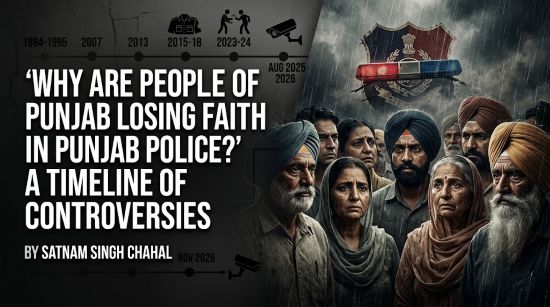
Punjab Police is one of the state’s most important institutions, entrusted with protecting citizens, maintaining law and order and ensuring that justice is delivered without fear or favour. However, a growing number of controversies involving alleged police misconduct, corruption, drug-related cases, custodial violence and questions about political interference have raised serious concerns about public confidence in the force.
The question being increasingly asked by ordinary people is simple: If citizens cannot trust the police to protect them, where should they go when they become victims of injustice?
The concern is not directed at every police officer. Thousands of Punjab Police personnel perform difficult duties, risk their lives and serve society honestly. But the alleged misconduct of even a small number of officers can damage the reputation of the entire institution, particularly when investigations and accountability take too long.
1984–1995: The legacy of police excesses during militancy
The period of militancy in Punjab left deep scars on society. Allegations of illegal detention, custodial torture, disappearances, encounter killings and illegal cremations became major human rights concerns. Decades later, these cases continue to influence public discussions about police accountability and the rule of law.
2007: Alleged list of police and political links with drug networks
Former Punjab DGP (Prisons) Shashi Kant later stated that he had prepared a list of suspected drug traffickers and their associates and submitted it to the then state government in 2007. He alleged that the list included political figures as well. The matter raised questions about whether influential individuals involved in the drug trade were being protected. <Link ref=”turn142439search0″ title=”The Tribune report on Shashi Kant’s allegations”/>.
2013: Drug mafia allegations reach the Punjab and Haryana High Court
In September 2013, the Punjab and Haryana High Court took notice of allegations made by former IPS officer Shashi Kant regarding the alleged nexus between drug traffickers, politicians and sections of the police establishment. The controversy brought the question of institutional accountability into public debate. <Link ref=”turn142439search1″ title=”Indian Express report”/>.
2015–2018: Questions about the alleged drug list remain unresolved
Shashi Kant reiterated his claims in court in January 2015, saying that the alleged list included politicians and others connected with the drug trade. Subsequent court proceedings and reports continued to refer to the issue, but the alleged list did not become a publicly established record of guilt against the individuals concerned. <Link ref=”turn142439search3″ title=”The Tribune timeline of the drug case”/>.
2023–2024: The question of police officers allegedly linked to drug networks resurfaces
The issue returned to public discussion when the Punjab government initiated efforts to identify police personnel allegedly connected with drug smugglers. The Tribune reported in September 2024 that the mystery surrounding the so-called black sheep in the police establishment remained unresolved, with no definitive public list emerging from earlier exercises. <Link ref=”turn420258search8″ title=”The Tribune investigation”/>.
May 2024: Historical encounter cases face further scrutiny
The CBI informed the Punjab and Haryana High Court that investigating approximately 6,733 alleged encounter killings, custodial deaths and illegal cremations from 1984 to 1995 would be difficult because of the passage of time, missing records and unavailable witnesses. The development highlighted the long struggle of families seeking answers. <Link ref=”turn420258search2″ title=”The Tribune report”/>.
August 2025: Five retired Punjab Police officers convicted in a 1993 case
A special CBI court in Mohali convicted five retired Punjab Police officers, including a former SSP and DSP, in connection with the killings of seven men in two alleged staged encounters in 1993. The case demonstrated that allegations of police abuse must be investigated through independent institutions and that accountability, even when delayed for decades, remains essential. <Link ref=”turn420258search3″ title=”The Indian Express report”/>.
November 2026: Khanna CCTV controversy raises fresh questions
One of the latest incidents has once again placed Punjab Police under public scrutiny. Hidden-camera footage from the residence of Shiv Sena leader Mahant Kashmir Giri in Khanna, Ludhiana district, allegedly shows ASI Sukhdev Singh placing an object under a mattress before a police team subsequently claimed to recover approximately 30 grams of heroin from the same location.
Following the circulation of the footage, Khanna SSP Dr Darpan Ahluwalia ordered the ASI’s suspension and constituted a Special Investigation Team headed by an SP-rank officer. Mahant Kashmir Giri was also discharged from the case, according to the Indian Express report.
The allegations are extremely serious because the planting of evidence, if established, would represent a direct attack on the credibility of criminal investigations and the rights of citizens. The investigation must establish the role of every person involved in the operation. <Link ref=”turn142439search4″ title=”The Indian Express report of November 2, 2026″/>.There are several reasons why ordinary citizens increasingly question the functioning of the police establishment.
First, allegations of political interference: Whenever police action is perceived to be influenced by political considerations, public confidence suffers. Law enforcement must remain impartial, irrespective of the political identity, influence or financial position of the person involved.
Second, the drug menace and alleged police-drug nexus: Punjab has been struggling with drug trafficking for years. Allegations that certain police personnel may have links with drug networks create an additional concern. Citizens want to know whether the people responsible for enforcing the law are themselves being investigated when credible allegations arise.Third, custodial violence and misuse of authority: Police custody is a place where citizens are entirely dependent on the protection of the state. Allegations of torture, illegal detention and abuse of authority therefore require immediate and independent investigation.
Fourth, the credibility of investigations: The Khanna incident has brought an important question into focus: If evidence itself is allegedly manipulated by an investigating officer, how can an ordinary citizen establish innocence? Such incidents can undermine confidence in the entire criminal justice system.Fifth, delayed accountability: Suspension or transfer of an officer cannot be considered a substitute for a proper investigation. Citizens expect departmental proceedings, criminal prosecution wherever warranted and punishment following due process.
Punjab needs a police accountability system in which no officer is above the law. Allegations against police personnel should be investigated independently, CCTV evidence should be preserved, custodial deaths should receive impartial judicial scrutiny and complaints against influential officers should not be buried within departmental files.
The government and senior police leadership must also ensure that honest officers are protected from political pressure and that officers who misuse their authority face appropriate legal consequences.
The Khanna case should not be treated merely as another controversy that disappears after a few days of public outrage. The SIT investigation must establish the complete sequence of events, including who knew about the search operation and whether any other personnel were involved.The relationship between citizens and the police is built on trust. People approach police stations expecting protection, fairness and justice, not intimidation or harassment.
Punjab does not need a police force that simply registers more cases or announces more arrests. It needs a professional, accountable and impartial police institution that earns public confidence through its conduct.The real question is not how many officers are suspended after a controversy. The real question is how many citizens receive justice, how many corrupt officers are held accountable and how many innocent people are protected from wrongful prosecution.A uniform represents responsibility, not unlimited authority. The law must apply equally to citizens and those entrusted with enforcing it.
Editorial note: The timeline distinguishes documented court convictions from allegations, disputed claims and ongoing investigations. The latest Khanna case is still subject to investigation.