
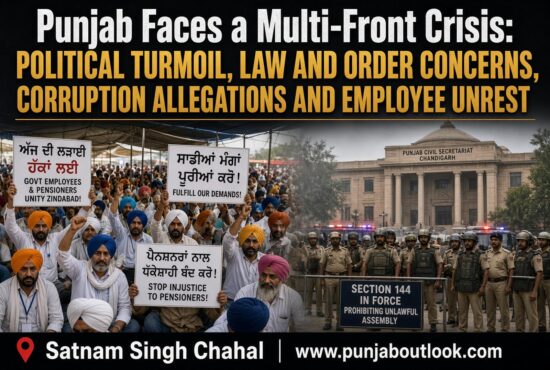
As the 2027 Assembly elections approach, the Bhagwant Mann government faces growing questions over governance, police accountability, corruption investigations, recruitment controversies and the mounting frustration of government employees. The central question is whether Punjab’s major problems are receiving the attention they deserve.
Punjab’s political and administrative landscape is witnessing controversies on several fronts. Political defections, disagreements within parties, allegations of corruption, questions about law and order, drug-related incidents, recruitment disputes and government employee protests have brought the functioning of the state government under increasing public scrutiny.
These are not isolated political arguments. They concern issues that directly affect ordinary people, including public safety, employment, education, government services, financial accountability and the rights of those working in public institutions. With the next Assembly elections approaching in 2027, these developments are also becoming important subjects of political debate.
The political atmosphere in Punjab has become increasingly active, with parties preparing for the next Assembly elections. The Aam Aadmi Party, which secured 92 of the 117 Assembly seats in 2022, entered government with a strong mandate and promises of administrative reform, employment opportunities, improved education, healthcare and action against corruption.
However, recent political developments have raised questions about party unity and the government’s relationship with its legislators. Two AAP MLAs, Chetan Singh Jouramajra and Harmeet Singh Pathanmajra, resigned from the party in November and subsequently joined the BJP, adding another dimension to the political contest. Their departures and criticism of the government have intensified discussion about internal disagreements and the party’s political direction. 
The larger issue is not simply which politician joins which party. Punjab’s voters deserve to know why political leaders change their positions, what disagreements led to their departure and whether their new political commitments reflect public interests or political calculations.Political parties across the spectrum must also explain their own records. Changing party flags, welcoming defectors and announcing election candidates cannot replace accountability for previous decisions and promises.
Law and order has emerged as one of the most serious subjects of public debate. Punjab has struggled with drug trafficking, gang-related violence, murders, extortion and incidents that have raised concerns about the effectiveness of policing.Recent incidents have placed the Punjab Police under particular scrutiny. The murder of anti-drug activist Parvinder Singh Jhota in Mansa on October 13, 2026, triggered public anger and protests. The handling of the situation, police action against protesters and subsequent disciplinary measures involving local police officials have raised questions about accountability.The controversy has become more serious following allegations involving police personnel in drug-related activities, planting narcotics to implicate individuals and other misconduct. Reports have also highlighted concerns surrounding deaths in custody and the handling of public protests. These allegations require independent investigation rather than political arguments or temporary departmental action.
The public has a legitimate right to ask: If the police are responsible for enforcing the law, who will investigate allegations against police personnel? Will action be taken against influential individuals as well as junior officers? Will families receive justice without having to stage prolonged demonstrations?
The government’s anti-drug campaign must also be evaluated on measurable results. Publicity campaigns and announcements are not enough. People want to see a reduction in drug availability, action against major suppliers, investigations into suspected protection networks and effective rehabilitation programmes.
Law enforcement must be impartial. The police should protect citizens regardless of their political affiliations, social standing or economic circumstances.
Corruption has become another major political and administrative controversy in Punjab.One particularly significant development involves the Central Bureau of Investigation (CBI) registering a case against Rajbir Singh Guman, an Officer on Special Duty (OSD) to Chief Minister Bhagwant Mann, and other officials. The investigation followed directions of the Punjab and Haryana High Court and a report received from the Enforcement Directorate.
According to the CBI, the allegations under investigation concern the possible manipulation of official postings, administrative approvals, tender conditions, licensing matters, land-use conversions and other government decisions in exchange for financial benefits. Searches were also conducted at eight locations, including the Chief Minister’s camp office.
Chief Minister Bhagwant Mann rejected the political implications of the action and alleged that central agencies were being used to target his government ahead of the elections. The allegations against the individuals concerned remain subject to investigation and must not be treated as established guilt. Nevertheless, this case raises an important question about the transparency of government administration. If government appointments, transfers, tenders and administrative decisions are influenced by financial considerations, the consequences can extend across the entire system.The people of Punjab deserve answers about how government decisions are made, who has access to influential offices and what safeguards exist to prevent misuse of public authority.
An independent investigation, access to relevant records and accountability through the legal process are essential. Neither political accusations nor political denials should replace evidence.
Government recruitment has also become a subject of controversy, particularly because thousands of young people are waiting for secure employment.
The Punjab and Haryana High Court has intervened in recruitment-related matters, including the appointment of pharmacy officers following allegations of an inter-state cheating racket in a recruitment examination. The court also stayed selections under the Punjab State Rural Livelihoods Mission amid allegations of irregularities in awarding marks and questions about the examination agency. Such developments are particularly worrying for young applicants who spend years preparing for competitive examinations.For an unemployed graduate, a recruitment examination is not merely an administrative exercise. It represents years of hard work, family investment and hope for a stable future.Every recruitment process must therefore be transparent, fair and free from political interference. Examination papers, evaluation procedures, merit lists and selection criteria should be open to proper scrutiny.If irregularities are established, responsibility must be fixed and affected candidates must receive justice. Young people should not have to wonder whether their future depends on merit or connections.Punjab cannot afford to lose another generation to unemployment, uncertainty and frustration.
Another major challenge for the Punjab government is the growing confrontation with its own employees and pensioners.Government employees have raised several long-pending demands, including payment of Dearness Allowance (DA) arrears, implementation of the Old Pension Scheme (OPS), pension-related benefits and fulfilment of earlier assurances.The controversy has reached the Punjab and Haryana High Court. On November 3, the High Court issued a contempt notice to Chief Secretary K.A.P. Sinha over alleged non-compliance with its directions concerning pending DA and Dearness Relief payments.According to the report placed before the court, the outstanding DA and DR liability for the period from July 2021 to September 2026 stood at approximately ₹22,818 crore, while the total outstanding liability towards employees and pensioners was estimated at ₹32,418 crore. The court directed the Chief Secretary to submit a compliance affidavit and appear personally on November 17.
The dispute has intensified further. On November 5, employee unions rejected the government’s announced three per cent DA increase, describing it as inadequate. They announced a month-long agitation beginning November 13, including a protest in Sangrur and demonstrations outside AAP legislators’ residences. The unions represent a large body of employees and pensioners, with nearly four lakh employees and 3.5 lakh pensioners reportedly involved in the latest agitation. The government has cited the financial burden and outstanding liabilities inherited from previous administrations. However, employees argue that their legitimate financial entitlements cannot remain unresolved indefinitely.There is an important distinction between political promises and legal obligations. Employees who have served the state for decades should not have to repeatedly approach courts and organise protests to secure their dues.
At the same time, the financial position of Punjab cannot be ignored. The government must present a realistic financial plan explaining how pending liabilities will be settled without compromising essential public services.A meaningful dialogue between the government and employee organisations is urgently needed.
Another important development is the growing involvement of the judiciary in matters concerning the Punjab government.The Punjab and Haryana High Court has examined several government decisions involving recruitment, employee benefits, law and order and the use of public funds.In September 2026, the Indian Express reported on a series of disputes between the High Court and the Punjab government. These included questions concerning the diversion of welfare-board funds, recruitment irregularities, police accountability and employee-related matters.The High Court’s scrutiny does not automatically establish wrongdoing by the government. However, it demonstrates the importance of legal oversight when administrative decisions are challenged.The government must respect judicial directions, present its position through proper legal channels and ensure that public administration operates within the law.
Punjab’s education and healthcare systems also deserve serious public discussion.The government made substantial commitments to improving government schools, expanding healthcare facilities and providing better public services. The question now is whether these commitments are translating into measurable improvements.
People want to know about school infrastructure, teacher vacancies, educational standards, hospital facilities, availability of doctors and medicines, and the quality of services delivered to ordinary families.Recruitment controversies and employee disputes can also affect the delivery of these services. When teachers, doctors, administrative employees and other public-sector workers are dissatisfied, the consequences can eventually reach ordinary citizens.The government must publish clear performance figures and allow independent assessments of its major programmes.
While the ruling government must answer for its decisions, opposition parties cannot escape public scrutiny.Congress, Shiromani Akali Dal, BJP and other political organisations must explain what they would do differently if given the opportunity to govern Punjab.They must present credible plans for controlling drugs, improving law and order, generating employment, managing government debt, strengthening education and resolving employee disputes.Opposition leaders should not restrict themselves to press conferences and criticism. They must explain their previous records, acknowledge past mistakes and present practical solutions.
Punjab needs a serious political discussion based on evidence, performance and public interest rather than personal attacks and party slogans.
The bigger question: Who is accountable to the people of Punjab?The most important issue emerging from these controversies is accountability..
A government receives authority from the people. That authority comes with responsibilities, including protecting citizens, maintaining law and order, providing employment opportunities, ensuring transparent recruitment, respecting employees’ rights and protecting public money.Similarly, government officials, police officers, elected representatives and political parties must all remain answerable for their decisions.Punjab is not short of political announcements, election promises or public programmes. What citizens increasingly want is evidence of implementation.The people want to know why drug trafficking remains a concern, why serious criminal incidents continue to generate public anxiety, why recruitment disputes reach the courts, why employees must organise repeated protests for their demands and why corruption allegations involving influential officials continue to dominate political discussions.
The government deserves an opportunity to respond to every allegation with facts and evidence. Equally, the opposition and the media have a responsibility to demand answers without turning unproven allegations into established facts.The coming months should not become merely a competition of political slogans ahead of the 2027elections. They should become an opportunity for Punjab to demand a complete account of governance.The people of Punjab need security, employment, honest administration, quality education, accessible healthcare and respect for the rights of government employees. These are not political favours; they are basic expectations from an elected government.Ultimately, the question is not which political party makes the loudest claims. The question is whether those entrusted with governing Punjab can demonstrate, through verifiable results, that public trust has been respected.
Editorial note: This article reflects developments reported up to November 5, 2026. Allegations and ongoing investigations are distinguished from established findings.