
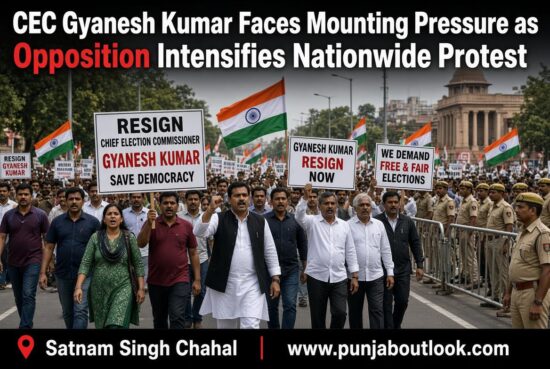
New Delhi: Chief Election Commissioner (CEC) Gyanesh Kumar is facing growing political and legal scrutiny as the controversy surrounding the Election Commission of India’s Special Intensive Revision (SIR) of electoral rolls continues to intensify. Opposition parties have stepped up their campaign, demanding Kumar’s resignation and questioning the transparency and impartiality of the country’s election machinery.
The latest development came on Thursday in Bengaluru, where INDIA bloc leaders and Congress workers staged a protest at Freedom Park against the SIR exercise and the functioning of the Chief Election Commissioner. Demonstrators staged a symbolic arrest of Kumar, with a protester wearing a mask resembling the CEC being paraded in handcuffs. The protesters demanded that the voter-roll revision be withdrawn, allegedly deleted voter names be restored after verification, and Kumar resign from his post. 
The Bengaluru demonstration followed a major opposition rally at Delhi’s Ramlila Maidan on November 1. Leaders from several opposition parties accused the Election Commission of allowing the electoral process to become vulnerable to political influence. Rahul Gandhi and other opposition leaders argued that the revision of voter lists could deprive eligible citizens of their right to vote. These remain political allegations and have not been established as findings of a court. 
One of the central concerns is the scale and impact of the voter-list revision. Reports say more than 130 million names have been removed during the exercise since last year. The Election Commission and the government maintain that the process is intended to identify duplicate, deceased, shifted and otherwise ineligible voters. Opposition parties, however, argue that eligible voters may also have been affected and that the process requires greater transparency, proper verification and an effective opportunity for people to appeal. 
The controversy has also moved into the courts. On November 4, the Supreme Court issued notice to the Centre and the Election Commission on a petition challenging Section 16 of the Chief Election Commissioner and Other Election Commissioners Act, 2023. The provision gives the CEC and Election Commissioners protection from civil or criminal proceedings for acts or statements made while performing, or claiming to perform, their official duties. The petition argues that such blanket immunity could weaken accountability. The Court’s notice seeks responses; it does not mean that the provision has been struck down or that the petitioners’ arguments have been accepted. 
Questions have also been raised about decision-making within the Election Commission. An investigation published by The Indian Express reported that the two Election Commissioners, Sukhbir Singh Sandhu and Vivek Joshi, had recorded objections to certain decisions concerning electoral rolls and the SIR process. The Election Commission has rejected the suggestion that the Commission was divided over its formal decisions. In its response to the Supreme Court, it maintained that the three major SIR orders were approved unanimously and explained that internal observations do not necessarily amount to formal decisions. 
The BJP has strongly rejected the opposition’s accusations, describing its protests as political theatre and defending the need to remove duplicate and ineligible names from electoral rolls. The ruling party has also questioned why opposition parties are challenging the revision process rather than supporting the removal of invalid entries. The disagreement reflects a wider political battle over the credibility of the Election Commission and the administration of elections in India. 
At the heart of this dispute lies a fundamental democratic principle: every eligible citizen must be able to exercise the right to vote without fear, confusion or unnecessary obstacles. Cleaning electoral rolls is a legitimate responsibility of the Election Commission, but the process must be transparent, impartial and open to independent scrutiny. Equally, allegations of wrongdoing must be examined through evidence and lawful procedures rather than treated as proven facts merely because they have been raised by political leaders.
The Election Commission is not an ordinary government department. It is a constitutional institution entrusted with protecting the fairness of elections and the confidence of voters. Its credibility depends not only on conducting elections but also on demonstrating that every political party and every eligible voter receives equal treatment.
The coming legal proceedings and the Commission’s handling of the SIR controversy will therefore be closely watched. The larger question is not simply whether Gyanesh Kumar should remain in office. It is whether India’s electoral institutions can maintain public confidence by ensuring transparency, accountability and equal protection of every citizen’s voting rights.