
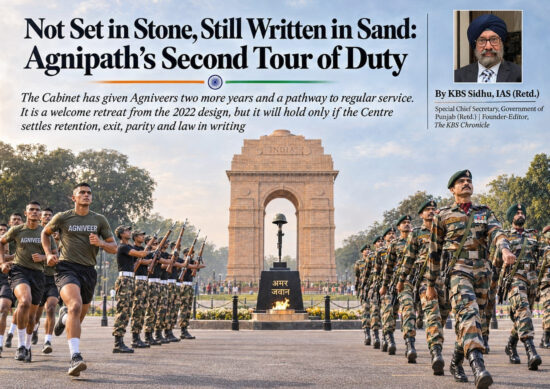
 On Wednesday, 4 November 2026, the Union Cabinet chaired by PM Modi approved a two-year “Second Tour of Duty” for Agniveers, and the task of explaining it fell to the Chief of Defence Staff (CDS), General NS Raja Subramani. The terms are simple enough. The top 25 per cent of a batch still enter the regular cadre after four years. The other 75 per cent, who under the 2022 design were to walk out with a Seva Nidhi cheque and a skill certificate, may now stay two years more on higher pay (the figures cited were ₹43,500 in the first year and ₹47,000 in the second). After six years, those willing will be offered regular enrolment, subject to objective selection criteria.
More than 18,300 Agniveers were due to be discharged by 31 December, with the Navy’s cohort finishing on 21 November, the Air Force’s on 21 December and the Army’s on the last day of the year. For the sailors, the reprieve arrived with 17 days to spare.
The CDS says the proposal came from the services themselves after three to four months of review, and that the scheme was never set in stone. The Congress calls it a pre-poll reversal. I suspect both are telling part of the truth. The forces needed these soldiers, and no government wanted thousands of soldiers discharged on New Year’s Eve, weeks before Punjab and Uttar Pradesh go to the polls.
One Batch Today, Every Batch Tomorrow
The Tribune reads the extension as meant for those whose term ends this year, while the ANI account of the Cabinet decision describes a pathway for all recruits. The notified text will settle it. I anticipate a permanent redesign, with every batch’s 75 per cent, including the one completing four years in December 2027, offered the same two years.
The reasoning is arithmetical. The first batch’s second tour ends in December 2028, barely months before the 2029 Lok Sabha polls. Confine the concession to that batch, and it would march out alongside the batch recruited in 2024, which reaches its own four-year mark that very month. Two mass exits would converge on the eve of a general election, and the intervening batch would have been sent home in between, watching its seniors stay on. No government will walk into that. So the second tour must become the rule.
That rescues the calendar without solving the problem, for an exit deferred is still an exit. Even a fraction of the first batch’s 13,700-odd Agniveers leaving in December 2028 will test the nerve of any government.
Consider the Delhi they would walk into. On 20 July, tens of thousands of largely Gen Z protesters massed at Jantar Mantar under the banner of the Cockroach Janta Party (CJP), and five days later the Union Education Minister resigned. By 10 October, the Centre was meeting the next round with some 23,000 central personnel, and on 11 October the Delhi Police Commissioner de-notified Jantar Mantar as a protest site, a decision now under challenge in the Supreme Court, and sent protest to Ramlila Maidan, Burari and the CBD Ground. Now imagine ex-soldiers in their twenties, not absorbed, joining that crowd at Ramlila Maidan. Service discipline ends with discharge. No commanding officer could forbid him, and the Constitution would protect his right to assemble peaceably as it protects any citizen’s. He would have no pension at stake, and a grievance earned in uniform. I do not doubt the loyalty of these young men. But a column of trained soldiers marching with the students of 2026 would be a horror story for the Centre.
I, therefore, expect the “objective selection criteria” to be read generously, or a further extension to appear, well before that date. The four-year tour survives only as an entry contract.
The Paltan Is Not a Waiting Room
The reports are silent on where these men will serve. I assume the retained and the extended will remain in their regiments, for Agniveers already belong to them. The trouble is that the fault line now runs inside the battalion, indeed inside the section. Two men of one batch, trained together, may share a sangar (a stone breastwork on the forward slope) while one is a regular with a career and the other a Tier 2 engagement with two more years of hope.
An Indian soldier fights for Naam, Namak and Nishan, the name of his paltan, his salt and its colours, and for the man beside him. The CDS was gracious in saying that those not picked are not bad, only relatively placed. A ranking, however, lifts a man only when his comrade falls. Maj Gen Yash Mor (Retd) warned of this wariness years ago, and a second gate at six years prolongs it.
Fairness demands the other side too. Six years is a better bond than four, and a soldier with a real chance of staying has every reason to invest in his unit. Some commanding officers have themselves wanted retention of 50–60 per cent, and sources quoted by the Financial Express last year rated Agniveers’ performance in Operation Sindoor as excellent. So I read this as a strain on the regimental system. The breach comes later, when two men die in the same trench and their families are treated differently. The Parliamentary Standing Committee on Defence urged parity in December 2023. The announcement, as reported, does not touch it.
The Ledger Nobody Has Opened
Here the critics, and I am one, must be honest. Agnipath was also a pension reform. Defence pensions stand at ₹1,71,338 crore in 2026–27, or 21.8 per cent of the defence budget, against 23.6 per cent in the previous year’s Budget Estimates. If nearly every Agniveer ends up a regular with a pension, the saving that justified the upheaval of 2022 shrinks with each batch.
Yet the Army carries a reported shortfall of about 1.8 lakh soldiers, with 60,000–65,000 retiring every year. The Government has given us a cost in neither direction. Before the Second Tour goes any further, we deserve to see the sums.
Dispense with the Pretence, Not the Soldier
Agnipath stood on three pillars: a four-year tenure, 25 per cent retention and a lean, pension-free force. The first has fallen, the second falls if six-year enrolment means what the CDS says, and the third will follow. As designed in 2022, the scheme has failed, and what survives is largely its name.
Scrapping the scheme is the obvious demand, and I weighed it. The old system offers the cleanest cohesion, and it brings back in full the pension line and the older force that drove this reform. Besides, with four years of intake already in the ranks, the clock cannot simply be turned back.
My answer is to retire the 2022 design and keep what experience has vindicated. Four years is a poor career and a good probation. Let it become a long probation that leads most men to a career and the rest to a real second one.
Four Stones for the Foundation
One: retain by need, and name the number. Raise the first gate to 50 per cent, and to 75 per cent in the Navy, which is what the services are reported to want, with technical trades treated likewise. Publish a cumulative ceiling across both gates; I would suggest three in four of each batch. Make the second gate a fixed standard of fitness, performance and conduct, so that a man competes against the bar and not against his buddy.
Two: turn the exit into a transfer. A quota alone is a promise, and we know how quotas fare. As of June 2021, ex-servicemen held 0.47 per cent of Group C posts in the Central Armed Police Forces (CAPFs), against a 10 per cent reservation. Punjab reserves 13 per cent, yet Parliament was told some years ago that only 1,150 of 60,772 registered ex-servicemen had been placed. The Centre’s new 50 per cent quota for constables is generous, but it was drawn for men leaving at four years. The first batch has a wider age relaxation. After it, a recruit who joins at 21 leaves at 27, while the CAPF limit of 23 plus three years’ relaxation stops at 26. Left alone, the second tour will age him out of his own quota. Count the years served, and better still, move those men by direct transfer. For regulars, revive the Sixth Pay Commission’s idea of lateral absorption in mid-career. The CAPFs gain seasoned men, and the pension date moves out.
Three: one soldier, one covenant. Give equal terms for death and disability in the line of duty, whatever the contract. Grant ex-serviceman status and its health and canteen benefits to everyone completing six years. Keep second-tour men in their own battalions wherever possible, and leave the class composition of the Sikh, Dogra and other regiments undisturbed.
Four: set it in stone. Notify the second tour for all batches. Publish the selection criteria, and settle whether the Seva Nidhi is enhanced, as one report has it, or merely continued, as another suggests. The scheme never went before Parliament or its Standing Committee in 2022, so let a White Paper go there now. As for Punjab, the high-powered committee of 12 May has had nearly six months. I have yet to see its policy notified. Let it come as statutory rules, as I urged then, with domicile and Punjabi as conditions.
From Sand to Stone
In May, I asked Punjab to build its Agniveer policy on stone, not sand. I now ask the same of Delhi. I served as Secretary, Defence Services Welfare, Punjab, and I have seen how gently a promise to a soldier can erode between the announcement and the file.
The CDS is right that a policy must change with experience. The terms on which a 22-year-old is asked to lay down his life for his paltan should be notified, and should then hold.
Share The KBS Chronicle