
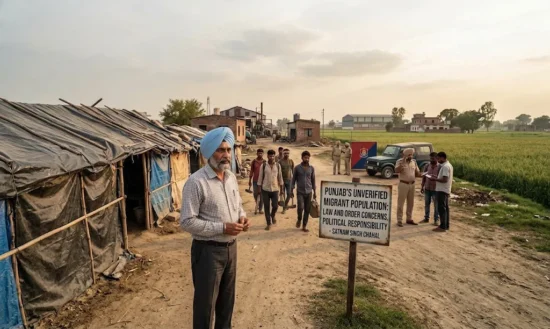
 By Satnam Singh Chahal | Punjab Outlook — Political Analysis-Punjab is facing an increasingly important challenge concerning the presence of large numbers of migrants whose identities, residential details and backgrounds have allegedly not been properly verified. The issue has raised questions about internal security, law and order, pressure on public infrastructure and the responsibility of government authorities to maintain accurate records of people living and working in the state. While migration for employment is a normal part of economic life, the absence of an effective verification system can create administrative and security concerns that cannot be ignored.
The central question is not whether people from other states should be allowed to earn their livelihood in Punjab. Every Indian citizen has constitutional freedom to move and work across the country. The real question is whether the state government, police administration and local authorities are properly identifying tenants, workers and new residents, maintaining records and investigating individuals involved in criminal activities. No individual should be treated as a suspect simply because of their place of origin, but nobody should be exempt from lawful identity verification and accountability.
The scale of migration into Punjab makes the issue particularly important. An NDTV analysis published on August 18, 2026, cited government data estimating approximately 3.3 million migrant labourers in Punjab, representing around 12–15 per cent of the state’s population. However, this figure represents migrant labourers, not undocumented or unverified residents. There is currently no reliable publicly established figure showing how many migrants are living in Punjab without proper police or residential verification. This information gap itself demands attention.
Punjab has witnessed repeated disputes over the verification of migrant residents. In September 2025, several village panchayats in Hoshiarpur district passed resolutions concerning migrants without local documentation and police verification. Similar concerns were reported in other districts. These developments demonstrate that the issue is not confined to one village or one locality. At the same time, collective restrictions against people merely because they come from another state cannot be justified. Verification must be conducted under the law, not through intimidation or discrimination.
Another serious question concerns the conduct of political representatives who reportedly encourage migrants to establish or continue living in temporary settlements, including jhuggies, and tell them not to leave Punjab. If political leaders are making such appeals without ensuring proper documentation, lawful land use, sanitation and police verification, they must explain their position to the public.
There is a fundamental difference between protecting the rights of poor workers and encouraging unregulated settlements. Every person deserves shelter, dignity and protection under the law. However, no political leader should encourage anyone to occupy government, panchayat or private land illegally. Nor should political considerations prevent lawful action against unauthorised encroachments or obstruct police verification.
Political parties must also clarify whether their public statements are intended to protect vulnerable workers or whether they are creating political expectations without taking responsibility for the administrative consequences. Any allegation that political leaders are encouraging permanent settlements for electoral considerations should be investigated through documented statements and evidence rather than assumptions.
Punjab Police and the state government have a responsibility to ensure that people living in villages, towns, cities and industrial areas have their identities and residential details properly recorded through lawful procedures. Landlords, factory owners, contractors, property dealers and employers should cooperate with the police and maintain required records.
The police have already demonstrated that large-scale verification operations are possible. A statewide operation reported by The Times of India involved checks at 1,043 locations, screening 8,328 tenants and verifying 7,815 identities. Such exercises should not remain occasional campaigns. They should become part of a consistent and accountable policing system.
It is equally important to establish that criminality is an individual matter. No entire migrant population should be blamed for the actions of particular individuals. If someone is involved in theft, murder, drug trafficking, organised crime, extortion or any other offence, the police must investigate and take action irrespective of whether that person is a migrant or a permanent resident of Punjab.
The government must also answer questions about the economic future of Punjab’s younger generation. Thousands of Punjabi youths continue to look towards foreign countries for employment and better opportunities. At the same time, agriculture, construction, manufacturing and several other sectors depend heavily on migrant labour.
This situation requires a serious employment and economic policy. Punjab must create more opportunities for its own young people, improve vocational training, encourage industrial investment and ensure fair employment practices. Migrant workers who contribute to the state’s economy should receive dignity and legal protection, while local residents must not be neglected in employment, housing and public services.
The Punjab government should immediately publish district-wise information on the number of migrant workers and temporary residents recorded by the authorities, the number whose identities and residential details have been verified, the number of pending verification cases and the action taken against illegal encroachments.
The government should also clarify the legal status of settlements on government and panchayat land. Where illegal occupation is established, the law should be applied through proper notice and due process. Where people are living legally and earning an honest livelihood, they should not face harassment.
The role of political leaders must also come under public scrutiny. Representatives who encourage people to remain in settlements should be prepared to explain whether those settlements comply with land-use regulations, municipal requirements and public safety standards. Political support cannot replace administrative responsibility.
Punjab has a long tradition of welcoming people who come here for work and livelihood. Its economy has benefited from the contribution of workers from different parts of India. That tradition must be respected. But hospitality should not mean an absence of law, and the rights of migrant workers should not be used as an excuse to ignore the rights and security of Punjab’s residents.
The state government must not wait for another serious crime, public confrontation or village-level dispute before taking preventive action. It must establish a transparent verification system, enforce existing laws equally and hold negligent officials accountable.
The message should be clear: Punjab welcomes honest workers, protects every individual’s dignity and respects constitutional rights. But every person residing in the state must follow the law, and no political leader should encourage unlawful occupation or obstruct legitimate verification. Punjab’s security, social harmony and future cannot be made subordinate to political interests.
Editorial note: The claim that lakhs of migrants are unverified should not be published as an established statistic until the government releases supporting figures. The 3.3-million estimate refers to migrant labourers, not unverified migrants. The specific allegation about political leaders encouraging jhuggi construction should also be supported by identifiable statements, videos or documented incidents.