
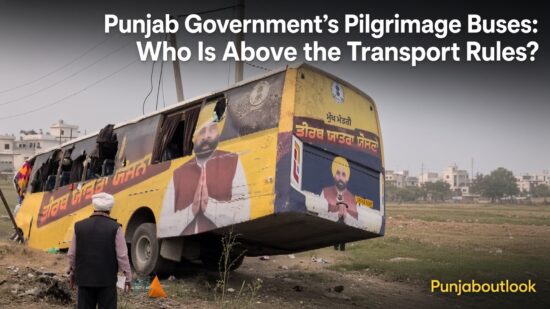
 The sight of a heavily decorated bus reportedly hired from outside Punjab for the Punjab Government’s pilgrimage programme raises serious questions about the enforcement of transport regulations, administrative accountability and equal treatment under the law.
Why are buses carrying such extensive political and promotional advertisements allowed to operate on Punjab’s roads? Are these vehicles complying with the same transport, safety and permit requirements that apply to private bus operators in the state?
The photograph raises questions that deserve answers from the Punjab Transport Department, traffic police and the authorities responsible for overseeing the government-sponsored pilgrimage programme.
The issue is not whether the government can hire private buses from other states. Government departments may engage outside transport operators, provided the vehicles meet all applicable legal requirements. The real question is whether these buses have the necessary permits, approvals and safety clearances to operate in Punjab.
Under Section 66 of the Motor Vehicles Act, 1988, transport vehicles must operate in accordance with the conditions of the applicable permit. Sections 73 and 74 also deal with contract carriage permits and their conditions. Interstate operation must comply with the relevant permit provisions, including Section 88.
The large-scale wrapping and display of political or government promotional material on these buses also deserve scrutiny. Are the advertisements authorised? Do they comply with applicable vehicle-display and road-safety requirements? Do they obstruct the driver’s visibility, windows, emergency exits or safety equipment? These are questions that the authorities should answer through a proper inspection rather than allowing public debate to remain unanswered.
There is also a question of fairness. Private bus operators in Punjab are expected to comply with transport regulations and face enforcement action when violations are detected. If government-hired contractors receive any special relaxation, the legal basis for that relaxation must be made public. Government sponsorship should not mean preferential treatment.
This controversy deserves particular attention because the safety of buses operating under the Mukh Mantri Tirath Yatra Scheme has already come under scrutiny.On October 25, 2026, the National Human Rights Commission took cognisance of complaints concerning the safety of AC sleeper buses being used under the scheme. It directed the Punjab Chief Secretary to arrange inspections of the buses and submit a report within seven days. Allegations included unauthorised structural modifications, obstructed emergency exits and inadequate fire-safety arrangements. These were allegations requiring investigation, not findings that every bus was unsafe.
Earlier, The Tribune, in its April 26, 2026 report, highlighted that private transporters engaged by the Punjab Government were operating buses covered with large promotional posters. The report also described government monitoring of the condition of those posters and deductions from contractors’ payments for damage or inconvenience. This raises a legitimate question about priorities: is the administration giving adequate attention to roadworthiness, passenger safety and statutory compliance alongside the presentation and publicity of the buses?
The Punjab Transport Department, State Transport Commissioner, Regional Transport Authorities and traffic police should clarify the following:
-
From which state have these buses been hired, and which companies or contractors have been awarded the contracts?
-
Do all buses possess valid registration, fitness certificates, insurance and the required interstate permits?
-
Who authorised the extensive political and government promotional wrapping?
-
Have the buses been inspected for visibility, emergency exits, fire safety and passenger protection?
-
Are the same rules being enforced against government contractors as against ordinary private bus operators?
-
What is the total public expenditure on hiring these buses, their decoration, advertising and operation?
The government should also publish the tender documents, contractor details, payment arrangements and inspection reports so that taxpayers can understand how public money is being spent.
The Punjab and Haryana High Court should consider taking suo motu cognisance of the wider questions of transport-law compliance, passenger safety and equal enforcement of regulations. Alternatively, the matter deserves an independent inquiry by the competent transport and road-safety authorities.
The objective should not be to stop religious pilgrimages or inconvenience elderly devotees. Providing opportunities for people to visit religious places is a legitimate public-service objective. However, religious sentiments and government-sponsored welfare programmes cannot become reasons for overlooking statutory requirements.
The central question remains: If an ordinary private bus operator cannot enjoy special privileges on Punjab’s roads, why should a bus hired by the government be treated differently?
Punjab’s roads belong to the public, and the law must apply equally to everyone, whether a vehicle is privately owned or hired by the government.
Editorial note: The photograph raises questions about the bus’s appearance and promotional wrapping. Its registration, ownership, permit status and compliance cannot be established from the photograph alone. These require official verification.
Disclaimer: This article and accompanying images are for informational and illustrative purposes only. Some visuals may be AI-generated or digitally enhanced and may not depict actual events or persons.Views expressed are based on publicly available information and analysis