
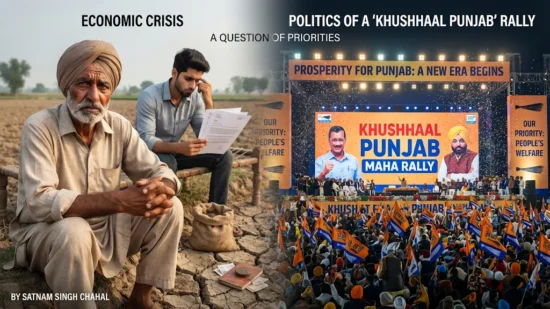
 When ordinary people in Punjab are struggling to arrange two meals a day, when educated young people are desperately searching for employment, when farmers are facing mounting financial pressures, and when small traders and shopkeepers are finding it increasingly difficult to sustain their businesses, the announcement of a political rally under the slogan “Khushhaal Punjab” (Prosperous Punjab) raises an important question: how does the ruling Aam Aadmi Party (AAP) government define prosperity, and how does that definition match the everyday reality of Punjab’s people?
The proposed Moga rally provides an opportunity to examine the gap between political slogans and economic conditions. A rally can demonstrate political organisation, attract supporters and communicate a government’s achievements. But the real test of prosperity is not the size of a gathering or the strength of its slogans. It is whether ordinary families have secure incomes, young people have employment, farmers receive sustainable returns, businesses can survive, and the state can meet its financial obligations without placing an ever-growing burden on future generations.
Punjab is not facing a single economic problem. Its difficulties are spread across agriculture, industry, employment, public finances and household incomes. Farmers continue to raise concerns about rising cultivation costs, agricultural diversification, inadequate returns and the future of farming. Industrialists have their own concerns about investment, electricity costs, infrastructure and the movement of businesses to other states. Small traders, shopkeepers and self-employed people are struggling with rising expenses and uncertain business conditions.
For thousands of young Punjabis, migration abroad has become an aspiration associated with better employment opportunities and financial security. Families often invest their savings, sell land or borrow money to finance overseas education and migration. The question for the government is why so many young people continue to see their future outside Punjab rather than in their own state.
A prosperous Punjab should mean that young people can find respectable employment at home, farmers can earn sustainable incomes, industrial units can expand, and families do not have to depend on borrowing to meet their daily expenses. Prosperity must be visible in people’s lives, not merely in government advertisements and political speeches.One of the biggest challenges confronting the Punjab government is the state’s accumulated debt and continuing fiscal deficits. According to the Punjab Budget Analysis 2026–27 published by PRS Legislative Research, the state’s outstanding liabilities are estimated at 45.1 per cent of its Gross State Domestic Product (GSDP) by the end of 2026–27.
The same budget projects a fiscal deficit of approximately ₹39,971 crore, or 4.1 per cent of GSDP, and a revenue deficit of ₹21,955 crore. The state has also budgeted net borrowings of approximately ₹38,471 crore for 2026–27. These figures underline the financial pressures facing Punjab.Debt is not simply a figure in a government document. It has consequences for future generations. Borrowed money must eventually be repaid, and interest payments reduce the resources available for education, healthcare, infrastructure, agricultural development and other essential public services.
Punjab needs a serious financial recovery strategy that increases productive investment, strengthens its revenue base, attracts industries and creates employment. Merely borrowing more money to meet recurring expenditure cannot provide a permanent solution.The AAP has announced its Khushhaal Punjab Maha Rally for November 26 at Matwani village in Moga district. The gathering will mark the party’s 14th foundation day and is expected to be addressed by national convenor Arvind Kejriwal and Chief Minister Bhagwant Mann. Media reports describe the event as the beginning of the party’s campaign preparations for the 2027 Punjab Assembly elections.
AAP leaders have highlighted initiatives such as 300 units of free electricity, Aam Aadmi Clinics and improvements in public infrastructure as evidence of their government’s performance. These programmes are part of the government’s case before the public and deserve to be assessed on their implementation, reach, quality and financial sustainability.
However, the government must also answer questions about the broader economic condition of the state. Free electricity and healthcare facilities may provide relief to households, but they cannot independently resolve unemployment, industrial stagnation, agricultural distress or the accumulated debt burden.The important question is not whether the government can organise a large gathering. It is whether it can demonstrate measurable improvements in the economic lives of Punjab’s people.
Where are the employment opportunities for Punjab’s youth?Unemployment and migration deserve a central place in any discussion about a prosperous Punjab. Every year, young people invest substantial amounts of money in IELTS coaching, overseas education, immigration consultants and other routes to foreign countries. Many families take loans or sell property to support these ambitions.
The government must explain how many sustainable private-sector jobs have been created, how many new industries have started operating, how much fresh investment has actually reached Punjab, and how many young people have secured employment in their own districts.Government recruitment is important, but a state of Punjab’s size cannot depend exclusively on government jobs. It needs industrial expansion, agricultural processing, technology-based enterprises, tourism, small businesses and private investment.Without a strong employment-generating economy, the slogan of prosperity will remain an aspiration rather than an achievement.
Punjab’s agricultural economy requires long-term reforms. Farmers need better returns, reliable procurement arrangements, affordable agricultural inputs, water conservation and opportunities to move towards diversified farming. Simply announcing schemes cannot resolve the structural problems facing agriculture.Similarly, industrialists need a business environment in which investment is encouraged, infrastructure is reliable and government policies remain predictable. Small traders and shopkeepers need economic activity that brings customers and purchasing power back into local markets.The government should present a district-wise account of industrial investment, new factories, employment generation and agricultural diversification. Such information would allow citizens to judge economic progress on the basis of evidence.
AAP inherited a state with substantial financial, agricultural and administrative challenges. Previous governments also carry responsibility for Punjab’s accumulated problems. It would therefore be incorrect to attribute every economic difficulty exclusively to the present government.However, after almost five years in office, the Mann government must be prepared to answer for its own decisions, financial management and achievements.
The people of Punjab have a right to ask:
– How much has the state’s total outstanding debt increased during the present government’s tenure?
– How much money is being spent on interest payments and debt servicing?
– How many permanent and private-sector jobs have actually been created?
– How much new industrial investment has materialised?
– What concrete progress has been made in agricultural diversification?
– What is the government’s strategy for reducing the fiscal and revenue deficits?
– How will Punjab generate sufficient revenue without continuously increasing its borrowing?
These are legitimate questions of democratic accountability, not merely opposition politics.The November 26 Moga rally may provide AAP with an opportunity to present its governance record and announce its future priorities. But the people of Punjab should expect more than political speeches and promises ahead of the 2027 Assembly elections.
If the government wants to convince people that Punjab is becoming prosperous, it should publish a comprehensive economic performance report, supported by independently verifiable figures. The report should explain the state’s financial position, employment record, industrial development, agricultural progress, education, healthcare and the financial implications of its welfare commitments.
The government should also present a five-year economic roadmap explaining how Punjab can reduce its debt burden, attract investment, generate employment and restore confidence among businesses and ordinary families.Punjab has enormous potential. Its hardworking farmers, skilled workforce, entrepreneurs, industrialists and worldwide Punjabi diaspora represent important economic strengths. What the state needs is an economic strategy that converts these strengths into sustainable growth.
A prosperous Punjab cannot be built through slogans alone. It must be built through employment, investment, financial discipline, agricultural prosperity and economic security for ordinary families.When families are struggling to arrange their bread and butter, when young people are leaving their homeland in search of opportunities, and when the state is carrying a substantial debt burden, the slogan of Khushhaal Punjab naturally invites public scrutiny.The people of Punjab are not simply looking for another political rally. They are looking for answers about their future.The ultimate question is simple: Will Khushhaal Punjab be measured by the size of a political gathering in Moga, or by the improvement in the lives of millions of Punjabis?
Punjab Outlook — Political Analysis
Sources for economic figures and rally details:
– PRS Legislative Research — Punjab Budget Analysis 2026–27.
– Hindustan Times — AAP’s Moga rally and 2027 campaign.
– Mint — Khushhaal Punjab rally and AAP’s political preparations.
punjabi