
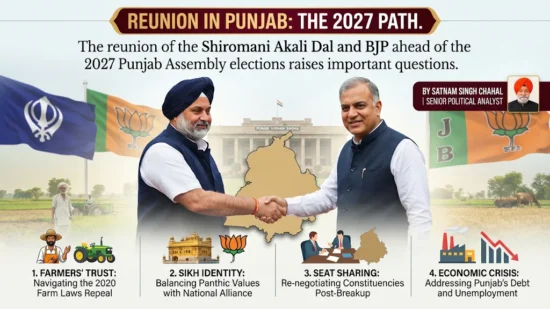
By Satnam Singh Chahal | Punjab Outlook — Political Analysis-The announcement of the revival of the Shiromani Akali Dal (SAD) and Bharatiya Janata Party (BJP) alliance on November 24, 2026, has opened a new chapter in Punjab politics. After nearly six years of political separation, the two former allies have decided to come together again ahead of the 2027 Punjab Assembly elections. The announcement, made in New Delhi on the occasion of the Parkash Purab of Sri Guru Nanak Dev Ji, has generated considerable political discussion across Punjab. The reunion brings back a partnership that once played a significant role in shaping the state’s electoral politics, but the circumstances surrounding the two parties have changed considerably since their separation.
The return of the alliance is not simply an electoral arrangement between two political organisations. It raises larger questions about Punjab’s regional identity, Sikh political representation, agricultural interests and the relationship between the state and the Union Government. Both parties will have to demonstrate that their reunion represents more than an attempt to improve their electoral position and that they have a common political programme addressing the problems facing Punjab and its people.
From a Long Political Partnership to Six Years of Separation
The Shiromani Akali Dal and BJP developed a strong political understanding during the 1990s. Their alliance became particularly successful in the 1997 Punjab Assembly elections, when they formed the government together. The partnership continued through the 2007 and 2012 elections, and the two parties governed Punjab for several years. Their victory in 2012 was particularly significant because they became the first incumbent government in Punjab to secure a second consecutive Assembly term.
The political arrangement was based on the different strengths of the two parties. The Akali Dal traditionally had a political presence in rural Punjab and among sections of the Sikh community and farming population, while the BJP had an established support base among sections of urban voters and business communities. This division of political responsibilities helped both parties maintain a long-standing electoral partnership.
However, differences gradually emerged over political priorities, agricultural policies and Punjab’s interests. The biggest disagreement occurred in 2020 when the Union Government introduced three controversial farm laws. The Akali Dal withdrew from the National Democratic Alliance (NDA), arguing that farmers’ concerns and Punjab’s agricultural interests had not been adequately addressed. The party’s decision came during the growing farmers’ agitation, which eventually developed into a major national movement. Although the three farm laws were repealed in November 2021, the political relationship between the two parties remained broken for nearly six years.
Political Setbacks and the Need for a New Understanding
The 2022 Punjab Assembly elections demonstrated how significantly the political position of both parties had changed after their separation. The Aam Aadmi Party won 92 of the 117 Assembly seats and formed the government. Congress secured 18 seats, while the Shiromani Akali Dal won only three and the BJP managed two seats. These results reflected the decline of the former alliance’s electoral influence and the emergence of a new political force in Punjab.
The 2024 Lok Sabha elections also presented a different picture. The Akali Dal managed to win one parliamentary constituency, while the BJP failed to win any seat in Punjab. However, the BJP secured a larger vote share than the Akali Dal. This indicated that both parties continued to have separate political constituencies, although converting their support into electoral victories remained a challenge.
Against this background, the decision to revive the alliance reflects a new political calculation. The Akali Dal wants to strengthen its regional political position, while the BJP has been attempting to expand its organisational presence throughout Punjab. Both parties may believe that cooperation can help them reconnect with sections of the electorate that supported their earlier partnership. Nevertheless, their political understanding will need to address the disagreements that caused the original separation.
Farmers’ Trust Will Be the Biggest Challenge
One of the most difficult questions facing the revived alliance concerns the farmers’ movement and the three farm laws of 2020. The Akali Dal left the NDA by presenting its decision as a stand in support of farmers and Punjab’s agricultural interests. Its leadership will now have to explain why it has decided to reunite with the same political organisation whose government introduced the controversial legislation.
The issue goes beyond the repeal of the three laws. During the farmers’ agitation, several important concerns were raised regarding Minimum Support Price (MSP), government procurement, agricultural reforms, federal relations and the future of Punjab’s farming economy. Many of these issues continue to influence political discussions in the state.
The BJP will also have to address the concerns of farmers and demonstrate that its agricultural policies recognise Punjab’s specific economic and geographical circumstances. The alliance will need a clear common position on MSP, procurement, crop diversification and agricultural sustainability. Without a convincing explanation of their respective positions, both parties may face difficult questions from farmers and rural voters.
Sikh Identity and the Regional Political Character of the Akali Dal
Another major challenge concerns the traditional political identity of the Shiromani Akali Dal. Historically, the party has presented itself as an organisation representing Sikh interests, Punjab’s regional aspirations and the concerns of the farming community. Its political relationship with the BJP was built around an understanding that allowed both organisations to maintain their separate identities.
However, several issues concerning the Sikh community remain important. These include the autonomy of Sikh religious institutions, the release of Sikh prisoners, justice for the victims of the 1984 anti-Sikh violence, federal rights, religious representation and the protection of Sikh interests. These issues continue to be discussed within different sections of the Sikh community.
The Akali Dal will therefore have to explain how it intends to maintain its independent Panthic and regional identity while sharing a political platform with the BJP. Its supporters will expect clarity on whether the party will continue to raise Sikh community concerns independently, even when those concerns involve policies or decisions of the Union Government.
The future of the alliance will depend partly on how both parties address these questions. Political cooperation cannot remove the need for independent positions on sensitive religious, cultural and constitutional issues.
Seat-Sharing and Leadership Could Create Differences
The distribution of Assembly constituencies will be another important test for the alliance. Under the previous arrangement, the BJP traditionally contested around 23 Assembly seats, while the Akali Dal contested most of the remaining constituencies. However, the political situation has changed since the two parties separated in 2020.
The BJP has expanded its independent political activities and may seek a larger share of constituencies than it received under the previous arrangement. Media discussions before the reunion referred to the possibility of the BJP seeking approximately 40 seats, although the final arrangement should not be treated as confirmed until an official agreement is announced.
The announcement that the Akali Dal will remain the senior partner and that the Chief Minister’s position will belong to the SAD addresses an important leadership question. However, several other issues remain to be resolved, including constituency distribution, candidate selection, local political arrangements and campaign responsibilities.
Both parties have spent six years developing separate political networks. In some constituencies, their local leaders may have competing ambitions and interests. Bringing these organisations together at the grassroots level will require negotiations, discipline and mutual understanding.
Internal Divisions Within the Akali Dal
The Akali Dal also faces the challenge of strengthening its internal organisation and rebuilding confidence among traditional supporters. Differences within the party, questions surrounding leadership and the emergence of alternative Akali political formations have affected its political position over recent years.
The emergence of Akali Dal (Waris Punjab De), along with other Panthic political voices and initiatives, has created additional competition over Sikh representation and regional political issues. The leadership of Sukhbir Singh Badal will therefore have to address questions concerning organisational unity, the party’s political direction and its relationship with different sections of the Sikh community.
Some Akali supporters and Panthic voices may question whether the renewed alliance with the BJP is consistent with the party’s traditional regional and religious identity. These concerns will require political engagement rather than simply electoral announcements. The Akali Dal will need to explain how it intends to strengthen its independent political identity while cooperating with the BJP.
BJP’s Expanding Political Ambitions in Punjab
During the six years following its separation from the Akali Dal, the BJP attempted to strengthen its independent political organisation in Punjab. Its performance in the 2024 Lok Sabha elections demonstrated that it had secured support beyond some of its traditional urban constituencies. However, the party’s inability to win a parliamentary seat also highlighted the difference between securing a significant vote share and translating that support into constituency victories.
The BJP now faces the challenge of balancing its independent political ambitions with its renewed partnership with the Akali Dal. Its Punjab leadership will want to expand the party’s organisational strength, while the Akali Dal will expect recognition of its position as the senior partner.
The two organisations will need to develop a clear understanding about political responsibilities, campaign leadership and the role of their respective state-level leaders. Any disagreement over these matters could affect coordination at the constituency level.
Punjab’s Economic Crisis Must Become a Central Issue
Beyond electoral arrangements, the most important concern for Punjab’s people remains the state’s economic future. Punjab is facing mounting public debt, unemployment, agricultural difficulties, industrial challenges, drug-related problems and financial pressure on government institutions. Young people continue to look for employment opportunities, while farmers and small businesses are struggling with economic uncertainty.
The Akali-BJP alliance will have to present a detailed economic programme explaining how it intends to address these challenges. It must clarify its plans for agricultural reform, industrial investment, employment generation, education, healthcare and the financial sustainability of the state.
The BJP’s position in the Union Government also makes its role particularly important. Punjab has several longstanding issues involving federal relations, river waters, Chandigarh, border-area development, industrial investment and financial assistance. The alliance will have to explain how it intends to address these matters through cooperation between Chandigarh and New Delhi.
People will expect measurable commitments rather than general election promises. A common economic programme could become an important part of the alliance’s political identity, but its credibility will depend on the details and the willingness of both parties to stand by their commitments.
AAP and Congress Will Have Their Own Political Arguments
The revival of the SAD-BJP alliance will create a new political situation for the Aam Aadmi Party and Congress. The AAP government will seek to defend its record on employment, education, healthcare, infrastructure, drugs and financial management. It may also raise questions about the previous relationship between the Akali Dal and BJP and the circumstances surrounding their separation in 2020.
Congress, meanwhile, will have an opportunity to question the political credibility of the reunion and highlight the performance of previous governments. It may also attempt to present itself as an alternative to both the AAP government and the renewed alliance.
The Akali-BJP leadership will therefore need to explain its common political programme rather than relying only on criticism of its opponents. Voters will want to know what the alliance intends to change in Punjab and how its proposed policies differ from those of the other political parties.
Can the Old Alliance Formula Work in Today’s Punjab?
The Punjab of 2026 is very different from the Punjab of 1997, 2007 or 2012. The political landscape has changed, new leadership has emerged and voters have developed different expectations. The rise of the Aam Aadmi Party has also transformed the traditional political competition in the state.
In earlier years, the Akali Dal and BJP alliance benefited from their different electoral constituencies. Today, however, both parties have undergone significant organisational and political changes. Their supporters may not necessarily have the same expectations as they did during the previous partnership.
The six-year separation also created independent political networks, local rivalries and different political narratives. Rebuilding cooperation will therefore require more than an announcement by senior leaders. Both parties will have to establish trust among their workers, resolve local disagreements and develop a common understanding of their political responsibilities.
A formal agreement can bring two organisations together, but public acceptance depends on political credibility, policy clarity and consistent action.
The Road Ahead: What Will Determine the Future of the Alliance?
The revival of the Shiromani Akali Dal and BJP alliance is an important development ahead of the 2027 Punjab Assembly elections. Both parties have a long history of cooperation, but they also have a history of serious disagreements. Their future relationship will depend on whether they can address the reasons behind their earlier separation and establish a common political programme.
For the Akali Dal, the central challenges concern its Panthic identity, regional political character, farmers’ interests, internal unity and relationship with the Sikh community. For the BJP, the challenges include expanding its political base, addressing concerns among farmers and sections of the Sikh community, and balancing its organisational ambitions with the Akali Dal’s position as the senior partner.
The immediate tasks will include finalising seat-sharing arrangements, selecting candidates, resolving local differences and preparing a common election manifesto. More importantly, the two parties will have to establish clear positions on agriculture, federal relations, Punjab’s economic difficulties and longstanding Sikh community concerns.
The future of the Akali-BJP alliance will not be determined merely by the number of constituencies contested or the political announcements made by its leaders. Its credibility will ultimately depend on how honestly and transparently both parties address their past disagreements and explain their commitments to Punjab and the Sikh community. The 2027 Assembly elections will provide voters with an opportunity to examine the political records, promises and policies of both organisations.
Punjab Outlook — Political Analysis
By Satnam Singh Chahal
Editorial Note: This article examines the historical background, political circumstances and future challenges of the revived Akali-BJP alliance. It is an independent political analysis and does not constitute an endorsement of any political party.