
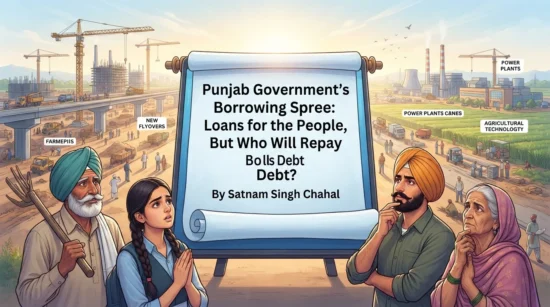
 Where Is the Borrowed Money Being Invested, What Is the Return on Investment, and What Are Punjab’s Sustainable Sources of Income?Punjab is facing an important economic question that deserves serious public discussion: What is the purpose of the state government continuously taking loans in the name of development and public welfare, and who will ultimately repay this growing debt? Borrowing money is not necessarily wrong for a government. Every state needs financial resources to build roads, bridges, hospitals, schools, irrigation facilities, industries and other infrastructure. However, borrowing becomes a serious economic concern when loans are increasingly used to meet routine expenditure, pay salaries, pensions, subsidies and interest on previous loans instead of creating productive assets that generate future income.
The Bhagwant Mann-led Punjab Government has presented several welfare and development programmes as investments in the people. Free electricity, financial assistance, health insurance, education, infrastructure development and other public services are important responsibilities of any elected government. However, the fundamental question is whether the money being borrowed is creating sufficient economic returns to repay the loans, or whether the government is simply transferring today’s financial burden to future generations of Punjabis.
According to the Punjab Budget 2026-27 analysis published by PRS Legislative Research, the state’s outstanding liabilities are estimated to reach approximately Rs 4.42 lakh crore by the end of March 2027, equivalent to around 45.1 per cent of the state’s projected Gross State Domestic Product. Other budget reporting has placed the projected debt figure at approximately Rs 4.47 lakh crore, depending on the liabilities included in the calculation. The scale of the debt makes it essential for the government to explain how it intends to manage future repayments. The state’s fiscal deficit for 2026-27 is budgeted at approximately Rs 39,971 crore. These are budget estimates, not final audited figures.
One of the most worrying aspects of Punjab’s financial position is the amount of money consumed by committed expenditure. According to the 2026-27 budget analysis, the state has estimated approximately Rs 90,335 crore for salaries, pensions and interest payments alone. Of this amount, approximately Rs 28,755 crore is expected to be spent on interest payments, Rs 39,115 crore on salaries and Rs 22,465 crore on pensions. These three expenditure heads together account for a substantial proportion of the state’s revenue receipts. Once these obligations are met, the government has considerably less flexibility to invest in new infrastructure, industrial development, employment generation and other productive activities.
The question is not simply how much money Punjab borrows, but where that money goes. If the government borrows thousands of crores to construct a highway, establish an industrial corridor, improve irrigation, develop renewable energy facilities or build infrastructure that creates employment and generates future revenue, such borrowing may be economically justified. Productive investments can increase economic activity, improve tax collections and strengthen the state’s ability to repay its loans. However, if borrowed money is used mainly to finance recurring expenditure without creating corresponding assets or additional revenue, the state can find itself borrowing again to meet the same financial obligations.
Punjab’s 2026-27 budget estimates capital outlay at approximately Rs 18,381 crore, while revenue expenditure is projected at approximately Rs 1,48,146 crore. Capital expenditure is particularly important because it creates assets such as roads, bridges, schools, hospitals, irrigation infrastructure and other long-term facilities. Revenue expenditure, on the other hand, includes salaries, pensions, interest payments, subsidies, grants and the day-to-day functioning of government departments. Both categories are necessary, but the government must demonstrate that an adequate share of borrowed resources is creating productive assets and long-term economic benefits.
Another important issue is the return on investment. When a government takes a loan for a development project, it should be able to explain what economic benefits that project will generate. How many jobs will it create? How much additional industrial production will it generate? How much revenue will it contribute to the state treasury? Will it reduce transportation costs, improve agricultural productivity or attract private investment? What is the expected period for recovering the investment? Without such an assessment, the public cannot determine whether borrowing is creating wealth or merely increasing liabilities.
Punjab also needs to strengthen its own income-generating resources. According to the 2026-27 budget estimates, the state expects revenue receipts of approximately Rs 1,26,190 crore. Its own tax revenue is projected at Rs 70,851 crore, while its own non-tax revenue is estimated at Rs 15,687 crore. The remaining resources are expected from Punjab’s share in central taxes, estimated at Rs 30,464 crore, and grants from the Central Government, estimated at Rs 9,189 crore. These figures show that Punjab must improve its own revenue collection rather than depend excessively on borrowing and financial assistance from the Centre.
The state’s major tax income sources include State GST, excise duty on liquor, VAT and sales tax, stamp duty and registration fees, motor vehicle taxes and electricity duties. These sources must be strengthened through better tax administration, prevention of tax evasion, transparent business policies and expansion of the formal economy. Punjab also has opportunities to generate additional non-tax income through mining royalties, industrial land development, transport services, tourism, government property management, public-sector enterprises and renewable energy projects. However, selling government land or other assets should not be treated as a permanent source of income because such resources are limited and cannot be sold repeatedly to finance recurring expenditure.
Industrial development is another area where Punjab needs a long-term economic strategy. The state has agricultural strength, skilled manpower, established industrial centres and a large Punjabi diaspora. These advantages can be converted into sustainable revenue through investment in food processing, agro-industries, textiles, manufacturing, information technology, renewable energy and logistics. Instead of depending primarily on loans to finance expenditure, the government must create conditions in which private investment expands, businesses grow, employment increases and the tax base becomes stronger.
Agriculture also requires a strategy that moves beyond subsidies and financial assistance. Punjab’s agricultural economy needs investment in food processing, crop diversification, modern storage, cold chains, agricultural technology and export-oriented industries. Farmers should have opportunities to earn more from their produce, while the state should develop industries that add value to agricultural products. Such investments can create employment in rural areas, increase farmers’ income and generate additional economic activity and tax revenue.
The electricity sector is another important part of Punjab’s financial challenge. Power subsidies represent a major recurring expenditure for the state. The government should publish transparent figures showing the total subsidy obligation, actual payments to PSPCL, outstanding subsidy dues and the financial impact on the power utility. At the same time, investment in solar energy, energy efficiency, modern transmission systems and better power management could help reduce long-term costs. Public welfare programmes must be financially sustainable so that their benefits can continue without creating an unmanageable burden on future budgets.
An equally serious issue is the repayment of existing loans. Every new borrowing creates an obligation for future governments and taxpayers. The people of Punjab, including future generations, will ultimately bear the financial consequences through government revenues, taxes, reduced development spending or other fiscal adjustments. If the state continues to borrow without increasing its productive capacity and revenue base, an increasingly large portion of future budgets may be consumed by interest and debt repayment instead of education, healthcare, infrastructure and employment.
The government should therefore publish a comprehensive annual borrowing and investment report. It should identify every major loan, its interest rate, repayment period, purpose, project cost and expected economic return. The public should also be informed about how much borrowed money has actually been spent on infrastructure, how much has gone towards routine expenditure and how much additional income has been generated by completed projects. Such transparency would allow citizens to evaluate whether public borrowing is producing measurable economic benefits.
The opposition parties, economists, financial experts, industrial organisations and civil society also have an important responsibility to examine Punjab’s financial position through facts and official documents. The issue should not be reduced to political accusations. Governments may differ in their development priorities, but the state’s debt obligations remain the responsibility of its people regardless of which political party is in power.
Ultimately, borrowing money in the name of public welfare is justified only when the benefits are sustainable and the state has a credible plan to meet its obligations. A government cannot measure economic success simply by announcing welfare schemes, distributing benefits or presenting large development budgets. It must also explain how those programmes will be financed over the long term and how the borrowed money will strengthen Punjab’s economy.
The most important questions for Chief Minister Bhagwant Mann and Finance Minister Harpal Singh Cheema are straightforward: How much of Punjab’s borrowed money has actually been invested in productive assets? What additional income has those investments generated? Which new industries and employment opportunities have been created? What are the state’s sustainable sources of income, and what is the concrete plan to repay the approximately Rs 4.4 lakh crore debt?
Punjab belongs to its people, and its financial resources must be managed in the public interest. Loans taken today cannot simply become tomorrow’s burden on farmers, employees, businessmen, taxpayers and young generations. The government must demonstrate that every rupee borrowed is creating long-term economic value.
Punjab needs investment that generates income, not borrowing that merely postpones financial problems. The real measure of development is not how much money a government borrows, but how much wealth, employment, infrastructure and sustainable revenue it creates from that money.
Punjab Outlook — Independent Political Analysis