
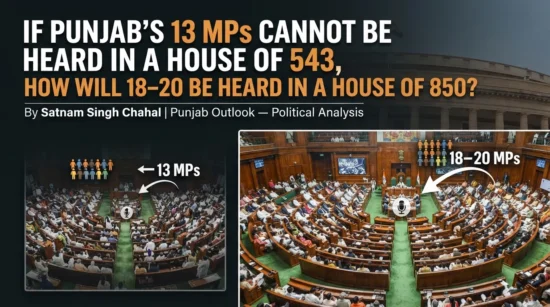
 Punjab’s political representation raises a serious question about the future of Indian democracy: if the 13 Members of Parliament elected from Punjab are unable to make their voices heard effectively in the present Lok Sabha of 543 members, how can anyone guarantee that increasing Punjab’s representation to 18–20 members in a House of 850 will give the state a stronger voice?
The issue is not simply the number of MPs. It is about political influence, democratic equality, the protection of regional interests and the ability of elected representatives to hold the central government accountable. Representation on paper does not automatically translate into representation in practice.
More MPs Do Not Necessarily Mean More Political Power
Punjab has 13 Lok Sabha constituencies at present. The proposed expansion of Parliament could increase this number to approximately 19 or 20, depending on the final allocation. The revised proposal cleared by the Union Cabinet reportedly envisages a 50 per cent increase in seats across states and protection of their relative share of representation until 2051. Parliament is expected to consider the legislative proposals in its forthcoming special session. These are proposals, not yet an implemented change.
But Punjab must look beyond the arithmetic. What matters is whether its elected representatives will have the opportunity, authority and political space to raise the concerns of the people they represent. If Punjab’s MPs cannot secure adequate attention for issues such as the state’s financial crisis, agricultural distress, river-water disputes, drug trafficking, unemployment, industrial decline, environmental degradation, border security and the concerns of Punjabi farmers, simply increasing their number will not solve the problem.
The central question is whether Parliament is functioning as a genuine forum for democratic debate or increasingly becoming a place where the numerical strength of the ruling party determines which issues receive attention. Opposition MPs are elected by millions of citizens. Their responsibility is not limited to supporting or opposing government legislation; they must question ministers, demand explanations, raise public grievances and ensure that regional concerns are not ignored.
Punjab’s position is particularly important because it has a distinct geographical, economic and historical significance. It is a border state, a major contributor to India’s food security and a region facing serious economic and social challenges. Its farmers, agricultural workers, industrialists, unemployed youth and families affected by drug abuse deserve meaningful representation at the national level. Punjab should not have to struggle repeatedly to obtain attention for matters that directly affect its people.
The Real Question Is the Quality of Representation
An increase from 13 to 19 or 20 MPs may look impressive, but the real test will be their ability to influence national decisions. Will Punjab’s representatives be able to speak freely and receive sufficient time in Parliament? Will their questions receive meaningful answers? Will the central government respond to their concerns? Will parliamentary committees give adequate consideration to Punjab’s problems? And will the state’s interests be protected when major national policies are framed?
There is also a responsibility on Punjab’s own political parties. The state sends MPs from different political parties to Parliament, but after elections, party loyalty and national political calculations sometimes take precedence over Punjab’s common interests. Punjab needs representatives who can rise above narrow party considerations whenever the state’s fundamental interests are involved.
The responsibility cannot be placed entirely on the central government. Punjab’s MPs must also demonstrate unity on issues where the interests of the state are at stake. Whether they belong to the Congress, AAP, Shiromani Akali Dal, BJP or any other political organisation, they must remember that their first responsibility is to the people of Punjab.
Punjab Must Demand a Stronger Voice, Not Just More Seats
The proposed expansion also raises a wider question about Indian federalism. Parliament is not merely a gathering of elected representatives; it is the institution through which the voices of India’s states, regions and communities must be reflected in national policymaking. A larger Lok Sabha should strengthen democracy, not make smaller states feel that their concerns are becoming less important.
The government must therefore ensure that parliamentary procedures provide meaningful opportunities for opposition representatives to participate. Increasing the number of seats without strengthening parliamentary accountability, debate and scrutiny risks creating a bigger House without creating a more responsive democracy.
Punjab should also demand transparency about the proposed delimitation process, the allocation of constituencies and the protection of its relative political representation. The state must not accept assurances without examining the actual constitutional provisions and legislative framework. The people of Punjab deserve clarity about how their political representation will be protected.
The debate must not become a competition between northern and southern states or between larger and smaller regions. Every state deserves a fair voice in the Union. Population is an important consideration in delimitation, but democratic representation must also respect India’s federal character and the historical contribution and legitimate interests of its constituent states.
The question Punjab should put before its political leadership and the Union Government is straightforward: If 13 MPs cannot make Punjab’s voice sufficiently heard in a Lok Sabha of 543 members, what guarantee is there that 19 or 20 MPs will be heard in a House of 850?
Punjab does not simply need more chairs in Parliament. It needs representatives who are heard, questions that receive answers, debates that produce accountability and a central government that takes the state’s problems seriously.
The strength of democracy is not measured by the number of MPs sitting inside Parliament, but by how effectively the people outside Parliament are represented. Punjab deserves representation with influence, dignity and accountability—not merely an increase in numbers.
Sources for the current delimitation debate:
– The New Indian Express — How the revised 850-seat proposal would work
– The Statesman — Punjab’s proposed increase to 19 or 20 Lok Sabha seats
– Reuters — Parliament expansion proposal and political debate