
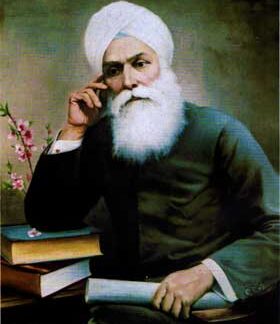
 Punjab’s intellectual and literary tradition has produced certain remarkable personalities who not only illuminated their own times but also became guiding lights for generations to come. Bhai Kahan Singh Nabha was one such towering scholar. A lexicographer, commentator, scholar of prosody, researcher, thinker, administrator, and profound interpreter of Gurmatt, he devoted his entire life to the pursuit of knowledge, the lucid exposition of Sikh thought, and the tireless service of his mother tongue, Punjabi.
Bhai Kahan Singh Nabha was born on 30 August 1861 at his maternal grandparents’ home in Banera Khurd, a village in the princely state of Patiala, to Mata Har Kaur. His family background was deeply rooted in spirituality, public service, and the traditions of the princely states. His ancestor, Baba Naudh Singh, a respected resident of village Pitho in Bathinda, had also served for some time as an associate of Maharaja Ranjit Singh. Carrying this legacy forward, Bhai Kahan Singh’s father, Baba Narayan Singh Ji, rendered devoted service at the historic religious shrine, Dera Baba Ajapal Singh, Nabha.
Baba Narayan Singh Ji was a man of deep religious inclination and extraordinary memory. His profound devotion to Gurbani and disciplined way of life left an enduring impression on young Kahan Singh. His thirst for knowledge, passion for learning, and disciplined approach to life took root in this spiritually enriched and cultured atmosphere at home.
Bhai Kahan Singh’s education was neither confined to a single subject nor limited to one teacher. He studied a wide range of disciplines under eminent scholars such as Bhai Bhup Singh, Bhai Ram Singh, Bhai Bhagwan Singh Dugg, Jawahar Singh, Pandit Sridhar, Bansidhar, Bhai Vir Singh Jalalke, Bawa Kalyan Das, and Mahant Gajja Singh. He also studied Persian under distinguished scholars in Delhi and Lucknow. Besides scholarship, he had a deep love for music, gardening, travel, and nature. His learning, therefore, was not merely bookish; it was enriched by experience and a broad understanding of life.
His literary journey is generally considered to have begun with ‘Raj Dharam’ (1884 A.D.). This was followed by significant works such as ‘Tika Jaimini Asvamedh’, ‘Natak Bhavarth Dipika’, and ‘Tika Vishnu Puran’. Later, the awakening generated by the Singh Sabha Movement gave a new direction to his pen. His writings increasingly focused on the clear exposition of Sikh principles, the strengthening of Sikh identity, and the presentation of the essential spirit of Gurmatt.
During this period, he authored several important works, including ‘Ham Hindu Nahin’, ‘Gurmat Prabhakar’, ‘Gurmat Sudhakar’, ‘Sadd Ka Parmarth’, and ‘Guru Gira Kasauti’. In particular, ‘Ham Hindu Nahin’ provided a powerful intellectual and theoretical foundation to the discourse surrounding Sikh religious identity. Through reasoned argument, historical references, and religious scholarship, Bhai Sahib sought to illuminate the distinctive character of the Sikh tradition.
The crowning achievement of Bhai Kahan Singh Nabha’s scholarship, however, remains the monumental ‘Gurushabad Ratnakar Mahan Kosh’. Published in 1930, this work is far more than a dictionary. It is an encyclopaedic treasury encompassing Sikhism, Gurbani, the Punjabi language, history, philosophy, geography, mythology, and culture. Behind this extraordinary achievement lay years of painstaking research, collection of references, sustained study, and immense intellectual labour.
Turning the pages of the Mahan Kosh, one gets the feeling that a single individual transformed the entire energy of his life into an ocean of knowledge. Even today, it remains an invaluable reference work for scholars and researchers of Gurbani, Gurmatt, Punjabi language, and Sikh history.
In addition, the works edited by him, ‘Anekarth Kosh’ and ‘Nam Mala Kosh’, greatly helped Punjabi readers understand the meanings of words occurring in Hindi and Braj literary texts. His works ‘Gurchhand Diwakar’ and ‘Gurushabad Alankar’ also earned him a distinctive place in the fields of prosody and poetics.
Another fascinating aspect of Bhai Sahib’s personality was his habit of maintaining diaries. He regularly recorded the events, meetings, journeys, and political and administrative developments of his time. His diaries, therefore, are not merely private reflections; they serve as living windows into the unwritten history of an era.
Bhai Kahan Singh Nabha also made a significant contribution to acquainting the noted British scholar Max Arthur Macauliffe with Sikhism, Gurbani, and Sikh history. Bhai Sahib provided valuable assistance in the preparation of Macauliffe’s celebrated work, ‘The Sikh Religion’, and also helped in reading its final proofs. This association highlights the international dimension of Bhai Kahan Singh Nabha’s scholarship.
Bhai Kahan Singh Nabha was not merely a master of the written word. He was equally accomplished in princely-state administration, political understanding, and courtly affairs. A scholar of several languages, a farsighted statesman, and a man of many talents, he possessed a truly multidimensional personality. It is for this reason that he continues to be remembered with honorifics such as ‘Panth Rattan’, ‘Bhai Sahib’, and ‘Sardar Bahadur’.
On 23 November 1938, this great man of learning departed from the mortal world at Nabha. Yet the light kindled by his pen has never faded.
The life of Bhai Kahan Singh Nabha teaches us that when knowledge rises above personal accomplishment and becomes a collective cultural inheritance, the dedication of one individual can illuminate the path of many generations. His books continue to speak to us, his ‘Mahan Kosh’ continues to guide scholars, and his learning still shines like an eternal lamp of knowledge upon the forehead of Punjabi heritage.
Indeed, Bhai Kahn Singh Nabha was not merely an individual, but an institution; not merely a writer, but an entire epoch in himself.
Dr. Jagmail Singh Bhathuan
A-68-A, Second Floor, Fateh Nagar
New Delhi–18
Contact: 8847047554