
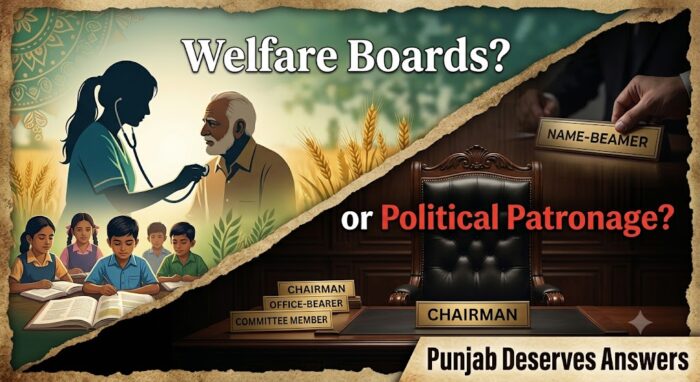
 The Punjab Government’s reported plan to appoint nearly 3,000 chairpersons to various welfare boards and committees, along with the creation of a network of approximately 38,000 office-bearers across the state, has sparked intense debate among citizens and political observers. According to recent reports, the proposed structure would extend from the state level down to districts and Assembly constituencies, creating thousands of new positions linked to welfare boards.
At a time when Punjab is struggling with unemployment, rising debt, a declining industrial base, and an ongoing exodus of youth seeking opportunities abroad, many people are questioning the priorities of the government. The concern is not merely about the creation of welfare boards; rather, it is about whether these positions are genuinely intended to improve public welfare or whether they are being used as a political tool to reward party workers and strengthen the ruling party’s grassroots network ahead of future elections.
When the Aam Aadmi Party came to power in Punjab, it promised a new style of politics based on transparency, accountability, and an end to traditional patronage systems. The party frequently criticized previous governments for distributing chairmanships and board appointments as political favors. However, the current plan appears strikingly similar to the very practices that AAP once condemned. Critics argue that instead of reducing political appointments, the government is now preparing one of the largest political appointment structures ever seen in the state’s history.
Supporters of the government may argue that welfare boards are necessary to ensure representation for different communities and to improve the delivery of government schemes. Indeed, the government has already established numerous welfare boards and maintains that these bodies help address the concerns of various social groups. However, the sheer scale of the proposed expansion raises legitimate questions. If every Assembly constituency is to have multiple boards with chairpersons, vice-chairpersons, and members, citizens have a right to ask what measurable benefits will be delivered and how the effectiveness of these boards will be evaluated.
The timing of the move is also significant. Across Punjab, thousands of educated unemployed youth continue to demand government jobs and recruitment drives. Many have spent years preparing for competitive examinations while waiting for vacancies to be filled. For these young people, the announcement of thousands of political appointments can appear deeply frustrating. They may wonder why the government can create tens of thousands of positions for party-linked office-bearers while regular government departments continue to face staff shortages and recruitment delays.
Another concern is the possibility of creating a parallel political structure that operates primarily for electoral purposes. By placing office-bearers at the constituency and district levels, the ruling party can potentially strengthen its organizational machinery throughout Punjab. While every political party seeks to expand its presence, taxpayers expect government institutions and welfare boards to serve the public rather than function as extensions of any political organization.
Transparency is therefore crucial. The government should clearly explain the criteria for appointments, the responsibilities attached to each position, and the mechanisms that will ensure accountability. Citizens deserve to know whether appointments will be based on merit, expertise, and community service or simply on political loyalty. Without transparency, suspicions of favoritism and political accommodation will continue to grow.
Punjab today needs investments, employment opportunities, better schools, improved healthcare facilities, stronger agricultural support, and policies that can stop the continuous migration of its youth. The state’s resources and administrative energy should remain focused on addressing these pressing challenges. If welfare boards genuinely contribute to social development, they should be welcomed. But if they become vehicles for political patronage, they will only deepen public cynicism about governance.
Ultimately, the people of Punjab are not opposed to welfare. They are opposed to the misuse of welfare in the name of politics. The government must demonstrate that these thousands of proposed appointments are designed to serve the public interest rather than party interests. Otherwise, many Punjabis will conclude that the promise of a new political culture has been replaced by an old formula: rewarding loyalists while ordinary citizens continue to wait for real change.
The true test of governance is not how many chairpersons are appointed, but how many lives are improved.