
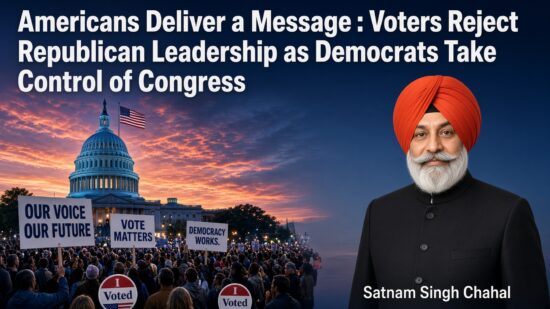
The 2026 US midterm elections have delivered a major political setback to President Donald Trump and the Republican Party, as voters across the country have turned out to express their dissatisfaction with the direction of the country, economic pressures and the administration’s policies. The election results have changed the political balance in Washington, with Democrats taking control of both the House of Representatives and the Senate, according to the reported results.
For many Americans, the midterm elections were more than a contest between two political parties. They became an opportunity to send a message to the president about the issues affecting their daily lives. Although Trump himself was not on the ballot, his leadership, public statements and policies became central issues in the election campaign.
What are ordinary Americans saying?
A common message emerging from voter surveys and election coverage is that many Americans want greater attention to the cost of living, economic security, healthcare, jobs and responsible government. People are increasingly concerned about the prices of groceries, housing, fuel, insurance and other essential expenses. For families struggling to manage household budgets, political arguments and campaign promises are less important than whether elected leaders can improve their everyday lives.
The Associated Press Voter Poll found that roughly three-quarters of voters were angry or dissatisfied with the direction of the country. Many voters also expressed concern about higher prices and blamed the Trump administration’s policies for contributing to their financial difficulties. These findings suggest that economic dissatisfaction played an important role in the election outcome.
The economy became a major issue
One of the strongest messages from voters concerned the economy. During his political campaigns, Trump repeatedly promised to strengthen the American economy, reduce costs and improve the financial situation of ordinary families. However, many voters continued to experience high prices and financial pressure.
For working-class families, small-business owners, senior citizens and middle-income households, the cost of living became an important measure of political performance. Many voters appeared dissatisfied with the gap between campaign promises and their everyday economic experiences. According to the AP Voter Poll, approximately six in ten voters who expressed concern about unusually high prices attributed them more to Trump’s policies.
Immigration and government policies also attracted attention
Immigration remained another major issue in the election. Trump’s administration had made immigration enforcement a central part of its political agenda. While some voters supported stronger border controls and stricter immigration enforcement, others expressed concerns about deportations, family separation, due process and the treatment of immigrants.
The election results do not mean that every American opposes Trump’s immigration policies. Rather, they demonstrate that voters have different expectations about how immigration laws should be enforced and how the government should balance border security with individual rights.
Democrats regain control of Congress
The election results represent a significant change in Washington’s political balance. Democrats gained control of both chambers of Congress, ending the Republican Party’s previous control of the House and Senate. Republicans suffered losses in several states and congressional districts, including areas where they had previously enjoyed considerable political support.
The results also demonstrated that voters in traditionally Republican areas were willing to support Democratic candidates. Texas, Georgia, South Carolina, Iowa and other states became important examples of the changing political landscape. The losses have raised questions within the Republican Party about campaign strategy, voter confidence and the political consequences of closely associating candidates with the president.
What did Trump say after the defeat?
Trump attempted to distance himself from the election results by pointing out that he was not personally on the ballot. He said that if he had been a candidate, Republicans would have won by a landslide. Nevertheless, the election campaign had repeatedly revolved around his presidency, and many voters treated the midterms as an opportunity to express their opinion about his administration.
The results have placed greater political pressure on the White House. With Democrats controlling both chambers, congressional investigations, hearings and scrutiny of administration decisions are likely to become important features of the remaining two years of Trump’s presidency.
A warning for the Republican Party
The Republican Party now faces important questions about its future political direction. Party leaders will have to examine why support declined among different groups of voters, including younger voters and Hispanic voters, and why some traditional Republican constituencies moved towards Democratic candidates.
The results also raise questions about whether Republican candidates should continue making their political campaigns primarily about Trump’s personality and leadership or focus more directly on local economic conditions, employment, healthcare and the concerns of ordinary Americans.
Democrats also have responsibilities
Although Democrats have gained control of Congress, the results should not automatically be interpreted as an unconditional endorsement of everything the Democratic Party stands for. Voters may have supported Democratic candidates because they wanted a change in direction or wanted stronger congressional oversight of the president.
The AP Voter Poll indicated that dissatisfaction extended beyond the Republican Party. Many voters also expressed reservations about Democrats and their ability to address the country’s problems. This means the Democratic leadership now has an important responsibility to demonstrate that it can deliver practical results rather than simply celebrate an electoral victory.
What message should American politicians understand?
Perhaps the most important lesson from these elections is that American voters expect accountability from their elected representatives. Winning an election gives politicians the authority to govern, but it does not give them unlimited public support. Voters expect leaders to listen, explain their decisions and address the problems affecting ordinary people.
The American political system is built around elections, public accountability and checks and balances. The midterm results demonstrate how voters can change the balance of power even when the president remains in office.
The bigger message from November 2026 is that no political party can take voters for granted. People may support a leader during one election and express disappointment two years later if they believe their expectations have not been fulfilled. Political power is temporary, but the responsibility to serve the public remains.
For Trump, the results represent a major congressional setback. For Democrats, they bring an opportunity as well as a test of responsibility. And for ordinary Americans, the most important question remains the same: Will their elected leaders now focus on making life more affordable, protecting democratic institutions, creating opportunities and addressing the real problems facing the country?
Ultimately, elections are not simply about who wins and who loses. They are about whether elected leaders understand what the people are telling them.
Sources: Associated Press Voter Poll, Reuters and The Guardian’s November 3–5, 2026, election coverage.
Disclaimer: This article and accompanying images are for informational and illustrative purposes only. Some visuals may be AI-generated or digitally enhanced and may not depict actual events or persons. Views expressed are based on publicly available information and analysis