
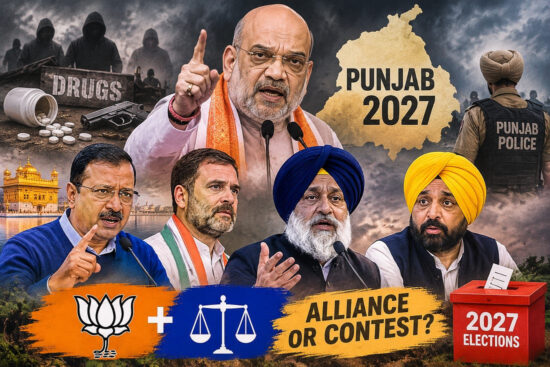
Way back on December 3, 2025, I wrote in Hindustan Times that law and order could become a defining issue of the 2027 Punjab Assembly elections. My concern was that gangsterism was no longer ordinary crime. Extortion, targeted killings and organised criminal networks were spreading fear. Ten months later, drugs and law and order have moved to the centre of Punjab’s political debate. The warning was not difficult to make; the signs were already there.
The two problems feed each other. Drug money sustains criminal networks; gangsters supply intimidation, weapons and protection. Extortion calls to businessmen, shootings in public places and attacks on police personnel strike at the credibility of the state. The killings of social media influencers raise another disturbing concern: growing intolerance and attempts at moral policing. Investigations must establish responsibility in each case, but no individual or group has the right to enforce its beliefs through violence.
It is against this background that Amit Shah’s intervention matters. He did not come to Punjab merely to burn a Ravan. His visits to the families of Parvinder Singh Jhota, Bikramjit Singh and Gulzar Singh put human faces to the drug crisis. Jhota’s killing, in particular, raises an uncomfortable question: why must social activists confront suspected drug sellers when Punjab has police, intelligence agencies and drug-control officials to do that job? The CBI has now taken over the case and secured custody of accused persons. Investigation, not competing political allegations, must establish what happened and whether officials failed in their duties.
The Ludhiana spectacle carried its own irony. In 2016, Ravneet Singh Bittu, then a Congressman, participated in burning a Chitta Ravan to condemn the SAD–BJP government. Ten years later, he stood beside Shah as another Chitta Ravan went up in flames, this time against AAP. Parties change, governments change, even political loyalties change. The Ravan of drugs remains.
AAP must answer for its policing and anti-drug record. Its enforcement drives and seizures do not by themselves settle the question of public safety. Equally, Shah is the Union Home Minister. Border security, central intelligence and interstate trafficking cannot be treated as somebody else’s problem. Punjab needs joint action and verifiable results, not competing claims of innocence.
Yet the larger political significance of Shah’s visits emerged in Delhi on October 22, when he spoke of an NDA government in Punjab in 2027. He did not merely refer to the BJP. The distinction has understandably revived speculation about a reunion with the Shiromani Akali Dal. The following day Sukhbir Singh Badal said SAD was open to alliances with parties sharing its ideology, while ruling out Congress and AAP. Punjab BJP president Kewal Singh Dhillon, however, maintained that BJP was preparing to contest all 117 seats. Back-channel talks are reported, but no alliance or seat-sharing agreement has been officially announced.
Here lies Punjab’s changing political chemistry. Before their separation over the farm laws in 2020, SAD contested 94 seats and BJP 23. The BJP now reportedly seeks a substantially larger role, while the Akalis have their own organisational interests and political baggage. Any reunion must confront the farmers’ agitation, questions surrounding leadership credibility, and the difficult issue of vote transfer. An alliance is not simply the addition of two parties’ vote shares. It can alter perceptions, but it can also revive old questions.
Arvind Kejriwal has already seized upon one of them. He mocked the prospect of Shah joining hands with Akali leader Bikram Singh Majithia while campaigning to eliminate drugs. It is a political attack, not proof of criminal wrongdoing, but it illustrates the contradictions that a renewed alliance would have to explain to voters.
For Congress, the challenge is no less serious. Pargat Singh has recently taken charge of the state unit. He must manage a party with experienced leaders, rival ambitions and a history of damaging internal disputes. The departure of former Congress MLA Raminder Singh Awla to SAD on October 25 is a reminder that candidate selection and organisational cohesion cannot be taken for granted. Congress cannot afford to spend another election fighting itself.
AAP also retains an important political asset: welfare programmes, especially free electricity, which many households value. It would be simplistic to assume that dissatisfaction with law and order automatically erases appreciation for these benefits. Public sentiment is more complicated than party slogans suggest.
Beyond these shifting alignments, Punjab faces mounting debt, unemployment, agricultural stagnation and weakening industrial competitiveness. Political parties must explain how they intend to reform governance and revive the economy, not merely who will sit with whom.
Amit Shah has stirred Punjab’s political chemistry. But an NDA remark is not an alliance agreement, a rally is not a vote, and burning Chitta Ravan is not the same as defeating drugs. The real test of 2027 should be whether any political combination can offer Punjab what successive governments have promised but failed to fully deliver: security, accountability and a credible future.