
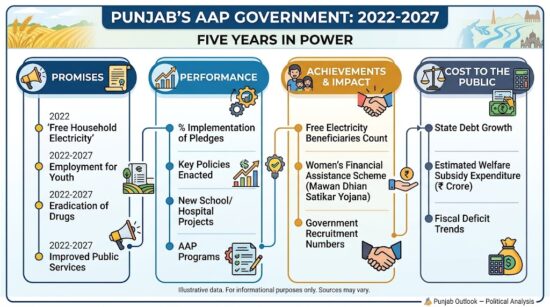
 CHANDIGARH(Punjab Outlook — Political Analysis): As Punjab approaches the final months of the Aam Aadmi Party (AAP) government’s five-year tenure, led by Chief Minister Bhagwant Mann, the time has come to examine its record beyond political speeches, election slogans and claims of achievements. The central question is whether the government has delivered the changes promised to the people in 2022, whether Punjab’s fundamental problems have improved, and whether public money has been used in a way that strengthens the state’s long-term economic and social position.
The government took office in March 2022 after securing a decisive Assembly majority on promises of clean governance, employment, action against drugs, improved public services, relief for households and a new political culture. Its term is scheduled to run until 2027. As of October 2026, the full five-year period has not yet concluded, but the available record provides sufficient grounds for a serious assessment of progress, shortcomings and unfinished commitments.
The first responsibility of any government is to translate election promises into measurable improvements in people’s lives. The AAP government has introduced and expanded several welfare measures, including free household electricity and free bus travel for women. These programmes have provided tangible benefits to eligible residents and should be recognised as part of its record.
The government has also highlighted improvements in public education, healthcare services and employment opportunities. These claims deserve examination through independent evidence, including school outcomes, hospital capacity, recruitment figures, the quality of public services and the number of jobs that represent permanent employment rather than temporary appointments or short-term contracts.
The question is not whether the government has done anything. It is whether the scale of its achievements matches the promises made and whether the benefits will remain financially sustainable after the present government leaves office.
Before the 2022 elections, AAP made extensive commitments concerning financial assistance for women, employment, the eradication of drugs, improved governance and relief for ordinary households.
Some commitments were implemented early, while others progressed more slowly. The government’s financial assistance scheme for women, Mukh Mantri Mawan Dhian Satikar Yojana, began distributing payments in July 2026, with the first instalments credited to beneficiaries. The scheme provides ₹1,000 per month to eligible women and ₹1,500 to eligible women from Scheduled Caste communities, according to the announced programme.
The introduction of this scheme is an important development for its intended beneficiaries. However, its late implementation also raises a legitimate question: why did a major election commitment take more than four years to reach the payment stage?
A fair assessment must examine both sides. The government deserves recognition for introducing a benefit, but voters are also entitled to ask why delivery was delayed, how many eligible women have actually received payments, whether payments are regular and how the programme will be financed over time.
The same standard should apply to every major promise. The government should publish a detailed status report identifying commitments that have been fulfilled, partially fulfilled, delayed or left outstanding. Such a report would allow the public to distinguish completed programmes from announcements and proposals.
Punjab’s financial position is one of the most important tests of the government’s performance. A government may provide immediate relief through subsidies and welfare schemes, but it must also ensure that sufficient resources remain available for infrastructure, agriculture, education, healthcare, salaries, pensions and economic development.
A July 2026 report by The Indian Express estimated that the AAP government’s expenditure on subsidies and welfare measures could exceed ₹1 lakh crore over its five-year tenure. The report identified electricity subsidies as the largest component, alongside free bus travel for women and other welfare programmes.
The same report placed the projected cumulative power-subsidy expenditure by the end of the 2026–27 financial year at ₹95,522 crore. This figure includes the budgeted allocation for 2026–27 and should not be mistaken for expenditure already paid by October 2026.
These figures demonstrate the scale of the state’s commitments. They do not, by themselves, establish that welfare spending is wasteful. Subsidies can protect vulnerable households and support particular economic sectors. The crucial questions are whether benefits are appropriately targeted, whether the expenditure is affordable and whether the government is generating sufficient revenue and economic growth to sustain its commitments.
The 2026–27 Punjab Budget, analysed by PRS Legislative Research, projected expenditure of ₹1,66,711 crore excluding debt repayment, a revenue deficit of ₹21,955 crore and a fiscal deficit of ₹39,971 crore. These are budget estimates, not final audited results. Nevertheless, they underline the continuing pressure on public finances.
The government must explain how Punjab will balance welfare commitments with development spending, manage borrowing and meet its future financial obligations. Opposition parties, too, should provide credible alternatives rather than relying solely on criticism.
The performance of the government must also be assessed through the functioning of the institution that scrutinises its decisions: the Punjab Legislative Assembly.
A June 2026 study by the PANJ Foundation reported that the 16th Punjab Assembly met for approximately 63 days between 2022 and 2026. The study also found that 60 of 61 Bills introduced between March 2022 and December 2025 were passed on the day of introduction.
These findings raise important questions about the time available for legislative debate and scrutiny. Passing a Bill quickly does not automatically mean that it is defective, and some legislation may require urgent consideration. However, laws affecting public finances, administration, rights and social policy deserve adequate examination.
The Assembly should provide legislators with Bills in advance, strengthen committee scrutiny and ensure that proposed laws receive meaningful debate. Opposition members should have sufficient opportunity to question provisions, identify unintended consequences and propose amendments.
The latest October 2026 session should be examined as part of this wider four-and-a-half-year record. Whether six Bills were passed during the particular session, their individual purposes and the time devoted to each must be confirmed through official Assembly records before drawing final conclusions about their merits.
A complete five-year assessment should also consider the total number of Bills passed, the number referred to committees, the frequency of legislative sittings, questions answered by ministers and the extent to which government assurances were implemented.
The financial cost of Assembly sessions is another issue that warrants transparency. A figure of ₹80–85 lakh per sitting day has been cited in earlier public discussion, but the actual cost of the October 2026 session must be established through official expenditure records.
If that estimate were applied to three sittings, the illustrative total would be ₹2.40–2.55 crore. This is a calculation based on an estimate, not a verified account of the session’s expenditure.
The Assembly administration should publish the actual cost, explaining expenditure on security, staffing, transport, facilities and other operating arrangements. It should distinguish costs directly attributable to the session from regular administrative expenses.
More broadly, taxpayers should be able to see the expenditure associated with every session alongside its legislative output. Such transparency would help citizens assess whether adequate time and resources are being devoted to the scrutiny of government decisions.
The drug problem remains a major public concern in Punjab. Success in this area should be measured through credible indicators: changes in drug availability, arrests and convictions of major traffickers, action against alleged official complicity, access to treatment and rehabilitation, and the long-term recovery of affected communities.
Arrests and raids alone cannot demonstrate that the problem has been solved. The government must explain whether enforcement has disrupted supply networks, whether investigations have resulted in convictions and whether rehabilitation services are accessible to those who need them.
Employment is equally important. Young people need sustainable opportunities in Punjab so that migration becomes a choice rather than a perceived necessity. The government should disclose verified figures for jobs created, vacancies filled, recruitment delays, private-sector investment and the quality of employment generated.
A five-year performance review should compare these outcomes with the promises made in 2022. It should also examine what remains unresolved and what additional action is required.
The government’s claims concerning education and healthcare should be assessed through outcomes rather than publicity. Relevant indicators include school enrolment and learning levels, teacher vacancies, classroom conditions, hospital staffing, medicine availability, waiting times and access to treatment in rural areas.
Similarly, Punjab’s agricultural future requires more than temporary relief. Farmers need predictable policy, water conservation, improved soil health, viable crop diversification, stronger agricultural markets and practical alternatives where paddy cultivation places excessive pressure on groundwater.
The government should present evidence of progress in each area and explain where its policies have fallen short. Where programmes have worked, the lessons should be retained and expanded. Where implementation has failed, the reasons should be made public and corrective action taken.
An important part of the five-year assessment must examine not only what the government passed but also what it failed to complete.
Some policy proposals may have been delayed because of legal objections, financial constraints, disagreements with the Union government or the need for further consultation. Others may not have progressed because of administrative shortcomings or changing political priorities. These circumstances should be distinguished rather than treated as equivalent.
The government should publish a list of major proposed reforms and Bills that were withdrawn, delayed, referred to committees or left pending. For each, it should explain the original objective, the reason for delay and whether the measure remains part of its policy programme.
The same review should identify legislation and reforms that could have benefited Punjab but did not reach implementation. Specific Bills must be named only after their status and intended benefits have been verified. This would make the assessment more credible and help citizens understand the difference between a missed opportunity and a proposal that was impractical or legally unsound.
Before seeking another mandate, the government should place a comprehensive five-year performance report before the public. That report should cover:
- The original election promises and their verified implementation status.
- Jobs promised, jobs created and recruitment completed.
- Progress in tackling drugs and improving law and order.
- Education and healthcare outcomes.
- Public borrowing, interest payments, subsidies and outstanding liabilities.
- Welfare payments actually received by eligible beneficiaries.
- Bills passed, legislative scrutiny and the functioning of Assembly committees.
- Major promises and reforms that remain incomplete.
The report should include dates, financial figures, independent evaluations where available and clear explanations of delays. Opposition parties should also be encouraged to present evidence-based assessments and realistic alternatives.
The AAP government’s tenure should not be judged entirely by its supporters’ claims or its opponents’ accusations. Both achievements and failures must be examined against verifiable evidence.
Free electricity, free bus travel for women and the introduction of financial assistance for eligible women are significant elements of the government’s welfare record. At the same time, the financial sustainability of subsidies, the state’s fiscal position, the implementation of employment commitments, the continuing drug challenge and the quality of legislative scrutiny demand serious examination.
As Punjab approaches the 2027 Assembly elections, citizens deserve clear answers about what has changed since March 2022, what remains unfinished and what the next government will inherit.
The ultimate test of five years in power is not the number of announcements, political rallies or Bills passed. It is whether people’s lives have improved, public institutions have become more accountable and Punjab is better prepared economically and socially for the future.
Sources for verification: PRS Legislative Research, 16th Punjab Legislative Assembly (2022–2027) and Punjab Budget Analysis 2026–27; The Indian Express, June and July 2026, on Assembly functioning and subsidy expenditure; and official Punjab government records on welfare schemes, recruitment and public finances.
Editorial note: This assessment reflects the available record as of October 2026. The government’s five-year term has not yet concluded, and final tenure-wide expenditure and performance figures will require updated official and audited data.