
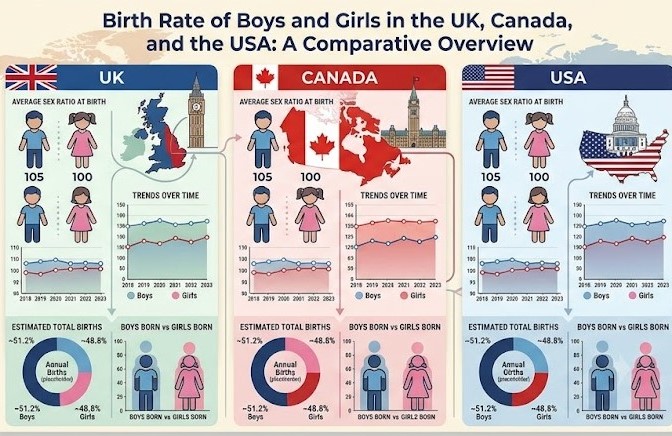
 The natural biological pattern of human births across the world shows a relatively stable sex ratio at birth, where slightly more boys are born than girls. On average, the global sex ratio ranges from about 103 to 107 boys for every 100 girls. This small imbalance is considered a natural biological phenomenon, and it is broadly consistent across most countries, including developed nations such as the United Kingdom, Canada, and the United States. However, demographic research in recent decades has examined whether this balance changes within certain communities due to cultural, social, or economic influences.
In Canada, national-level statistics generally show a sex ratio close to the global norm, around 105 boys per 100 girls. Studies using large administrative birth datasets over extended periods have mostly confirmed this stability in the overall population. However, some academic research has explored whether specific immigrant communities show variations in sex ratios under certain conditions, such as family composition (for example, families with two or more children) or birth order. These findings are often complex and debated, as they can be influenced by multiple factors including small sample sizes, migration patterns, and statistical variability. While some studies have reported unusual patterns in particular subgroups, researchers caution against drawing broad or definitive conclusions without considering broader social and methodological contexts.
In the United States, the overall sex ratio at birth is also stable and closely aligned with global averages, typically around 105 boys per 100 girls. The U.S. has a large and diverse population, and research has occasionally examined whether sex ratios differ among certain ethnic or cultural groups. Some studies have suggested minor deviations in specific subpopulations under certain conditions, but the overall national pattern remains consistent with biological expectations. Public health experts emphasize that the U.S. data does not show large-scale or systematic deviations in sex ratio trends at the national level.
Similarly, in the United Kingdom, the sex ratio at birth remains stable, with approximately 105 boys born for every 100 girls. The UK Office for National Statistics has tracked births for decades, and the data consistently shows only minor natural fluctuations. As in other Western countries, occasional academic studies have explored demographic patterns within certain communities, but the overall findings do not indicate any significant nationwide imbalance.
Across all three countries—Canada, the USA, and the UK—the key demographic conclusion is that the sex ratio at birth remains largely stable and biologically consistent. Where variations appear in academic studies, they are typically small, context-specific, and often subject to ongoing debate among demographers. Experts generally stress caution in interpreting subgroup-level statistics, as such patterns can be influenced by many factors including cultural preferences, access to healthcare, reporting methods, and random variation in smaller datasets.
Overall, while the subject of sex ratio at birth is an important area of demographic research, the broader evidence from developed countries shows no major deviation from natural biological patterns at the national level. Any discussion of differences within communities must therefore be handled carefully, with attention to scientific uncertainty and avoidance of broad generalizations.