
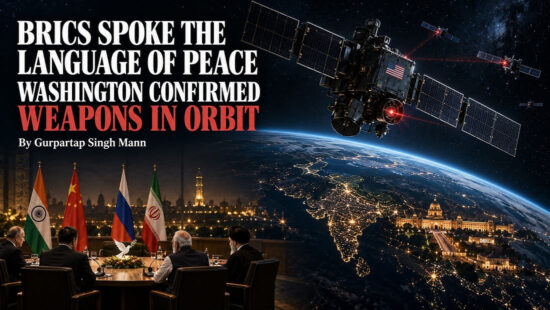
Barely a day after the BRICS Summit concluded in New Delhi, the United States made an extraordinary admission: American weapons are already orbiting the Earth. Nothing was revealed about their number, design, location or destructive capacity. Yet those few carefully chosen words were sufficient to announce that global military competition had crossed another dangerous frontier.
US Secretary of the Air Force Troy Meink stated verbatim:
“The United States has on-orbit space control weapons capable of defending the Joint Force against hostile adversary action.”
The statement appears in the official account published by the US Space Force. Meink, however, declined to reveal the nature, number or precise capabilities of these secretive weapons. More importantly, he later acknowledged that the phrasing was “very well thought out” and that revealing their existence was necessary for deterrence. This was, therefore, neither a careless disclosure nor an accidental revelation of a classified programme. Washington wanted the world to hear it. Whether the world interprets it as legitimate deterrence or as a carefully worded global threat is now for national capitals to decipher.
Who are these weapons meant for? Surely not aliens on Mars or Venus, nor rogue meteors approaching Earth. They have been positioned for conflicts between nations. That does not necessarily mean America has stationed bombs in space to rain down upon cities. “Space-control weapons” could include sophisticated electronic jammers, laser dazzlers, cyber systems or manoeuvrable satellites capable of approaching, disabling or destroying another satellite. The Space Force says that space control can involve “disruption, degradation and even destruction” for either offensive or defensive purposes. The exact capability, however, remains classified.

The immediate targets may therefore be satellites, but the ultimate battlefield remains Earth. Modern armies depend upon satellites for navigation, secure communications, missile warning, intelligence, drone operations and precision targeting. Neutralise those satellites and an advanced military could become paralysed, partially blind, deaf and disoriented even before the first conventional missile is fired.
The timing gives this dramatic disclosure another significant dimension. Paragraph 46 of the BRICS New Delhi Declaration had just supported the peaceful use of space and called for the prevention of an arms race and weaponisation in outer space. China, Russia, India and Iran were together in Delhi, speaking of multipolarity, reforming global institutions and strengthening the collective voice of the Global South.
BRICS did not create a common currency or formally declare war upon the dollar. It did, however, promote trade in national currencies and explore payment arrangements capable of gradually reducing dependence upon Western-controlled financial channels. Its declaration supported deeper economic integration and greater representation for emerging economies in powerful global institutions. Such initiatives inevitably attract Washington’s attention.
There is no public evidence that the American announcement was ordered as a direct response to BRICS. It was made at a scheduled military conference and was probably prepared well in advance. Nevertheless, strategic, well phrased communication is judged not only by the intention of the sender but also by how its message is received. One day BRICS spoke against the weaponisation of space; the next, Washington confirmed that its weapons were already there. The contrast was too powerful to be ignored.
The message was principally directed at Beijing and Moscow. China accused the United States of expanding its military build-up and “preparing for war in outer space”. Beijing urged Washington not to transform space into another dangerous battlefield. China’s reaction was immediate and official. Russia was even sharper. Foreign Ministry spokesperson Maria Zakharova warned of “catastrophic consequences for humanity” and enormous risks to the economic systems on Earth that depend upon satellites. Moscow also promised to raise the issue at the United Nations.
The announcement will not begin a space-arms race; that silent race had already begun. It will, however, legitimise and accelerate it. China and Russia will cite the American admission to justify their own weaponised space capabilities. India, which demonstrated its anti-satellite capability through Mission Shakti in 2019, will also have to invest more heavily in protecting its valuable satellites and developing credible counter-space deterrence.
This is why the announcement is not an ordinary defence story. Peel away its many layers and one finds deterrence, technological supremacy, military secrecy, BRICS, China, Russia, alternative financial systems and the approaching struggle for the ultimate strategic high ground. Washington did not disclose enough to reveal its hand. It disclosed just enough to make the world nervous.
The underlying message sounded unmistakable: the world may discuss multipolarity on Earth, but America intends to remain the dominant power above it.