
In the spring of 1993, as Deputy Commissioner of Amritsar, I dealt with two hijacked Indian Airlines aircraft at Raja Sansi within a month. On 27 March the hijacker of IC-439 surrendered, and on 24–25 April the NSG stormed IC-427; neither aircraft was allowed to take off. On Christmas Eve 1999, IC-814 stood on the same tarmac for 47 minutes and nobody stopped it leaving. Seven days later, India freed Masood Azhar at Kandahar.
On 14 September 2026, Pakistan’s Federal Investigation Agency (the FIA) entered Maulana Masood Azhar, founder of the Jaish-e-Mohammed (JeM), in its 2026 Red Book of most-wanted terrorists as a fugitive, and raised the reward for his arrest by PKR 20 lakh, to PKR 70 lakh. The listing comes weeks before the October plenary of the Financial Action Task Force (FATF, the Paris watchdog on money laundering and terror financing), and Pakistan, off the FATF grey list since October 2022, means to stay off it.
Indian television has had a busy day with this, and not without cause. Islamabad says Azhar slipped across the Durand Line into Afghanistan in May 2019. Yet in March 2019 its own Foreign Minister, Shah Mahmood Qureshi, told CNN that Azhar was in Pakistan and too unwell to leave his house. The Taliban say, and said again last week, that he is not in Afghanistan. Indian intelligence sources place him in Nawabshah, in Sindh. And the FIA’s own notice gives his address as Kousar Colony, B Model Town, Bahawalpur.
So yes, Pakistan is lying through its teeth. But Azhar was once in an Indian jail, and we let him go.
Our Prisoner, Their Asset
He was picked up almost by chance at Khanabal, near Anantnag, in February 1994, travelling on a Portuguese passport, and held in Srinagar, then Tihar, then Kot Balwal jail in Jammu. His handlers valued him more than we did, and tried three times to get him back: kidnapped tourists in Delhi in 1994, kidnapped trekkers near Pahalgam in 1995, a tunnel under Kot Balwal in 1999. All three failed. The fourth attempt, on Christmas Eve 1999, succeeded, and it succeeded first at an airport I knew well.
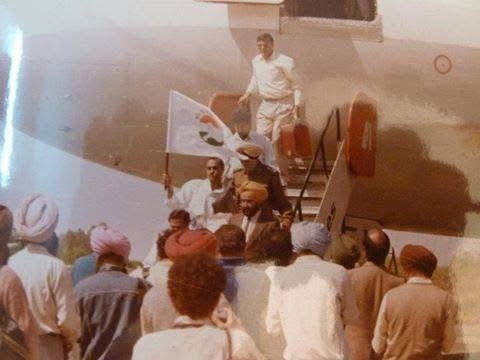
27 March 1993, Raja Sansi Airport, Amritsar. The hijacker of Indian Airlines IC-439 surrenders, with no casualty, after negotiations led by the author, KBS Sidhu, then Deputy Commissioner, Amritsar, and SSP Hardeep Singh Dhillon. The author is seen in the picture; DGP K.P.S. Gill received the surrendering hijacker.
Chocks Away at Raja Sansi
In the spring of 1993, as Deputy Commissioner of Amritsar, I was on the tarmac at Raja Sansi (Amritsar’s international airport) for two hijackings. On 27 March the lone hijacker surrendered after a long negotiation, most of it carried by the SSP, Hardeep Singh Dhillon, and me. On 24–25 April, IC-427 from Srinagar landed with a hijacker carrying two loaded pistols; after eighteen hours, NSG (National Security Guard) commandos flown in from Delhi stormed the aircraft and killed him, and nobody else was hurt. Both times we worked to one rule: a hijacked aircraft does not take off, at no cost, repeat, at no cost.
By December 1999 I was no longer at Amritsar. I had been transferred out in August 1996, after a four-year stint as Deputy Commissioner of a district that then took in what is now Tarn Taran district, and after a year-long MA Economics course at the University of Manchester (1996–97) I was back in Chandigarh. Six years after those two hijackings, IC-814 from Kathmandu, held by five hijackers and short of fuel, circled Amritsar for about forty minutes and then stood on that same tarmac for 47 minutes. In all that time, nobody blocked the runway or disabled the aircraft. The tanker dawdled, the hijackers sensed a trap, and the aircraft left without clearance.
The people involved give different accounts of who failed. A.S. Dulat, then Chief of RAW (the Research and Analysis Wing), has said that no clear instruction ever reached the Punjab Police; by his account, the Home Minister and the Prime Minister’s most senior advisers were in the loop, and nobody decided anything. He says the Punjab DGP, Sarabjit Singh, told him the Chief Minister did not want bloodshed in Amritsar and that the aircraft could go if it had to. Sarabjit Singh tells it differently. His commandos had AK-47s and no anti-hijack training; they had no count of the hijackers and no way into the aircraft. He says he told the Intelligence Bureau Director, Shyamal Datta, that his men were ready but casualties would be heavy. KPS Gill, retired by then, said he rang the Cabinet Secretary, Prabhat Kumar, twice to offer his experience of the two 1993 cases, and neither call was returned.
“Chocks away” is the aviator’s call that the wheels are free to roll. At Raja Sansi that evening nobody gave that call, and nobody refused it either.
Whom Were We Saving?
Once the aircraft left Indian soil, the men in Delhi had only bad choices left. Lahore first switched off its runway lights, then let the aircraft land and refuel. At Dubai the hijackers let 13 women and 11 children off, and the body of Rupin Katyal, stabbed by the hijackers, was taken off with them. At Kandahar, India did not recognise the Taliban regime, which complicated the negotiations.
From 25 December, relatives of the hostages gathered outside the Prime Minister’s residence at 7, Race Course Road, and on one day some tried to force their way in.
One passenger’s name was missing from the published list. Shashi Bhushan Singh Tomar, a RAW officer, was aboard; Dulat’s book confirms it. He was also the brother-in-law of N.K. Singh, then a Secretary in the Prime Minister’s Office. It has been alleged, but never shown, that his presence made Delhi more cautious at Amritsar. I record the allegation because the question of whom the state was trying to save should be asked in public. I cannot answer it.
India struck the bargain on 31 December. The hijackers had come down from 36 prisoners and $200 million to three men. Farooq Abdullah, then Chief Minister of Jammu and Kashmir, opposed releasing Azhar; he later said the decision had been thrust on his government by the Centre, and that he believed even L.K. Advani had been against it. External Affairs Minister Jaswant Singh flew to Kandahar with Azhar, Omar Sheikh and Mushtaq Ahmed Zargar aboard. That evening 154 hostages and the crew came home, hours before the new millennium.
Soft State, Hard Bill
Azhar set up the JeM in March 2000, and the bill arrived in instalments. India laid the attack on Parliament on 13 December 2001 at the door of the JeM and the Lashkar-e-Taiba (LeT). Pathankot and Uri followed in 2016, and Pulwama on 14 February 2019, when forty CRPF men were killed. Omar Sheikh went on to the murder of Daniel Pearl. For the record, 26/11 was a Lashkar operation, and loose attribution helps only Pakistan.
Gunnar Myrdal, the Swedish economist, coined the phrase “soft state” in Asian Drama (1968) for governments that make rules and lack the will to enforce them. On hostages, India in 1999 fitted the description, and the record crossed party lines. In December 1989 the Union Government freed five militants in exchange for Rubaiya Sayeed, the Home Minister’s daughter, in a kidnapping in which Zargar had a hand. Kandahar repeated the habit ten years on.
With hindsight, I think the ministers at Kandahar faced a choice that had already been made for them. The soft decision was taken at Amritsar, and it was a chain of non-decisions: a Crisis Management Group that deliberated, a state government that, by one account, wanted no blood on its tarmac, a police chief who would not act without an order, an NSG that waited for clearance, and a Cabinet Secretary who did not return a call. Each of them could say he had done his part. None of them kept the aircraft on the ground.
The families got their people back, and I do not grudge them a single day of those lives. The price was paid by others, at Parliament House, at Pathankot and on the highway at Pulwama, and none of them was consulted.
What the Bounty Does Not Buy
At the October plenary, India’s delegation should hold up the FIA’s notice in one hand and the Taliban’s denial in the other, and ask Pakistan which one is false.
At home, the Cabinet Committee on Security adopted an anti-hijack policy in 2005, and Parliament passed a new Anti-Hijacking Act in 2016. Paper, however, is not nerve; the rule of 1993 lived in a ground team that was willing to enforce it. On 27 December 1999 the government ordered an inquiry into why IC-814 was allowed to leave Amritsar. Nearly twenty-seven years later, the country has not been told, in any detail I know of, what that inquiry found or who answered for it.