
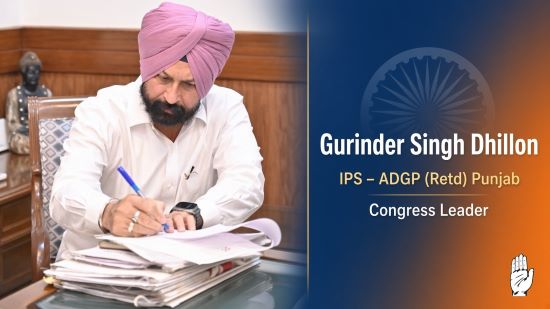
 Chandigarh: Former senior Punjab Police officer Gurinder Singh Dhillon has raised an important question about the use of language in government offices, urging the Punjab government to ensure that Punjabi is given greater prominence in official work across the state.In a social media post addressed to Chief Minister Bhagwant Mann and the Chief Minister’s Office, Dhillon pointed out what he described as a contradiction between Punjab’s linguistic identity and the language commonly used in government offices.
“Punjab’s language is Punjabi,” Dhillon said, questioning why government and semi-government offices across the state continue to rely heavily on English for computer-based official work.
His intervention has brought the issue of Punjabi in government administration back into public discussion. Dhillon questioned whether the state bureaucracy could be directed to use Punjabi more extensively in official computer work and day-to-day administrative functioning.
The former IPS officer’s argument goes beyond the question of language preference. It raises concerns about accessibility, administrative identity and the relationship between government institutions and ordinary citizens. For many people in Punjab, particularly those living in rural areas, Punjabi remains the primary language of communication and interaction with government authorities.
The use of English-dominated computer systems and official documentation can potentially create an additional barrier for citizens who are more comfortable conducting official business in Punjabi. Supporters of greater use of Punjabi argue that government services should be available in the language most widely understood by the state’s population.
Dhillon’s comments also raise the question of whether Punjab has fully implemented the spirit of its language policy in the digital era. While Punjabi is the official language of the state, government administration increasingly depends on computer systems, online portals, databases and digital correspondence. Ensuring that these systems function effectively in Punjabi would therefore require more than simply translating printed documents.
It would involve developing Punjabi-language software interfaces, official templates, digital forms, databases, websites and administrative applications, along with adequate training for government employees.
The issue is particularly relevant as Punjab’s government services continue to move online. Citizens increasingly interact with departments through digital portals for certificates, land records, welfare schemes, registrations, applications and other public services. If these platforms are predominantly designed around English, the language gap can continue even when the physical government office is located in Punjab.
Dhillon’s intervention therefore presents the Mann government with an opportunity to examine the issue comprehensively rather than treating it simply as a symbolic language question.
A practical policy could require all major government and semi-government digital platforms to provide full Punjabi-language functionality alongside English. Official correspondence addressed to citizens could also be made available in Punjabi, while employees could be encouraged and trained to conduct routine administrative work in Punjabi wherever practical.
At the same time, English remains important for communication with central government institutions, international organisations, technical agencies and other jurisdictions. The issue, therefore, need not be framed as Punjabi versus English. Rather, it could be about ensuring that Punjabi is not disadvantaged within Punjab’s own administrative system.
Dhillon, a 1997-batch IPS officer who served in senior positions including ADGP Law and Order, took voluntary retirement from the police service in 2024 after about three decades of service.
His latest remarks are likely to renew the debate over whether Punjab’s official language is receiving adequate practical importance within the state’s bureaucracy and digital administration.
The larger question for the Punjab government is straightforward: If Punjabi is the language of Punjab, should a citizen have to depend on English to access his or her own government?
The answer could determine whether Punjab’s language policy remains largely symbolic or becomes a genuinely functioning part of modern public administration