
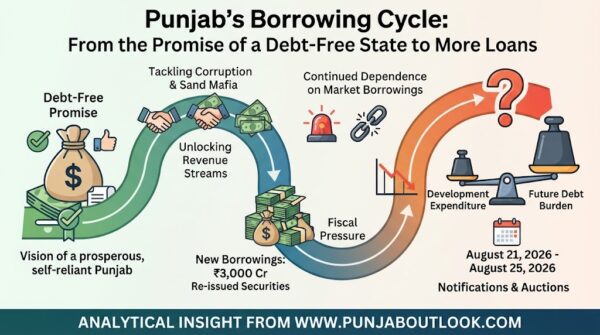
Chandigarh: When the Aam Aadmi Party came to power in Punjab, one of its most politically powerful promises was to put the state on the path towards a debt-free Punjab. The party repeatedly spoke about ending corruption, tackling the alleged sand mafia and unlocking thousands of crores in additional revenue for the state.But the latest Punjab Government Gazette notifications raise a difficult question: if Punjab was supposed to become financially stronger, why does the state continue to return to the borrowing market?
Two Finance Department notifications dated August 21, 2026, show Punjab re-issuing two state government securities with a combined notified amount of ₹3,000 crore. One notification concerns the re-issue of 7.02% Punjab State Government Securities 2030 for ₹1,500 crore, while the other concerns the re-issue of 7.62% Punjab State Government Securities 2039 for another ₹1,500 crore. Both notifications state that the borrowing is intended to finance part of the capital expenditure of Plan Schemes and other development schemes under execution. The auctions were scheduled through the Reserve Bank of India on August 25, 2026.
The documents themselves are important because they provide an official record of Punjab’s continued dependence on market borrowing. The government may legitimately borrow for productive capital expenditure, but the larger concern is whether borrowing is becoming a routine mechanism for managing the state’s financial obligations rather than a carefully controlled tool for investment and development.The political contrast with the AAP’s original promises is therefore becoming increasingly difficult to ignore.The party had presented itself as an alternative to the traditional political establishment and promised a new model of governance. Punjab’s voters were given the impression that leakages would be plugged, corruption would be tackled and additional revenue would be generated instead of repeatedly burdening the state with more debt.
Yet Punjab continues to face a difficult fiscal reality.The question is not whether the government should ever borrow. Every government may need to borrow for productive infrastructure and long-term capital investment. The real question is whether every new loan is creating an asset, generating future revenue or strengthening Punjab’s productive economy—or whether borrowing is increasingly being used to bridge recurring financial pressures.This distinction matters because every borrowing today creates a responsibility for tomorrow. Government securities have to be serviced through future budgets, meaning that today’s borrowing can reduce the fiscal space available to future governments for education, healthcare, infrastructure, agriculture and employment.
The latest notifications illustrate that point clearly. One of the securities being re-issued will mature in 2030, while the other carries a maturity extending to 2039. In other words, the financial consequences of decisions taken today will remain with Punjab for years.At the same time, Punjab’s employees and pensioners are raising serious financial concerns of their own. The continuing demand for implementation of the Old Pension Scheme and other employee-related issues demonstrates that the government’s financial choices are being closely watched by those who depend on the state for their legitimate service benefits.This creates an uncomfortable contradiction. The government must find resources to meet the legitimate demands of its employees, but it must also explain why Punjab’s finances continue to require repeated borrowing.
Where is the promised revenue revolution?
Where are the additional revenues that were supposed to come from tackling illegal mining and other leakages? Where is the comprehensive strategy for expanding Punjab’s tax base? Where is the large-scale industrial investment capable of generating sustainable employment and tax revenue? Where is the long-term plan to reduce the state’s dependence on debt?These are not merely opposition questions. They are questions that Punjab’s taxpayers, employees, farmers, young people and future generations have a right to ask.
The government can point to development expenditure and argue that loans are being used for capital projects. That argument deserves consideration. But it should also publish a transparent loan-to-development accounting statement showing how much is borrowed, where each rupee is spent, what assets are created, what economic returns are expected and how the debt will ultimately be serviced.Punjab cannot afford a situation in which every financial problem is answered with another borrowing notification.The state needs a fundamentally different fiscal approach: increase own-source revenue, reduce unnecessary expenditure, widen the productive economic base, attract investment, improve tax compliance, stop revenue leakage and borrow only when borrowing creates measurable long-term value.
Public money should also be protected from avoidable expenditure. If the government can find resources for publicity, political promotion and non-essential administrative spending, it must demonstrate the same urgency when dealing with employee obligations, public services and revenue-generating infrastructure.The government should also be honest with the people about the actual debt trajectory. Instead of presenting each loan as an isolated financial transaction, Punjab needs a consolidated public dashboard showing its outstanding debt, annual interest burden, principal repayments, fresh borrowings and the purpose of every major loan.The political promise of a debt-free Punjab cannot be judged by slogans. It must be judged by numbers.The latest ₹3,000-crore borrowing notifications may be presented as financing for development schemes, and that distinction is important. But they also underline a larger reality: Punjab remains dependent on borrowing, and the government must explain how and when that cycle will be broken.
Chief Minister Bhagwant Mann and Finance Minister Harpal Singh Cheema therefore owe Punjab a clear answer—not simply about the latest ₹3,000 crore, but about the state’s entire fiscal strategy.What is the roadmap to increase Punjab’s own income? What is the plan to reduce unnecessary expenditure? How much additional debt will Punjab take during the remainder of this government’s tenure? And, most importantly, when will the promise of putting Punjab on a genuinely debt-reduction path become a measurable financial reality?Punjab does not need another political promise. It needs a credible revenue plan, disciplined expenditure, productive investment and a transparent roadmap to reduce its debt burden.Because a loan can finance development—but a continuous dependence on loans cannot become Punjab’s development model.
Disclaimer: This article and accompanying images are for informational and illustrative purposes only. Some visuals may be AI-generated or digitally enhanced and may not depict actual events or persons.Views expressed are based on publicly available information and analysis