
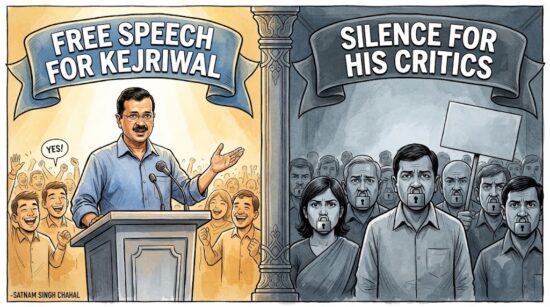
 Punjab’s digital democracy cannot survive a system where censorship is condemned when it hurts the powerful but tolerated when it targets the opposition.There is something deeply disturbing about the politics of free speech in Punjab today: everyone appears to support freedom of expression until someone actually exercises it against them.The controversy surrounding restrictions on the social-media account of Aam Aadmi Party leader Arvind Kejriwal has rightly triggered questions about freedom of expression. But those questions cannot be asked selectively. The Aam Aadmi Party cannot demand democratic protection for its own political leadership while remaining silent when opposition leaders, journalists and independent digital platforms face cyber complaints, copyright actions or other forms of pressure.
That is not a defence of democracy. That is the politics of convenience.The Punjab Legislative Assembly should have the courage to confront this contradiction directly.If restricting Arvind Kejriwal’s social-media account is unacceptable, then the use of government machinery or cyber mechanisms to target opposition voices must also be unacceptable. If political criticism deserves protection when AAP is the victim, it deserves precisely the same protection when AAP is the subject of criticism.There can be no two definitions of freedom of speech.
The allegations surrounding cyber complaints against opposition leaders, including those whose social-media accounts have challenged the Punjab government, deserve serious scrutiny. The public has a right to know why such complaints were filed, who authorized them, what material was considered unlawful and whether the law was being used to address genuine violations—or to create fear among political opponents.
And then comes an even more troubling question: the reported use of copyright strikes involving official AAP Punjab social-media handles against journalists and web channels.If a genuine copyright violation has occurred, the law provides remedies. But copyright law must never become a backdoor censorship mechanism.A journalist should not have to choose between reporting the truth and risking a digital takedown. An independent web channel should not have to wonder whether critical coverage will trigger a complaint from a powerful political organization. And an opposition politician should not have to calculate the legal consequences of every post simply because that post criticizes the government.
That is how a chilling atmosphere develops—not necessarily through one dramatic act of censorship, but through repeated complaints, threats, takedowns and institutional pressure.Punjab has a proud tradition of political debate. Governments have been criticized. Chief ministers have been challenged. Ministers have been questioned. Journalists have exposed corruption and administrative failures. Opposition parties have survived precisely because Punjab’s political culture has historically allowed dissent.That democratic culture must not be replaced by digital intimidation disguised as legal procedure.
The Aam Aadmi Party came to power promising a different kind of politics. It cannot now become comfortable with the very practices it once condemned. A government that believes its mandate is strong should not fear criticism. A confident government answers criticism with facts; an insecure government tries to silence the critic.The same principle applies to every political party.
NAPA does not defend free speech because it supports Arvind Kejriwal. NAPA defends free speech because without free speech there is no meaningful democracy.Today it may be Kejriwal’s account. Tomorrow it could be an opposition MLA. The day after tomorrow it could be a journalist, a farmer, a student, an activist or an ordinary Punjabi citizen.Once governments and political parties normalize selective suppression, nobody can predict where the line will eventually be drawn.
The Punjab Legislative Assembly should therefore stop treating this as merely another political quarrel. It should demand transparency about cyber complaints involving political opponents and scrutiny of any alleged misuse of copyright mechanisms against journalists and digital media.The question before Punjab is much bigger than one social-media account.Who controls the digital conversation?Is social media still a democratic space where citizens can question those in power—or is it slowly becoming another arena where political power determines whose voice gets heard?The answer will tell us much about the future of democracy in Punjab.NAPA’S Warning: Democracy can not have a “VIP” version of free speech.Satnam Singh Chahal, Executive Director of the North American Punjabi Association (NAPA), issued a blunt warning:
“Let me make this absolutely clear:
NAPA will not accept a political system in which freedom of speech is treated as a privilege for the powerful and a liability for their critics. If restrictions on Arvind Kejriwal are wrong, then restrictions against opposition leaders are wrong. If journalists deserve protection when they report against Delhi, they deserve exactly the same protection when they report against Punjab. There cannot be one Constitution for the ruling party and another for its opponents.”
“AAP cannot stand in the Assembly and demand freedom for its own leader while ignoring allegations that its own political and governmental machinery has been used against critics. That is not principled politics. That is selective outrage. Free speech cannot be switched on when it benefits you and switched off when it embarrasses you.”Chahal added:
“We challenge every political party in Punjab to answer one simple question: Are you prepared to defend the freedom of speech of the person who criticizes you? If the answer is yes, then you believe in democracy. If the answer is no, then you do not want freedom of speech—you want freedom from criticism.”
“Punjab has sacrificed too much for democratic rights to allow political parties to turn cyber complaints, copyright mechanisms or institutional power into weapons against dissent. NAPA will stand with the right to question, the right to criticize and the right to publish. Governments come and go. Political parties rise and fall. But the democratic right to speak must remain.”
The final Question
The people of Punjab should not be asked to choose between free speech for the ruling party and free speech for the opposition.They should demand free speech for everyone.Because the moment a government begins deciding whose voice deserves protection and whose voice deserves punishment, democracy has already begun to lose its voice.Free speech is not a favour from the government. It is not a gift from a political party. It is not a privilege reserved for leaders.
It is a right.
And NAPA will defend that right whether the person speaking is powerful enough to command headlines or powerless enough to stand alone.
Disclaimer: This article and accompanying images are for informational and illustrative purposes only. Some visuals may be AI-generated or digitally enhanced and may not depict actual events or persons.Views expressed are based on publicly available information and analysis.