
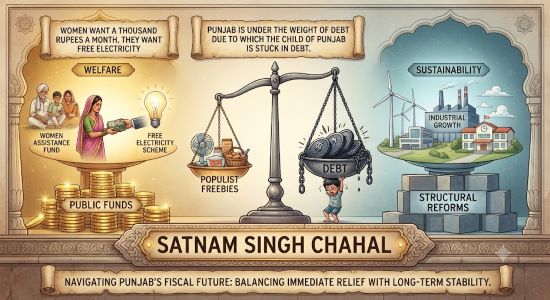
 The discourse surrounding Punjab’s economic trajectory frequently returns to a complex dilemma: balancing the immediate socio-economic needs of citizens through populist welfare measures against the long-term dangers of mounting public debt. As highlighted in the ongoing political and economic debate, the heavy reliance on borrowed funds to finance freebies such as subsidised or free electricity and direct financial assistance programs has pushed the state’s fiscal framework under severe strain.
The Weight of Legacy Debt and Financial Sustainability
Punjab has historically carried a substantial debt burden, a consequence of structural economic shifts, legacy liabilities, and ongoing fiscal deficits. When a state government continuously relies on market borrowings and loans to fund recurrent expenditures rather than capital investments (such as infrastructure that generates long-term revenue), it creates a compounding cycle of debt servicing.
A significant portion of the state’s revenue receipts is diverted toward paying interest on past loans, leaving fewer resources available for critical development sectors like healthcare, quality education, and industrial modernisation. Critics argue that excessive borrowing effectively mortgages the future of younger generations, who inherit a fiscal deficit that restricts state capacity and economic opportunity, leaving many residents feeling that the youth of Punjab are permanently stuck in debt.
The Popularity and Mechanics of Welfare Schemes
On the other side of the debate, populist welfare measures enjoy widespread electoral support because they address immediate economic vulnerabilities faced by common households. Programs providing free power up to certain units or offering monthly allowances (such as assistance funds for women) are defended by policymakers as vital safety nets.
For low-income families grappling with inflation and limited employment opportunities, these schemes offer immediate relief and ease cost-of-living pressures. One common refrain among beneficiaries is, “Women want a thousand rupees a month. They want free electricity,” highlighting the tangible impact these schemes have on daily household budgets, even if their long-term viability is questioned.
The Governance Challenge and Structural Reform
The tension between populist spending and fiscal responsibility points to a deeper governance challenge within the state. Many financial experts argue that true economic recovery requires strengthening the state’s internal revenue generation—improving tax compliance, broadening the tax base, and rationalizing expenditures—rather than depending solely on central grants or continuous borrowing.
In the political sphere, the use of welfare schemes to secure votes is a well-established strategy. As critics often point out, successive political players lean into the same playbook: taking loans and offering temporary free facilities to secure votes while attempting to keep opponents from dismantling or matching them. This dynamic perpetuates a cycle where each new administration feels compelled to outbid its predecessors, leading to an environment where the underlying financial warnings are sidelined.
Navigating Punjab’s Fiscal Future
Ultimately, navigating Punjab’s fiscal future requires a delicate balance. Addressing the immediate livelihood concerns of vulnerable populations is non-negotiable for any democratic government, but it must be coupled with structural economic reforms.
To break free from this paradox, the state must transition from consumption-driven populist spending to investment-led growth. Only by fostering industrial expansion, boosting employment, and instilling rigorous fiscal discipline can Punjab protect its most vulnerable citizens today without compromising the financial security of tomorrow.
Disclaimer: This article and accompanying images are for informational and illustrative purposes only. Some visuals may be AI-generated or digitally enhanced and may not depict actual events or persons.Views expressed are based on publicly available information and analysis.