
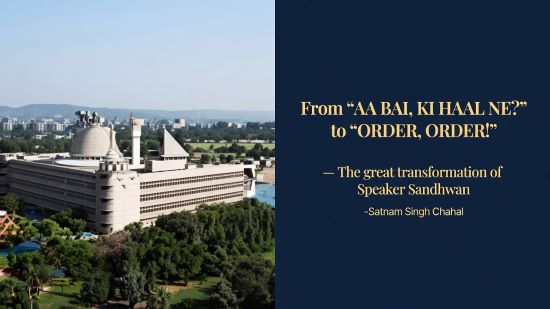
 When a cheerful opposition MLA became Speaker, Punjab expected a guardian of the House. Instead, controversies keep raising the question: has the chair changed the man? There was a time when Kultar Singh Sandhwan had a completely different image in Punjab politics. When he was sitting in the Opposition, he was seen as a polite, cheerful and approachable politician. Whether the issue was dirty drinking water, floodwater, administrative negligence or the suffering of ordinary people, Sandhwan Sahib seemed ready to reach the spot. He had the energy of a politician who did not need an invitation to enter the people’s problems. He would arrive, pick up the phone and, in his familiar Punjabi style, ask an official, “Aa bai, ki haal ne tere?” Those moments created the impression of a leader who was close to the people and unafraid of authority.
There was also the memorable episode when, as an MLA, he travelled from his Kotkapura constituency to Muktsar and confronted a senior official over a public issue. His style was direct, emotional and unmistakably Punjabi. People saw a politician who could challenge the powerful without losing his human touch. At that time, Sandhwan Sahib looked like the man who would one day become a powerful voice for the people inside the Punjab Vidhan Sabha.
Then came power.
And then came the Speaker’s chair.
Somewhere between the opposition benches and the Speaker’s chair, however, Punjab seems to have discovered a completely different Kultar Singh Sandhwan. The man who once demanded answers from the government is now frequently being asked to provide answers about the functioning of the House. The man who once questioned authority now sits in the highest chair of authority inside the Assembly. And Punjab, with its legendary sense of humour, might well ask him today: “Sandhwan Sahib, hun dasso… ki haal ne tere?”
One of the most memorable political promises associated with Sandhwan Sahib was his appearance at the Sukhraj Singh Morcha, where he spoke with the confidence of a politician who believed that his government would soon deliver justice. The message was essentially that the government had arrived, that it was only a matter of days, that a thanksgiving ceremony would be held and that if things did not happen, the government would be made to stumble. Punjab listened. The government came. The government stayed. The years passed. And now the government’s own term is approaching its final stretch. So the question naturally arises: the government was supposed to stumble, but who actually stumbled? The promise, the political memory, the calendar—or the expectations of the people?
This is where satire becomes almost poetry. Before becoming Speaker, Sandhwan Sahib appeared to be the man asking the government, “Why haven’t you acted?” After becoming Speaker, people increasingly seem to be asking him, “Why haven’t you decided?” Politics has a strange habit of changing the questions once a politician changes seats.
The Speaker’s chair, however, is not an ordinary political chair. An MLA can shout. A minister can defend the government. An opposition leader can attack the government. A party worker can cheer for his party. But the Speaker is expected to stand above all of them. The Speaker is not supposed to ask which party is speaking before deciding whether the rules apply. The Speaker is supposed to ask only one question: what does the rulebook say?
This is precisely why repeated questions about Sandhwan Sahib’s impartiality deserve serious attention. Opposition members have raised questions about his conduct and decisions inside the House. Whether every criticism is justified is a matter for the record, but the very fact that the Speaker’s neutrality has become a recurring political issue should concern everyone who believes in the dignity of parliamentary institutions. A Speaker should not merely be neutral; he should also appear to be neutral. In parliamentary democracy, perception matters almost as much as procedure.
The controversy surrounding Dr. Sukhwinder Kumar Sukhi is another example of the difficult responsibility resting on the Speaker. Dr. Sukhi left the Shiromani Akali Dal and joined the Aam Aadmi Party in 2024, following which a disqualification petition was filed before the Speaker. The matter has involved hearings and opportunities for the MLA to present his side. But Punjab’s political calendar is moving rapidly, and ordinary citizens are entitled to ask why important decisions sometimes appear to move at the speed of a bullock cart while political slogans travel at the speed of 5G.
The irony is impossible to miss. Governments come with five-year mandates, but constitutional and parliamentary responsibilities do not come with a five-year waiting period. The Speaker cannot operate according to the convenience of political time. The law has its own clock, the Constitution has its own clock, and public accountability has an even faster one.
Sandhwan Sahib has also found himself surrounded by controversies outside the strictly parliamentary sphere. The 2022 episode involving a cow’s tail touching his turban created a controversy that ultimately led to his seeking forgiveness at Sri Akal Takht Sahib. Whatever one’s interpretation of that incident, it demonstrated how quickly a public figure’s personal conduct can become a matter of wider religious and political discussion when that person occupies a prominent public position.
Then came the more recent controversies involving remarks in the Assembly about beards and language that invoked transgender people. This is where the matter becomes much more serious than ordinary political banter. The Speaker’s words carry the weight of the institution. A joke made at a political rally may be dismissed as political rhetoric, but words spoken from the Speaker’s chair are heard as words coming from the institution itself.
The question is not whether a person has a beard or is clean-shaven. The question is whether anyone’s appearance should become a weapon for questioning their religious commitment, political legitimacy or right to speak. Punjab contains Sikhs with long beards, trimmed beards and no beards. People have different personal choices and different interpretations of religious practice. The dignity of the Assembly requires respect for all of them.
And here satire cannot resist entering the room. If beard length becomes a parliamentary qualification, Punjab may soon need a new government department—the “Department of Beard Verification.” Before entering the Assembly, every MLA could perhaps be asked to submit a beard measurement certificate. The Speaker could then announce: “Members whose beard is below the prescribed parliamentary limit are requested to remain silent until further notice.”
It sounds ridiculous because it is ridiculous.
A clean-shaven person does not lose the right to ask a question. A person with a beard does not automatically become morally superior. Faith cannot become a measuring tape, and the Assembly cannot become a barber shop.
The same principle applies to the Speaker himself. If Sandhwan Sahib is a religious man, a Gursikh and a person who sincerely respects Sikh institutions, that should be a matter of personal faith and dignity. But the higher the religious and constitutional responsibility, the greater the responsibility for humility in language. Religious identity should make a public representative more careful with words, not less careful.
There is also an uncomfortable contradiction when a politician speaks strongly about accountability for other institutions while his own office faces questions about transparency, neutrality and decision-making. Sandhwan Sahib has spoken publicly about accountability and transparency in Sikh institutions, and that is a legitimate position. But the same principle must apply everywhere, including the Punjab Legislative Assembly. Accountability cannot be a one-way street. It cannot mean “you answer my questions” while refusing to answer questions about your own office.
The issue of Akal Takht Sahib has also added another layer to this discussion. Sandhwan Sahib has publicly invoked Sikh values and institutions, yet he himself has faced questions and scrutiny from Akal Takht Sahib over matters connected with the functioning of the Punjab government and legislation concerning sacrilege. He appeared before Akal Takht Sahib in connection with those concerns. Whatever one’s personal or political interpretation may be, there is an important lesson here: those who demand accountability from institutions must also be prepared to face accountability themselves.
Perhaps the greatest challenge before Sandhwan Sahib is therefore not political. It is institutional.
The Speaker is not the government’s defence lawyer. The Speaker is not the Opposition’s enemy. The Speaker is not an AAP spokesperson sitting on a higher chair. The Speaker belongs to the entire House, including those members who may spend five years criticising him. That is the price of the office.
Sandhwan Sahib can certainly remain a politician. He can have political opinions. He can support his party. He can campaign. He can criticise opponents. But when he enters the Speaker’s chair, the politician must leave the room. The rulebook must enter. Patience must enter. Constitutional neutrality must enter. And perhaps, most importantly, humility must enter.
Punjab once saw Kultar Singh Sandhwan as the man who would knock on the doors of power and ask questions on behalf of ordinary people. Today, the people are asking him questions from the other side of the door. That is the inevitable cycle of politics. Yesterday’s questioner becomes today’s decision-maker, and today’s decision-maker eventually becomes tomorrow’s subject of political history.
There is a poetic irony in the transformation. Yesterday, Sandhwan Sahib was saying, “Aa bai, ki haal ne tere?” Today, Punjab is saying, “Speaker Sahib, ki haal ne neutrality de?” Yesterday, he wanted answers from the government. Today, people want answers from the Speaker. Yesterday, he stood outside the corridors of power. Today, he sits at the centre of them.
But power is temporary. The chair is temporary. Governments are temporary. Political parties are temporary. Even the loudest Assembly debate eventually becomes a page in an old file.
The record remains.
The people remember.
And history is usually less polite than the Speaker’s microphone.
So the message to Kultar Singh Sandhwan is simple: you may be a religious man, you may be a Gursikh, and you may sincerely believe that you are serving Punjab and the Sikh Panth. Those qualities deserve respect. But the Speaker’s chair demands something even greater—it demands that you rise above your party, above your political friendships, above personal emotions and above political convenience.
Because that chair does not belong to Kultar Singh Sandhwan.
It belongs to the Punjab Legislative Assembly.
And the Punjab Legislative Assembly does not belong to one party.
It belongs to Punjab.
Therefore, Sandhwan Sahib, when you sit in that chair, please leave the politician outside the door and bring the Speaker inside. Bring the rulebook. Bring patience. Bring dignity. Bring humour—but not humiliation. Bring faith—but not religious policing. Bring authority—but not arrogance.
And when the Opposition asks a question, do not hear the party.
Hear Punjab.
Because one day the Assembly will empty. The microphones will go silent. Ministers will leave. MLAs will return to their constituencies. The government will change. The Speaker’s chair will have a new occupant.
But the record will remain.
And history may ask the simplest question of all:
“Kultar Singh Sandhwan Sahib, when Punjab gave you the chair, did you become the Speaker of Punjab—or merely the loudest echo of the government?”
Disclaimer: This article and accompanying images are for informational and illustrative purposes only. Some visuals may be AI-generated or digitally enhanced and may not depict actual events or persons.Views expressed are based on publicly available information and analysis.