
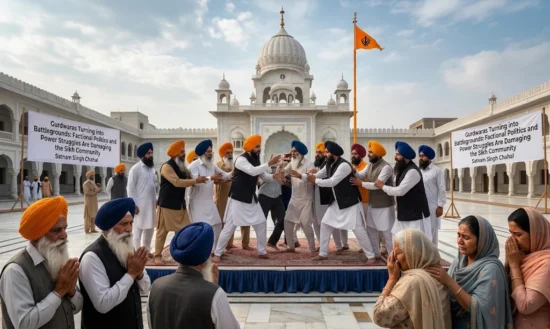
When the Houses of Guru Nanak Become Battlegrounds for Control, Personal Ambitions and Financial Power
Gurdwaras are not ordinary religious buildings. They are sacred institutions established on the principles of equality, humility, selfless service, brotherhood and devotion to the teachings of the Sikh Gurus. For Sikhs across the world, a Gurdwara represents the spiritual identity of the community and a place where everyone, irrespective of caste, colour, nationality or social status, is welcomed.
Unfortunately, an increasingly disturbing trend has been damaging this sacred identity. Factional politics, personal rivalries, management disputes and struggles for control over Gurdwara committees have repeatedly turned places of worship into centres of confrontation. Incidents involving physical clashes, police intervention, court battles, competing management claims and financial controversies have raised serious questions about the functioning of Sikh religious institutions.
The greatest tragedy is that these disputes are not merely disagreements between individuals. They are damaging the collective reputation of a community internationally recognised for its humanitarian work, Langar service, disaster relief and generosity towards people in need.
A disturbing historical timeline
The problem is not new. Historical records and academic research document repeated disputes in Sikh institutions in India and the diaspora over several decades.
March 1982 – Pape Avenue Gurdwara, Toronto, Canada: A dispute connected with a Gurdwara election reached a tragic level when a shooting occurred inside the Ontario Supreme Court during proceedings relating to the election. Two people, including advocate Oscar Fonsica and Bhupinder Singh Pannu, were killed. This was an extreme example of how institutional disputes can have devastating consequences.
March 1986 – East Ham, London: Disturbances were reported at the East Ham Gurdwara, reflecting the growing problem of factional confrontations within British Sikh institutions.
May 1987 – Belvedere, Kent, UK: A violent confrontation involving rival Sikh groups reportedly resulted in 46 arrests. The incident was linked to an alleged attempt to take control of a religious institution.
1988 – Surrey, British Columbia, Canada: A dispute over the distribution of Langar, apparently involving whether devotees should sit on the floor or at tables, developed into a confrontation between rival groups. Reports and historical research linked the deeper disagreement to management power and the use of Gurdwara funds. Police intervention was required.
May 28, 2001 – Coventry, UK: Violent clashes were reported at Guru Hargobind Sahib Gurdwara, demonstrating that internal factional confrontations had continued despite earlier incidents.
2005 – Leamington Spa and Leicester, UK: Serious disturbances were reported at Sikh religious gatherings. In Leamington Spa, a large group reportedly attacked people at a Gurdwara amid disagreements over activities in the community hall. In Leicester, a meeting descended into disorder and required a substantial police response.
2008 – Bristol, UK: A dispute arose over whether women should have voting rights in Gurdwara elections. The controversy exposed disagreements about representation, equality and the democratic functioning of religious institutions.
2009–2016 – Several British Gurdwaras: Further disputes were reported over management positions, religious practices, committee authority and finances. These included protests in Southall in 2013, a presidency dispute in Huddersfield in 2014, a management dispute in Croydon in 2015 and controversy over approximately £126,000 in Gurdwara funds in Wolverhampton in 2016.
January 2018 – Sikh institutions in the diaspora: A campaign involving Gurdwara organisations in Canada, the United States and the United Kingdom brought another dimension of institutional disagreements into public discussion. More than 100 places of worship were reported to be involved in restrictions on official visits by Indian government representatives. This was a political and institutional dispute rather than necessarily a physical management clash, but it illustrated the growing divisions surrounding the autonomy and administration of Sikh institutions.
December 15, 2024 – Vilvoorde, Belgium: A confrontation between rival factions reportedly took place in connection with a continuing dispute over Gurdwara management and institutional control.
January 15, 2025 – Vilvoorde, Belgium: Bakhtawar Singh Bajwa, a 52-year-old Sikh man from Punjab, was killed during a dispute at a Gurdwara. Subsequent reporting linked the killing to the continuing conflict between rival factions. The incident demonstrated how dangerous prolonged institutional rivalries can become.
August 2025 – SGPC and DSGMC: Disagreements between the Shiromani Gurdwara Parbandhak Committee and the Delhi Sikh Gurdwara Management Committee over arrangements for the 350th anniversary of Guru Tegh Bahadur’s martyrdom became public. Although this was an organisational disagreement and not a reported physical clash, it raised questions about coordination and institutional rivalry.
July 2026 – Gurdwara committees in Canada: A controversy emerged over the transportation of 225 saroops of Sri Guru Granth Sahib Ji to Surrey by sea. Different Sikh organisations raised concerns about religious protocol and handling, while the receiving Gurdwara’s management rejected allegations of damage. The disagreement was referred to the Akal Takht. This was a dispute over religious protocol, not a physical fight, but it further demonstrated the lack of consensus among institutions.
This timeline is illustrative, not exhaustive. The incidents differ in nature: some involved physical violence, some management disputes, some protests and others disagreements over religious protocol. They should not be treated as identical cases or as proof that every Gurdwara committee is involved in wrongdoing.
What is driving these disputes?
The first major factor is the struggle for authority. In some institutions, committee positions have become symbols of social status and personal influence rather than responsibilities of service. Individuals and groups sometimes behave as if controlling a Gurdwara means controlling the local Sikh community.
The second issue is financial transparency. Gurdwaras receive contributions from devotees who make donations with faith and confidence that their money will be used for religious, educational, charitable and community purposes. If accounts are not independently audited and publicly presented, suspicions and allegations can develop into serious confrontations.The third problem is political interference and factionalism. Political affiliations, personal loyalties and rival organisations can enter religious institutions and weaken the spirit of collective responsibility. A Gurdwara should never become a platform for political ambitions or personal campaigns.
The fourth issue is the absence of effective dispute-resolution mechanisms. When disagreements over elections, membership, property, financial records or religious decisions cannot be resolved through transparent constitutional procedures, factions may resort to protests, intimidation, litigation or physical confrontation.
The damage goes far beyond the Gurdwara walls
Every violent incident inside or around a Gurdwara creates distress among devotees. When confrontations take place in the presence of Guru Granth Sahib Ji, the issue becomes even more serious because the sanctity and discipline of the sacred space must be protected.Such incidents also attract police attention, court proceedings and international media coverage. Sikh communities have spent generations building a positive reputation through Langar, humanitarian assistance and voluntary service. Images of people fighting over committee positions or control of religious property undermine that reputation.
The greatest long-term danger is the alienation of younger generations. Young Sikhs who see religious institutions repeatedly consumed by factional disputes may lose confidence in their leadership and become reluctant to participate in Gurdwara administration. The community cannot afford to lose a generation of capable, educated and service-minded young people because of the ambitions of a few individuals.
The way forward: Reform must begin now
Gurdwara management must be treated as a sacred responsibility, not an opportunity for power or personal recognition.Every Gurdwara should have a clearly written constitution, transparent membership rules, fair election procedures and independently audited financial accounts. Annual financial statements should be accessible to the congregation. Donations, expenditure, salaries, property transactions and major contracts should be properly documented.
Where appropriate, communities should explore consensus-based selection of management committees instead of allowing every election to become a battle between rival camps. However, consensus must not become a method of excluding ordinary members or avoiding accountability. Democratic participation and constitutional safeguards must remain protected.
Independent mediation committees comprising respected, impartial and knowledgeable members of the Sikh community should be established to resolve disputes before they reach the police or courts. Allegations of financial misconduct or violence must be investigated fairly, with evidence and due process, rather than settled through factional pressure.
Women and young people must have meaningful opportunities to participate in management. Religious institutions cannot preach equality while denying fair representation to sections of their own congregation.
A question the Sikh community must answer
The Sikh community must seriously ask itself: If the institutions established in the name of the Sikh Gurus cannot demonstrate humility, transparency, equality and brotherhood, what message are they sending to the world?The respect earned through generations of sacrifice, service and humanitarian work cannot be protected through slogans alone. It requires responsible leadership, honest management and a willingness to put the interests of the Panth above personal ambitions.
A Gurdwara belongs to the Guru and the Sangat, not to an individual president, secretary, faction or political group. Those entrusted with its administration are temporary servants of the congregation, not owners of the institution.The time has come to end the politics of possession and restore the tradition of Seva. The dignity of the Gurdwara must be greater than the ambition of any individual or group.The Sikh community does not need more powerful Gurdwara presidents. It needs more humble, honest, accountable and service-oriented leaders.
Disclaimer: This article and accompanying images are for informational and illustrative purposes only. Some visuals may be AI-generated or digitally enhanced and may not depict actual events or persons. Views expressed are based on publicly available information and analysis