
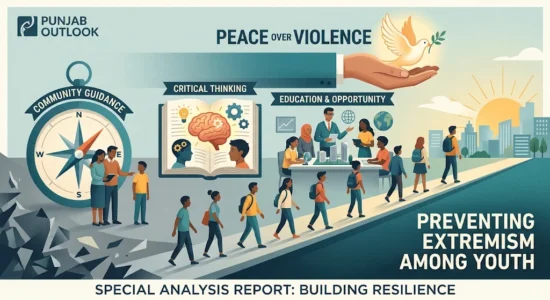
By Satnam Singh Chahal | Punjab Outlook — Special Analysis-One of the most disturbing questions facing humanity is why some young people, who should be building families, careers and peaceful societies, instead become involved in terrorism and participate in the killing of innocent people.
Every terrorist attack leaves behind grieving families, orphaned children, injured survivors and communities living with fear. Behind every victim is a human story that has been destroyed. But another important question deserves attention: what happens in the minds and lives of young people who eventually decide that killing innocent human beings is justified?
Understanding this transformation is essential. Condemning terrorism is necessary, but preventing the next generation from entering violent extremist organisations requires a deeper understanding of how radicalisation develops.
1. There is no single type of terrorist
It is wrong to assume that every terrorist comes from a poor family, has no education or belongs to a particular religion or nationality.Some individuals are highly educated, while others have limited schooling. Some come from economically disadvantaged families, while others grow up in financially comfortable homes. Some are motivated by political extremism, others by racial hatred, religious misinterpretation, revenge, personal grievances or the desire for power.There is no single psychological or social profile that explains every individual who becomes involved in terrorism.
2. Why do some young people become radicalised?
Identity crisis and the search for belonging: Adolescence and early adulthood are periods when people search for identity, recognition and purpose. Young people who feel isolated, rejected or humiliated may become attracted to groups that promise brotherhood, importance and a sense of belonging.Anger and personal grievances: Experiences of discrimination, bullying, humiliation, family breakdown or perceived injustice can create emotional vulnerability. Extremist recruiters may exploit these feelings and convince individuals that violence is the only answer.
Political exploitation: Some organisations deliberately manipulate young people by presenting political conflicts as a permanent struggle in which peaceful solutions are supposedly impossible.Religious or ideological manipulation: Extremist recruiters sometimes misuse religious texts, historical events and ideological arguments to justify hatred and violence. They present selective interpretations as unquestionable truth and discourage independent thinking.It is important to distinguish genuine religious belief from extremist organisations that exploit religion for political or violent purposes.
Social media and online propaganda: The internet allows extremist groups to circulate propaganda, glorify violence, spread conspiracy theories and contact vulnerable individuals. Online communities can reinforce hatred and make violence appear acceptable.Desire for recognition and power: Some individuals are attracted by the false promise of becoming heroes, leaders or important figures. Extremist groups exploit the human desire for recognition and significance.
Financial incentives and coercion: In certain conflict zones, armed groups exploit poverty, offer money or threaten individuals and their families. Some young people are recruited through pressure, manipulation or forced participation rather than genuine ideological commitment.
3. Different categories of people who may become involved
It is useful to understand several broad pathways, without treating them as fixed personality types.The isolated individual who seeks acceptance and belonging.The angry individual who believes violence is revenge for perceived injustice.The ideologically motivated individual who accepts extremist beliefs.The opportunist who seeks money, status or power.The manipulated individual who is deceived through propaganda and false promises.The coerced individual who joins under threats or pressure.The online radicalised individual whose worldview becomes increasingly shaped by extremist content.These categories can overlap. A person may experience several of these influences simultaneously.
4. A historical timeline of modern terrorism
Late nineteenth century: Political violence by revolutionary and anarchist groups became an international concern. Assassinations and attacks were sometimes used to advance political objectives.
1914: The assassination of Archduke Franz Ferdinand in Sarajevo became the immediate trigger for the First World War. This was a political assassination, not the same phenomenon as modern mass-casualty terrorism, but it illustrates the enormous consequences of political violence.
1960s–1970s: Hijackings, bombings, kidnappings and attacks by different ideological and separatist organisations received growing international attention. Political violence increasingly crossed national borders.
1980s: Armed conflicts in several regions contributed to the growth of militant networks. International rivalries, civil wars and external interventions shaped the environments in which some extremist organisations developed.
1990s: The 1993 World Trade Center bombing and the 1995 Oklahoma City bombing demonstrated different forms of terrorism and extremist violence. The decade also witnessed the 1998 bombings of US embassies in Kenya and Tanzania.
2001: The September 11 attacks in the United States killed nearly 3,000 people and transformed international security policies. The attacks demonstrated the devastating reach of transnational terrorist networks.
2002–2010: Terrorist attacks in different regions, including Bali in 2002, Madrid in 2004, London in 2005 and Mumbai in 2008, demonstrated that terrorism was not restricted to one country or community.
2011–2019: The rise of ISIS, its territorial expansion in Iraq and Syria, and its recruitment of foreign fighters brought a new dimension to extremist propaganda. Online recruitment and the exploitation of vulnerable young people became major international concerns.
2020–2026: Terrorist threats have continued to evolve. Decentralised extremist networks, online radicalisation, lone-actor attacks and the exploitation of international conflicts remain serious concerns. The use of digital platforms and artificial intelligence also creates new challenges for prevention and public safety.This timeline identifies selected international developments rather than suggesting that all forms of terrorism share the same history, ideology or causes.
5. Why do terrorists target innocent people?
Terrorist violence often seeks to achieve more than the physical destruction caused by an attack. It can be intended to create widespread fear, provoke communal conflict, undermine confidence in governments, attract publicity or force political concessions.Civilians become targets because attacks on ordinary people create maximum psychological shock. This is precisely why the deliberate killing of innocent civilians must be rejected without qualification.
No political objective, historical grievance or ideological belief can justify deliberately murdering innocent people.
6. What role do families play?
Families are often the first to notice changes in a young person’s behaviour. Sudden isolation, increasing obsession with violent propaganda, expressions of hatred towards entire communities, glorification of attacks and secretive relationships with extremist networks may be warning signs.However, these signs alone do not prove that someone is becoming a terrorist. Families should respond with conversation, support and appropriate professional assistance rather than automatically treating a troubled young person as a criminal.Parents should create an environment where children can discuss difficult political, religious and social questions without fear.
7. What should schools and governments do?
Educational institutions should teach critical thinking, media literacy, conflict resolution and respect for human rights. Students must learn to question propaganda and distinguish facts from misinformation.Governments should address discrimination, corruption, exclusion and legitimate grievances through lawful institutions. Counterterrorism measures must remain subject to human rights and the rule of law.Police and intelligence agencies must investigate credible threats, while communities should have safe channels to report recruitment, threats and plans for violence.Religious leaders, educators, journalists and civil society organisations can also challenge messages that glorify violence and hatred.
8. Can radicalised young people return to peaceful society?
Yes, some can. Not every individual involved in extremist activity is beyond rehabilitation. Appropriate approaches may include psychological support, education, vocational training, family counselling, disengagement programmes and community reintegration.The process must be carefully assessed according to the individual’s circumstances and the nature of their involvement. Victims’ rights and public safety must remain central.
9. The responsibility of journalism and society
Media organisations must report terrorist attacks responsibly. They should not glorify attackers, reproduce recruitment propaganda or blame entire religious and ethnic communities for the actions of individuals.Journalists should investigate the networks, financing, recruitment methods and institutional failures behind terrorism while giving proper attention to victims and survivors.
Conclusion: Prevention must begin before violence occurs
The world cannot eliminate terrorism simply by arresting or killing individuals after attacks have taken place. Security measures are necessary, but prevention must begin much earlier.A young person who feels respected, educated, included and hopeful about the future is less vulnerable to those who promise importance through violence. Families, schools, governments, religious institutions and communities must work together to prevent hatred from turning into organised violence.The most important question is not only how to defeat terrorists, but how to prevent another young person from becoming one.Saving one young person from radicalisation may save dozens or hundreds of innocent lives. That is a responsibility the entire society must share.
Disclaimer: This article and accompanying images are for informational and illustrative purposes only. Some visuals may be AI-generated or digitally enhanced and may not depict actual events or persons. Views expressed are based on publicly available information and analysis