
 This year, heat has scorched almost the whole of India. Summers are harsher, nights remain warmer, and winters are sharper. Yet the ordinary Indian house is still built as if the climate of the 1970s will return out of courtesy.Brick, concrete, cement, marble, exposed roofs, large windows, little shading, no insulation, and almost no thought to sun or airflow. We build homes that invite heat in summer and lose warmth in winter. Then we install ACs and heaters. First we create the disease. Then we buy machines to manage the symptoms.
This is not merely bad architecture. It is national wastage. A badly built house increases grid demand, overloads transformers, forces DISCOMs to buy costly power, burns more coal, adds emissions, and becomes part of the subsidy burden.
Punjab’s Warning Signal
Punjab is seeing this crisis in real time. This week, Punjab’s power demand crossed 16,000 MW and touched 16,130 MW, pushed by heat and paddy transplantation. Domestic cooling demand and agricultural pumping are colliding in the same summer window. People switch on ACs and coolers, while lakhs of tubewells run for paddy. The grid groans and power becomes firefighting.
India cannot solve this only by producing more electricity. We must also stop wasting it. We promoted LED bulbs and star-rated appliances. We tell farmers to reduce excessive urea because it is costly and subsidised. Then why are we silent about buildings? India needs a National Energy-Efficient Construction Policy.
Green Building Cannot Remain a Luxury
This should not be another decorative “green building” certificate for luxury hotels and corporate campuses. It should become basic construction law. Every new house, colony, school, hospital, office, mall and government building must be built according to climate.
Thermal conductivity tells us how easily heat passes through a material. Lower is better. Indian studies show fired clay bricks at roughly 0.38 to 1.12 W/m·K, solid cement concrete blocks at 0.66 to 1.55 W/m·K, and AAC blocks around 0.18 W/m·K. Many brick and concrete walls therefore allow several times more heat to enter than AAC blocks.
Roofs are even more important. A bare concrete slab absorbs heat all day and releases it after sunset. The AC is not only cooling air; it is fighting stored heat. Cool roofs, reflective coatings, roof insulation, ventilated roof layers, terrace shading and solar panels should become normal practice.
My Batala Experience
I can say this from personal experience. In 2019, when I built a house in Batala, I used AAC blocks instead of ordinary brick and placed thermocol sheets for insulation above the concrete roof slab. The house remains cooler. The AC load is much lower. The electricity bill is lower. If one private house can benefit, why can this not become public policy?
India already has the knowledge. The Bureau of Energy Efficiency has the Energy Conservation Building Code for commercial buildings and Eco Niwas Samhita for residential buildings. ECBC applies to new commercial buildings with connected load of 100 kW or contract demand of 120 kVA or more. It recognises approximate savings of 25%, 35% and 50% or more. Eco Niwas Samhita seeks to limit heat gain, limit heat loss, and improve ventilation and daylighting.

The problem is not absence of knowledge. The problem is weak enforcement.
Codes Sitting on Websites Do Not Cool Homes
A code sitting on a website does not cool a house. It must enter municipal bylaws, RERA approvals, bank lending, public procurement, housing schemes and completion certificates.
Punjab has already moved part of the way. Punjab building rules refer to the Punjab Energy Conservation Building Code. They provide for rooftop solar, rainwater harvesting and environment-friendly construction materials. In specified green-building provisions, at least 20% environment-friendly material is required, including AAC blocks, fly ash bricks and hollow bricks. In GMADA areas, rules already recognise solar photovoltaic systems and rainwater harvesting. If the State can mandate solar panels and water harvesting, why not mandate energy-efficient walls, insulated roofs and shaded windows?
The 50-Year Carbon Footprint
Large projects expose the gap. Environmental clearance is required for building and construction projects beyond the prescribed built-up area, commonly 20,000 square metres and above. But the approval mindset still focuses on construction: dust, debris, sewage, water, traffic, waste and tree cover.
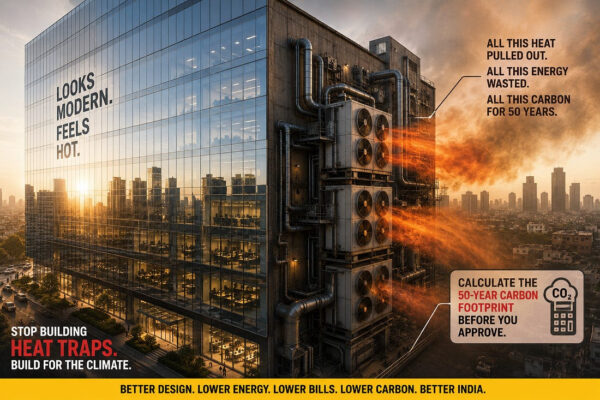
The real climate cost of a commercial building often begins after occupation. A glass-fronted mall, hotel, hospital or office tower may stand for fifty years. For all those decades, it consumes electricity every day for air-conditioning, lighting, lifts, pumps, ventilation and common services.
This is the blind spot. We scrutinise construction dust, but not the electricity the building will consume for half a century. We count trees cut during construction, but not the coal burned for decades to cool unshaded glass and concrete.
Without calculating the 50-year carbon footprint caused by energy consumption, environmental approval for lavish commercial buildings remains incomplete. Before approval, the builder should disclose cooling load, wall material, roof insulation, glazing, ventilation, solar generation, common-area demand and projected annual electricity consumption.
Make Energy Disclosure Mandatory
India must regulate its obsession with glass. Huge glass facades may look modern, but in Indian heat they often behave like greenhouses. A commercial building with large unshaded glass walls is not progress. It is foolishness wearing a tie.
Every building plan should carry an energy disclosure. The buyer should know whether the building uses AAC blocks or ordinary brick, whether the roof is insulated, whether windows are shaded, and what the likely cooling load will be.
Government buildings must lead. Every new school, hospital, police station, court, office and university building should be energy efficient by law. Existing government buildings should undergo energy audits and roof retrofits.
India will build millions of homes and thousands of commercial buildings. If we build them badly, we will lock the country into fifty years of avoidable electricity demand. If we build them wisely, we will save power, coal, subsidy, household income and emissions.
The cheapest power is the power we do not waste. A unit saved is national wealth protected.
India must stop building heat traps. Earlier the bette