
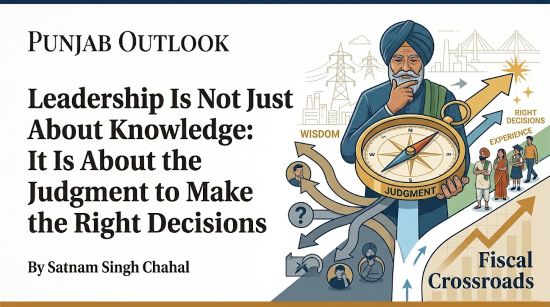
In today’s competitive world, organizations, governments and political parties invest heavily in developing expertise. People are trained to understand systems, follow procedures, analyze information and deliver results. Yet, despite having highly qualified advisers, experienced administrators and knowledgeable leaders, many institutions continue to make decisions that create public dissatisfaction, damage credibility and weaken public trust. The reason is simple: expertise and judgment are not the same thing.
Expertise enables a person to understand a subject, but judgment determines how that knowledge should be used in a particular situation. A leader may know every rule in a book, understand every technical detail and possess years of experience, yet still make a poor decision if the leader fails to consider the wider consequences. True leadership begins when knowledge is combined with wisdom, responsibility, fairness and the ability to understand the human impact of a decision.
Rules and procedures are essential for maintaining discipline and accountability. However, real-life situations are rarely as simple as written instructions. Leaders frequently face circumstances in which different interests compete, information is incomplete and every available option carries some risk. In such situations, simply repeating the rules may not be enough. A responsible leader must examine the facts, consider the alternatives, assess the consequences and choose a course of action that can be justified ethically and practically.
This does not mean that leaders should ignore established rules or make exceptions to favour particular individuals. Rather, it means understanding the purpose of those rules and applying them fairly, lawfully and with sound reasoning. A decision should not be judged only by whether it technically follows a procedure, but also by whether it addresses the problem effectively and protects the legitimate interests of those affected.
The importance of judgment becomes even greater in politics. Political leaders may have experienced advisers, professional consultants, election strategists and detailed reports at their disposal. Nevertheless, expertise alone cannot guarantee good governance. A leader must understand the difference between winning an election and fulfilling the responsibilities of public office.
For example, a government may have the technical ability to announce welfare schemes, launch development projects or introduce new policies. But sound judgment requires it to ask whether the schemes are financially sustainable, whether the benefits will reach the intended people, whether public money is being used responsibly and what consequences the decisions may have for future generations.
Similarly, an opposition party may be highly skilled at criticizing the government. But responsible political judgment requires it to offer practical alternatives rather than merely exploit public dissatisfaction. Leadership is not demonstrated by the ability to identify every mistake made by opponents; it is demonstrated by the capacity to develop workable solutions and accept responsibility for their consequences.
One of the greatest weaknesses in leadership emerges when advisers become more concerned about pleasing the leader than telling the truth. In such an environment, inconvenient facts are ignored, criticism is discouraged and decisions are made on the basis of personal loyalty rather than objective assessment.
A wise leader does not fear disagreement. Instead, the leader encourages informed debate, invites alternative opinions and asks difficult questions before making important decisions. The purpose of consultation is not to collect approval for a decision that has already been made. It is to discover weaknesses, understand competing perspectives and improve the final outcome.
Leaders who refuse to listen may continue to exercise authority, but their decisions gradually become disconnected from reality. By contrast, leaders who welcome honest criticism develop the confidence to reconsider their positions when the evidence demands it.
Good judgment cannot be developed through classroom training alone. It grows through experience, careful observation, meaningful discussion and an honest assessment of past decisions. Leaders must be willing to examine not only their successes but also their mistakes.
When a decision produces a disappointing result, the important question is not simply who should be blamed. Leaders must determine whether the information was inadequate, whether important risks were overlooked, whether the wrong priorities were established or whether the decision-making process itself was flawed. At the same time, a favorable outcome should not automatically be treated as proof of sound judgment. Sometimes a poor decision succeeds because of circumstances beyond anyone’s control.
Organizations should therefore encourage constructive reviews of major decisions. Team members should be invited to explain what they would have done differently and why. Senior leaders should also explain the reasoning behind their own choices, including the compromises they considered and the risks they accepted. Such discussions help others develop independent thinking instead of becoming dependent on instructions from above.
A leader’s responsibility is not limited to producing immediate results. It also includes preparing others to make sound decisions when the leader is absent. An organization that depends entirely on one individual may appear efficient, but it remains vulnerable if nobody else is trusted or trained to exercise independent judgment.
Effective leaders delegate meaningful responsibilities, establish clear boundaries and allow people to learn from manageable mistakes. They provide guidance without controlling every detail. They also distinguish between an honest error made after careful consideration and careless conduct resulting from negligence or disregard for established standards.
This approach creates a culture in which employees and future leaders are encouraged to think critically, take responsibility and act with integrity. Over time, the institution becomes stronger because sound decision-making is shared across the organization rather than concentrated in one office.
The real test of a leader is not how impressive the leader’s qualifications appear, how many experts surround the leader or how quickly instructions are issued. The real test is the quality of decisions made when circumstances are uncertain, competing interests must be balanced and there is no ready-made answer.
This principle applies equally to businesses, public administration, political parties and democratic institutions. People need leaders who can distinguish short-term popularity from long-term public interest, personal loyalty from institutional responsibility, and technical compliance from genuinely effective action.
Expertise helps leaders understand the available options. Judgment helps them recognise which options deserve priority and which consequences cannot be ignored. Integrity ensures that the final decision can be defended openly and honestly.
Institutions do not become stronger simply by recruiting more experts or accumulating more information. They become stronger when people learn to think independently, assess competing interests and make responsible decisions under pressure.
The best leaders do not try to provide an answer to every possible question. They develop the ability of others to ask the right questions, challenge assumptions, understand consequences and act responsibly when circumstances change.
Ultimately, expertise may establish a person’s competence, but judgment demonstrates the maturity to use that competence wisely. Leadership reaches its highest standard when knowledge is supported by wisdom, authority is balanced by accountability and decisions are guided by the public interest rather than personal convenience.
Expertise makes a leader knowledgeable. Judgment makes a leader dependable. Integrity makes that leadership worthy of trust.
Disclaimer: This article and accompanying images are for informational and illustrative purposes only. Some visuals may be AI-generated or digitally enhanced and may not depict actual events or persons. Views expressed are based on publicly available information and analysis