
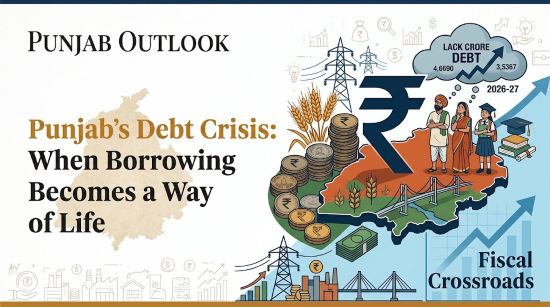
 Punjab’s mounting debt has become one of the most serious questions facing the state as it approaches the 2027 Assembly elections. The issue is no longer simply how much the government borrows, but whether Punjab can generate enough revenue to finance its development, welfare commitments, salaries, pensions, electricity subsidies and debt repayments without placing an ever-growing burden on future generations.
According to the Punjab Budget 2026–27 and the analysis published by PRS Legislative Research, the state’s outstanding liabilities were estimated at approximately ₹4.08 lakh crore for 2025–26. The government projects that figure will rise to approximately ₹4.48 lakh crore by March 31, 2027. Its budget estimates net borrowing of about ₹39,971 crore during 2026–27. These are budget projections, not the final audited figures for the year. PRS Legislative Research
The projected increase raises an uncomfortable question: can economic growth eventually reduce Punjab’s debt burden, or will the state continue to borrow faster than it strengthens its productive economy?
The answer requires an examination of the decisions taken by successive governments, the policies of the present Aam Aadmi Party (AAP) administration, and the political culture that has repeatedly placed electoral promises ahead of long-term fiscal planning.Punjab’s financial difficulties did not begin in 2022. Congress governments, Shiromani Akali Dal–BJP governments and the current AAP administration must all be assessed against their borrowing decisions, revenue performance and development priorities.However, historical responsibility cannot become a permanent excuse for present-day decisions.
The state’s 2026–27 budget estimates outstanding liabilities at ₹4,47,754 crore by the end of the financial year. The budget also projects a fiscal deficit of approximately ₹39,971 crore and a revenue deficit of ₹21,955 crore.A fiscal deficit means expenditure exceeds receipts and the gap must be financed. A revenue deficit is particularly concerning because it indicates that ordinary revenue is insufficient to meet revenue expenditure. In practical terms, the state is not generating enough recurring income to cover all its routine commitments.PRS estimates that outstanding liabilities will be around 45.1 per cent of Punjab’s projected GSDP at the end of 2026–27. The government argues that economic growth can improve this ratio even while nominal debt rises. That argument has economic merit, but it depends on achieving the projected growth rate and maintaining fiscal discipline. Punjab cannot measure financial health by the size of its budget alone. It must also examine how much of its expenditure creates productive assets, generates employment or increases future revenue.
Borrowing has remained a prominent feature of Punjab’s financial management during the current financial year.In April 2026, the government’s borrowing plan attracted attention, with reports initially describing a proposed ₹4,000-crore loan. The government subsequently raised ₹2,800 crore through market borrowing that month, followed by ₹2,500 crore in May.By June, reports indicated that another ₹1,000 crore was planned, with a further ₹1,500-crore borrowing scheduled for July. In July, the government also announced a larger borrowing plan of approximately ₹13,000 crore for the July–September quarter. The planned amount should not be confused with the amount actually raised. Hindustan Times, April 2026 The Tribune, June 2026 Hindustan Times, July 2026Congress leaders, including Pargat Singh and Raja Warring, have criticised the government over its borrowing and questioned whether sufficient revenue is being generated to finance its commitments.The government has offered a different explanation. In May, Finance Minister Harpal Singh Cheema said the state had paid ₹5,845 crore towards debt servicing over approximately 50 days while raising ₹5,300 crore in new market loans during that period. According to the minister, this meant that the amount borrowed was lower than the debt servicing paid during that period. The Times of India, May 2026This distinction matters. Gross borrowing is not the same as net borrowing, and not every rupee raised through a loan represents new money available for development. Some borrowing is used to refinance or repay existing obligations.
Nevertheless, the broader question remains: how much of Punjab’s annual borrowing ultimately finances productive investment, and how much merely sustains an expenditure structure that the state’s recurring revenue cannot comfortably support?That is the question the government must answer with transparent, comparable figures.The AAP won Punjab in 2022 amid strong public expectations of political change, improved governance, employment opportunities and financial relief for households.The party’s promises became an important part of its electoral appeal. The 2027 Assembly election will provide voters with an opportunity to evaluate not only whether promises were fulfilled, but also whether the government has built a financial foundation capable of sustaining them.The record must be examined promise by promise rather than through broad claims of success or failure.
Free electricity: The government’s scheme providing up to 300 units of free electricity per month to eligible domestic consumers has delivered a real benefit to many households. Its social value should not be dismissed merely because it costs money. The legitimate fiscal question is whether the subsidy is fully and promptly reimbursed to Punjab State Power Corporation Limited (PSPCL), whether the utility’s finances remain sustainable, and whether the government has a credible long-term funding plan.
Monthly financial assistance for women: One major pre-election commitment remained unfulfilled for several years after the 2022 election. In the 2026–27 budget, presented in March 2026, the government announced the Mukh Mantri Mawan Dhiyan Satikar Yojana, providing for monthly assistance of ₹1,000 to eligible women generally and ₹1,500 to eligible Scheduled Caste women. The budget allocated ₹9,300 crore for the programme, with implementation planned from July 1, 2026. The Indian Express, March 2026
This is an important correction to any claim that the government has provided no financial assistance to women. The scheme was announced and budgeted in 2026; its actual coverage, regularity of payments, expenditure and long-term affordability must be assessed using implementation data.
Employment: The government’s performance should be measured through verified figures for permanent government appointments, private-sector job creation, vacancies filled, unemployment and the quality of employment. Appointment announcements alone cannot establish whether Punjab’s employment crisis has been resolved.
Education and healthcare: Budget allocations and announcements are only the first stage. The public deserves evidence of improvements in staffing, facilities, access, outcomes and service quality.
The central issue is not whether welfare schemes should exist. It is whether the government can finance them consistently while also investing in jobs, industrial development, public services and infrastructure.
The ₹9,300-crore allocation for the women’s assistance scheme makes the debate about Punjab’s welfare model especially important.Financial support can help women manage household expenses, improve personal independence and strengthen their position in family decision-making. In a state facing economic uncertainty, such assistance can be meaningful.But a budget allocation is not the same as actual expenditure, and an announced entitlement is not proof that every eligible beneficiary has received payment.The government should publish regular figures showing the number of registered beneficiaries, the number receiving payments, the amount disbursed, administrative costs and the scheme’s funding source.It should also explain how the scheme will be financed in subsequent years. If recurring welfare expenditure is supported by recurring revenue, it can be more sustainable. If it depends increasingly on borrowing, future governments may have to choose between maintaining benefits and financing other essential services.
The same test must apply to every political party. Opposition parties cannot credibly condemn all welfare spending while promising additional benefits of their own without explaining their funding.Punjab needs a debate about the quality, targeting, fairness and affordability of public expenditure—not a competition to announce the largest financial package before an election.Debt becomes more difficult to manage when interest payments and other committed expenditure leave little room for investment.Punjab’s 2026–27 budget estimates revenue receipts of approximately ₹1.26 lakh crore. Contemporary budget reporting indicates that interest payments alone consume roughly 24 per cent of revenue receipts. The precise share should be checked against the final accounts when they become available. Hindustan Times, March 2026The burden is not limited to interest. Salaries, pensions, electricity subsidies and other committed expenditure compete for the same revenue.When these obligations expand faster than recurring income, capital investment becomes vulnerable. Roads, irrigation, hospitals, schools, water systems and industrial infrastructure require sustained investment, not simply announcements during budget speeches.Government employees and pensioners also deserve timely payment of their legitimate dues. Their claims should not be dismissed as an inconvenience to fiscal management. At the same time, the government must publish a credible schedule for settling outstanding liabilities and explain how future commitments will be met.A responsible fiscal strategy must protect essential services and employee rights while preventing debt servicing from crowding out development.
Punjab’s electricity policy illustrates the difficult balance between social protection and financial sustainability.Free or subsidised electricity can provide meaningful relief to households and farmers. However, the cost does not disappear simply because consumers are not paying the full tariff. It must be met through government subsidy payments, utility revenue or other financing arrangements.If subsidy payments are delayed, PSPCL may face pressure on cash flow, power procurement, maintenance and investment. The public therefore needs clear information on the subsidy amounts due, payments made by the government, outstanding departmental electricity bills and the utility’s financial position.The answer is not necessarily to abolish free electricity. It is to ensure transparent accounting, timely reimbursement, better energy efficiency and a subsidy framework that can be sustained without undermining the power system.Political leaders must explain the full cost of their electricity promises instead of treating the scheme’s popularity as a substitute for financial planning.
The legacy-debt argument cannot be ignored. Punjab accumulated liabilities under successive Congress and Akali Dal–BJP governments. Their decisions on subsidies, public expenditure, revenue generation and economic development must be part of any honest assessment.The end of GST compensation in 2022 also affected the state’s revenue position. Punjab’s agrarian economic structure, limited industrial diversification and longstanding employment challenges have further constrained its capacity to generate new revenue.However, the AAP government has been in office since March 2022 and must be judged on its own decisions.It must explain whether its promises were accompanied by realistic revenue estimates, whether promised economic reforms generated the expected returns, whether investment translated into productive employment, and whether spending priorities have improved the state’s long-term finances.
The opposition must also be held to the same standard. Parties that governed Punjab previously cannot blame the current administration for the entire debt burden without acknowledging their own records. Nor can they promise an extensive new welfare agenda without presenting credible funding plans.The responsibility is shared across political generations, but accountability must remain specific to each government’s tenure.
Punjab’s finances are also shaped by its relationship with the Union government, tax devolution, grants, centrally sponsored schemes and the end of GST compensation.The state has legitimate grounds to seek a fair and transparent distribution of national tax revenues and timely release of funds to which it is entitled. The Centre, in turn, should explain its calculations and comply with applicable financial arrangements.However, disputes between governments cannot substitute for a state-level economic strategy.Punjab must improve its own revenue collection, strengthen compliance, reduce leakages and build a more diverse economy. Legal mining, property taxation, industrial investment, food processing, renewable energy and higher-value agricultural activity deserve serious attention.Any claim that a particular central decision has caused a specific portion of Punjab’s debt should be supported by official figures. Political disagreement alone is not sufficient evidence.
The earlier version of this report raised concerns about approximately ₹12,000 crore allegedly left unused or diverted from disaster-related funds. Such a serious allegation must not be treated as an established fact without documentary evidence.The government should disclose the relevant fund balances, releases, expenditure, utilisation certificates and audit findings. It should also clarify which funds were available for which purposes and during what period.For a flood-prone state, the central concern is whether money allocated for embankments, drainage, flood forecasting, emergency response and rehabilitation reaches the intended projects on time.If independent audit reports identify irregularities or delays, the government must answer those findings. If the figures refer to different funds or periods, those distinctions must be made clear.Fiscal accountability requires evidence, not merely accusations exchanged between political parties.
Punjab requires a credible, multi-year fiscal recovery plan that survives changes in government. The first step should be a publicly accessible account of outstanding liabilities, annual borrowing, interest payments, guarantees, departmental arrears and the financial position of state-owned enterprises.Second, the government should publish an annual promise-and-performance report. Each major electoral commitment should be listed with its original terms, implementation date, expenditure, beneficiary coverage and funding source.Third, Punjab must expand its productive economic base. Agriculture remains essential, but the state also needs stronger manufacturing, food processing, logistics, technology services and renewable energy industries. Investment incentives should be evaluated by actual investment delivered, employment created and revenue generated.Fourth, subsidies and welfare schemes should undergo transparent evaluation. The purpose should not be to withdraw assistance indiscriminately, but to determine whether each programme achieves its intended social objective at a sustainable cost.
Fifth, the state must protect capital expenditure. Investment in irrigation, public health, education, roads, urban infrastructure and industrial facilities can strengthen future productivity and revenue. Persistent underinvestment can make a debt problem worse by weakening the economy that must eventually service the debt.Finally, Punjab’s political parties should agree on a minimum fiscal transparency framework. No government should be able to hide behind its predecessor, and no opposition party should be permitted to promise unlimited benefits without explaining the cost.
Punjab’s debt crisis is the accumulated result of decades of fiscal choices, structural economic constraints and political promises. The AAP government inherited substantial liabilities, but inheritance does not remove its responsibility to manage public finances prudently. Previous governments, meanwhile, cannot escape scrutiny for the decisions that contributed to the present position.The 2026–27 budget projects outstanding liabilities of approximately ₹4.48 lakh crore by March 2027. The government hopes that economic growth and improved fiscal management will make this burden more manageable. That possibility should be judged by actual outcomes rather than political assurances.The forthcoming 2027 Assembly election should therefore be more than a contest over free electricity, monthly financial assistance, employment promises or competing claims of development. It should become a public examination of what each party proposes to do about debt, revenue, jobs, public services and long-term economic growth.Punjab’s people deserve welfare, dignity, employment and reliable public services. They also deserve to know who will pay for those commitments, how they will be financed and what will remain for the next generation.Borrowing can support development when it creates productive assets and future economic returns. Borrowing to sustain recurring expenditure without strengthening the revenue base, however, risks narrowing the choices available to future governments.
Punjab needs a government that can combine social responsibility with fiscal discipline—and an opposition capable of offering credible alternatives. Without that change in political culture, the state may continue to announce new promises while struggling to finance old commitments.The real test of leadership is not how much a government promises or borrows, but whether it leaves Punjab economically stronger, financially more stable and better prepared for the next generation.
Editorial note: This analysis incorporates publicly reported developments and Punjab’s 2026–27 budget estimates available as of October 21, 2026. Budget estimates and borrowing plans are not final audited outcomes. Allegations concerning public funds require verification through official records and independent audits.
Disclaimer: This article and accompanying images are for informational and illustrative purposes only. Some visuals may be AI-generated or digitally enhanced and may not depict actual events or persons. Views expressed are based on publicly available information and analysis