
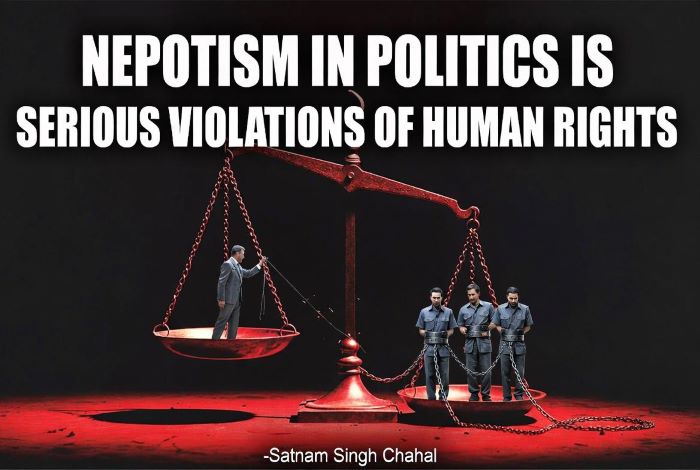
 Nepotism in politics refers to the practice where power, influence, and opportunities are concentrated within specific families or close networks. Instead of rewarding merit, capability, or public service, leadership effectively becomes a family inheritance. Over time, this pattern has become deeply embedded in many political systems. It is particularly common in democracies where electoral success often gets converted into dynastic succession. While democracy is meant to ensure equal opportunity for all citizens, nepotism directly undermines this foundational principle. One of the most serious consequences of political nepotism is the weakening of democratic values.
When leadership positions are repeatedly passed within families, talented and deserving individuals from ordinary backgrounds are often pushed aside. This creates a flawed system. In this environment, loyalty to a family or dynasty becomes far more important than loyalty to the public or the nation. As a result, governance suffers. Decision-making is ultimately influenced more by personal or familial interests than by true merit or public welfare. Nepotism also directly slows down national development. Leaders who come into power solely through family connections often lack the necessary experience, training, or accountability required to govern effectively.
In many cases, this leads to misallocated national resources, short-sighted public policies, and an increased risk of systemic corruption. Most importantly, the voice of the common citizen becomes weaker as political representation becomes concentrated in the hands of a few influential families. There are several well-known examples of nepotism in politics across the world. In India, the most frequently cited example is the Nehru–Gandhi family, where multiple generations have held top leadership positions in the Congress party. Regional politics across India mirror this trend: The Badal family in Punjab (Shiromani Akali Dal), the Karunanidhi–Stalin family in Tamil Nadu (DMK), and the Yadav family in Uttar Pradesh & Bihar.
Internationally, political nepotism can be observed in various forms. Notable examples include the Bhutto family in Pakistan and the Bush family in the United States.The most concerning impact of nepotism is the toll it takes on ordinary citizens. When political systems are dominated by a few families, public trust in democracy rapidly declines. Young and capable leaders without a prominent family background find it incredibly difficult to enter politics. This barrier creates widespread frustration among citizens and weakens the idea of equal opportunity. Only by actively encouraging merit and transparency can the rights of common people be protected and democracy truly serve its purpose.The ImageThe image below illustrates the themes discussed in the article: the struggle between inherited power (represented by the gilded figures and shadows) and the true, diverse representation of a nation’s citizens.
Disclaimer: The photographic elements used in the accompanying graphic are for symbolic and illustrative purposes only. The individuals depicted do not imply actual endorsement, involvement, or association with substance