
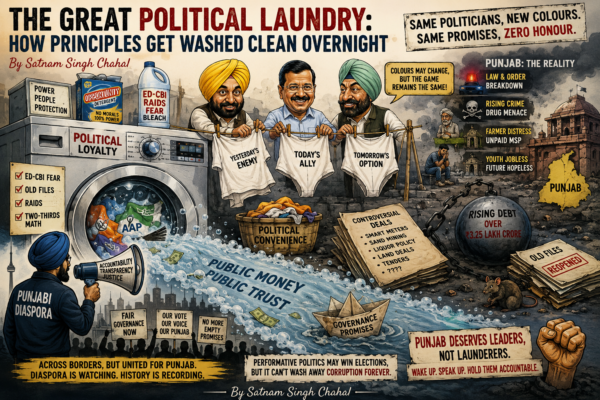
In the grand circus of modern politics, there is a special category of leaders who deserve a unique award—the “Flexible Spine Lifetime Achievement Award.” These distinguished personalities begin their political careers by swearing eternal loyalty to one party, comparing it to their mother, their family, and sometimes even their religion. Yet, remarkably, their devotion lasts only until the next raid, summons, investigation, or political opportunity appears on the horizon.
These leaders often speak passionately about ideology, sacrifice, and public service. They spend years criticizing rival parties, calling them corrupt, anti-people, anti-democratic, and dangerous for the nation. Their speeches are so fiery that one would think they would rather jump into a volcano than join their political opponents. However, politics is a magical profession. The same leaders who yesterday called their rivals “the greatest threat to democracy” suddenly discover that these very rivals are actually “visionary statesmen” and “great patriots” after a short visit to the capital city.
Mysterious circumstances usually trigger the transformation. Sometimes it is the fear of the Enforcement Directorate knocking at the door. Sometimes it is the fear of old files being dusted off and reopened after years of peaceful retirement in government cupboards. Sometimes it is the fear of income tax raids. And occasionally, it is the miraculous realization that national interest requires them to immediately change sides—preferably before breakfast.
Political scientists may spend decades studying ideology, but Indian voters have developed a simpler formula. Whenever a leader suddenly changes parties, citizens begin guessing the reason. Was it fear of the ED? Was it fear of the CBI? Was it fear of forgotten files suddenly becoming important? Or was it simply the irresistible attraction of a ministerial bungalow, official car, and security cover? The public may never know, but the timing is often so perfect that even astrologers are impressed.
Perhaps the most entertaining explanation comes when leaders claim they switched parties to “save democracy.” Strangely, democracy always seems to require saving immediately after an investigative agency issues a notice. Even more fascinating is how years of ideological differences disappear overnight. Policies that were once described as disastrous suddenly become revolutionary. Leaders who were called dictators become champions of democracy. It is political alchemy at its finest—turning criticism into praise within twenty-four hours.
Then comes the famous mathematical miracle known as the “two-thirds formula.” A group of legislators who cannot agree on anything suddenly become united when the possibility of power emerges. The same leaders who could not sit together in a meeting suddenly discover deep friendship and common purpose. Their unity is so extraordinary that it deserves inclusion in school textbooks under the chapter “Unexpected Wonders of Nature.”
Unfortunately, while political loyalties may change rapidly, moral character is expected to remain constant. Public representatives are elected on the basis of promises, principles, and trust. When leaders repeatedly switch sides for personal survival or political convenience, citizens begin to question whether ideology was ever important in the first place. If a party is evil on Monday and glorious on Tuesday, perhaps the problem was never ideology but opportunity.
The greatest victims of such defections are ordinary voters. They cast their votes based on party manifestos, policies, and leadership. When elected representatives switch camps without seeking a fresh mandate from the people, voters often feel betrayed. Their vote becomes a transferable asset traded in the marketplace of political convenience.
In the end, history rarely remembers those who changed loyalties out of fear or personal gain. It remembers leaders who stood firm during difficult times, defended their convictions, and accepted political consequences with dignity. Power comes and goes, governments rise and fall, agencies open and close files, but character remains the true test of leadership.
As citizens watch another season of political migration unfold, they can only wonder whether these leaders are guided by ideology, conscience, fear, or simple mathematics. Whatever the answer may be, one thing is certain: in the grand theatre of politics, principles often travel with a very small suitcase.
Disclaimer: The photographic elements used in the accompanying graphic are for symbolic and illustrative purposes only. The individuals depicted do not imply actual endorsement, involvement, or association with substance