
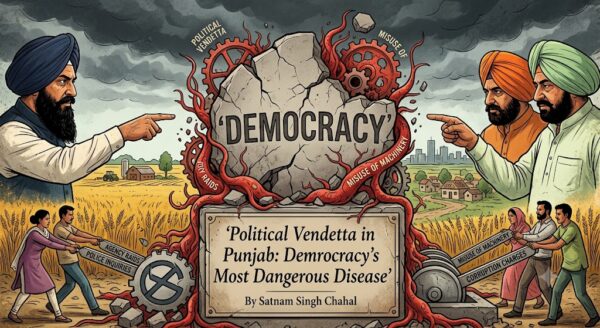
 Political vendetta has become one of the most frequently used and controversial terms in Punjab’s political vocabulary. Almost every political party, whether in power or in opposition, accuses its rivals of misusing government machinery, investigative agencies, police forces, and administrative institutions to settle political scores. The unfortunate reality is that while governments change, the allegations often remain the same.
Punjab has witnessed numerous instances where opposition leaders have claimed they were targeted through investigations, raids, vigilance inquiries, and criminal cases. At the same time, governments have defended such actions by arguing that they are fighting corruption and ensuring accountability. The debate therefore is not simply about law enforcement; it is about whether state institutions are being used impartially or as instruments of political pressure.
During the past several years, allegations of political vendetta have come from all sides of Punjab’s political spectrum. The Congress has accused both the BJP-led central government and the ruling AAP government of pursuing “vendetta politics” through raids and investigations targeting political opponents. Congress leaders have argued that opposition voices are being selectively targeted while similar scrutiny is not applied elsewhere.
On the other hand, the Aam Aadmi Party has repeatedly alleged that central agencies such as the Enforcement Directorate and the CBI are being used to weaken opposition governments and leaders who challenge the ruling establishment at the national level. AAP leaders have described several investigations and raids in Punjab as politically motivated actions rather than impartial legal proceedings.
Similarly, the Shiromani Akali Dal has also accused the Punjab government of targeting its leadership through legal and administrative measures. Akali leaders have argued that attempts are being made to intimidate opposition figures and silence criticism of government policies.
The larger concern is that when politics becomes dominated by revenge rather than governance, ordinary citizens become the biggest losers. Punjab today faces numerous challenges, including unemployment, drug abuse, migration, declining agricultural profitability, industrial stagnation, law and order concerns, environmental degradation, and a growing financial burden on the state. Citizens expect governments to focus on these pressing issues rather than spending excessive energy fighting political battles.
Political vendetta also weakens public trust in democratic institutions. When every investigation is portrayed as political revenge and every corruption allegation is dismissed as conspiracy, citizens begin to lose faith in the fairness of the system. Genuine anti-corruption efforts become suspect, while legitimate legal action is viewed through a political lens. This creates a dangerous situation where institutions lose credibility regardless of whether they are acting correctly or incorrectly.
Social media has further intensified this culture of political confrontation. Supporters of different parties often view every police action, raid, protest, or court case through partisan lenses. Instead of discussing policy and governance, public discourse increasingly revolves around personal attacks, accusations, and political rivalries. Many citizens express frustration that politicians seem more interested in defeating opponents than solving public problems.
Punjab’s political history offers an important lesson. Governments come and go, but democratic institutions must remain independent and credible. A party that is in power today may find itself in opposition tomorrow. If institutions are weakened for short-term political advantage, future governments may use the same tactics against their predecessors. The cycle of revenge then continues indefinitely.
A healthy democracy requires accountability, but accountability must be based on evidence, transparency, and due process rather than political considerations. Corruption should certainly be investigated, regardless of the party involved. However, investigations must be conducted in a manner that inspires public confidence rather than creating perceptions of selective targeting
The people of Punjab deserve politics that focuses on development rather than revenge. They deserve leaders who spend more time creating jobs than filing cases, more time improving education than attacking opponents, and more time addressing public concerns than engaging in political warfare. Democracy flourishes when governments are judged by their performance, not by their ability to intimidate rivals.
As Punjab moves toward future elections, voters may ultimately ask a simple question: who is working for the people and who is merely fighting political battles? The answer to that question could determine the future direction of the state’s politics. Political vendetta may provide temporary headlines, but it rarely provides lasting solutions. Punjab’s future depends not on revenge, but on governance, accountability, and the restoration of public trust in democratic institutions.
Disclaimer: The photographic elements used in the accompanying graphic are for symbolic and illustrative purposes only. The individuals depicted do not imply actual endorsement, involvement, or association with substance