
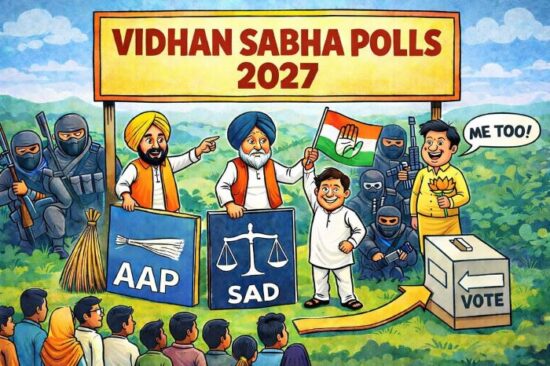
The conclusion of the Punjab Legislative Assembly’s October 22–27, 2026, session has raised important questions about the performance of the Bhagwant Mann-led Aam Aadmi Party government, the effectiveness of the opposition and the extent to which the Assembly addressed Punjab’s most urgent problems. Although the session was scheduled across several calendar days, the House did not sit continuously because of the weekend and a gazetted holiday. The Assembly was adjourned sine die on October 27.
A session of the Vidhan Sabha should not be judged simply by the number of Bills passed, resolutions adopted or speeches delivered. Its real value lies in whether elected representatives secured answers from ministers, scrutinised government decisions, exposed administrative failures and produced meaningful outcomes for Punjab’s people.
The opening sitting on October 22 lasted approximately 10 minutes before the House was adjourned until the following day. At the same time, the Congress raised concerns about drugs, gangsterism and law and order, while the government faced pressure to respond to public concerns over these issues.
Such developments highlight a fundamental question: are Punjab’s legislative proceedings being used to their full potential? The Assembly is not merely a venue for political speeches or exchanges of accusations. It is the institution where the government must explain its performance and the opposition must scrutinise it on behalf of the public.
Punjab continues to face serious challenges involving drug trafficking, unemployment, farmers’ difficulties, public debt, healthcare, education and the condition of public services. People have a right to expect detailed discussions, clear commitments and measurable progress on these matters.
One of the major outcomes of the concluding sitting was the passage of eight resolutions. These addressed Punjab’s claim to a share in Yamuna waters, control of irrigation headworks at Ropar, Harike and Ferozepur, opposition to the Dam Safety Act, demands for payment or royalty for river water supplied to Rajasthan, diversion of Ravi waters, continuation of public welfare schemes and reopening of the Sri Kartarpur Sahib Corridor. The House also adopted a resolution concerning nominations to Panjab University’s Senate.
These are important issues, particularly for Punjab’s farmers, water security and Sikh religious heritage. The demand to reopen the Kartarpur Sahib Corridor also carries deep significance for Sikhs who wish to visit Gurdwara Darbar Sahib, associated with Guru Nanak Dev Ji.
However, passing a resolution does not automatically change a law, settle an inter-state dispute or secure a financial payment. The government must explain what steps it will take next, which authorities must act, what legal procedures are required and how progress will be measured.
The river-water resolutions deserve particular attention. Punjab’s agricultural economy depends heavily on water, and the state has a legitimate interest in ensuring that its legal claims are examined fairly. Yet political declarations must be followed by documented legal action, negotiations and practical water-management measures. Farmers need reliable irrigation, not merely assurances delivered from the Assembly floor.
The concluding sitting was marked by a confrontation over the suspension of Congress MLA Sukhpal Singh Khaira. Congress legislators protested after alleging that their colleague had been prevented from entering the House, and the party boycotted proceedings. These developments further highlighted the strained relationship between the ruling AAP and the opposition.
The opposition has a democratic responsibility to challenge the government on drugs, law and order, unemployment and public finances. But its effectiveness must also be judged by the evidence it presents, the questions it asks and the alternative solutions it offers. Walking out or boycotting proceedings may communicate protest, but it also reduces opportunities to question ministers directly.
The ruling party, meanwhile, cannot treat its numerical majority as a substitute for accountability. With 94 MLAs in a 117-member Assembly, according to contemporary reporting, AAP has substantial legislative strength. That majority gives the government the ability to advance its programme, but it also places a greater responsibility on the ruling party to ensure fair debate and meaningful scrutiny.
Democracy suffers when legislative proceedings become primarily a contest of slogans, personal attacks and political demonstrations. Punjab requires an Assembly in which disagreement is permitted, questions are answered and public interest takes precedence over party interests.
The concerns are not limited to the October session. A study by the PANJ Foundation, reported by The Indian Express in June 2026, found that the 16th Punjab Legislative Assembly had met for approximately 63 sitting days between 2022 and 2026, below the 40 sitting days per year prescribed under its Rules of Procedure. The study also reported that 60 of 61 Bills introduced between March 2022 and December 2025 were passed on the day of introduction.
These findings raise important questions about legislative scrutiny. Complex laws can affect farmers, employees, businesses, public institutions and ordinary families for years. Legislators therefore need sufficient time to read Bills, consult experts, examine financial implications and propose amendments.
Passing legislation quickly is not necessarily evidence of poor governance; some measures may be straightforward or urgent. But routinely approving Bills on the day they are introduced risks weakening the Assembly’s role as an independent forum of scrutiny.
Punjab needs stronger legislative committees, better research support for MLAs and transparent records of the time spent discussing each Bill. The public should be able to determine not only what was passed but also why it was necessary, what it will cost and whether it achieves its intended purpose.
The financial cost of Assembly sessions is another issue that deserves transparency. An estimate of ₹80–85 lakh per sitting day has been cited in public discussion, but this should not be presented as the audited cost of the October session.
If the estimate were applied to three sitting days, the illustrative total would be ₹2.4–2.55 crore. This is only a calculation based on that estimate, not a verified expenditure figure for the session.
The Assembly administration should publish the actual costs of staffing, security, transport, facilities and other relevant operations, distinguishing between expenses incurred specifically for the session and routine expenditure that would have occurred anyway.
Taxpayers deserve accurate figures rather than political speculation. If public money is spent convening elected representatives, the public should be able to assess the results against the cost.
The most important measure of the October session is not the number of resolutions adopted or the intensity of political exchanges. It is whether the proceedings helped address the problems affecting Punjab’s people.
-
Drug menace: What measurable progress has been made against drug trafficking and the networks responsible for supplying narcotics?
-
Farmers: What concrete steps will improve irrigation, protect groundwater and address compensation and agricultural distress?
-
Employment: What commitments have been made to create sustainable jobs for Punjab’s young people?
-
Public finances: How will the government manage debt and spending while protecting essential services?
-
Law and order: What accountability measures will ensure that citizens can live without fear?
-
Sikh heritage: What practical diplomatic and administrative steps will follow the resolution seeking to reopen the Kartarpur Sahib Corridor?
-
Legislative accountability: How many questions were answered, how much time was spent examining legislation, and what commitments will ministers be required to fulfil?
These questions demand documented answers, not merely statements of political intent.The October 2026 Punjab Assembly session produced eight resolutions on significant matters, including river-water rights, irrigation infrastructure, welfare schemes and Sikh religious heritage. At the same time, confrontations between the government and opposition renewed concerns about the quality of legislative debate and accountability.
The Bhagwant Mann government should publish a clear account of its achievements, outstanding commitments and implementation plans. The opposition should provide evidence-based scrutiny and credible alternatives. The Assembly administration should disclose verified expenditure and comprehensive records of legislative business.
Punjab’s people do not elect representatives merely to attend sessions, exchange accusations and pass resolutions. They expect effective governance, protection of their rights, economic opportunities and institutions that work in the public interest.The final verdict on this session will not be written by the ruling party or the opposition. It will be determined by whether Punjab’s people see meaningful improvements in their lives.
Disclaimer: This article and accompanying images are for informational and illustrative purposes only. Some visuals may be AI-generated or digitally enhanced and may not depict actual events or persons. Views expressed are based on publicly available information and analysis