
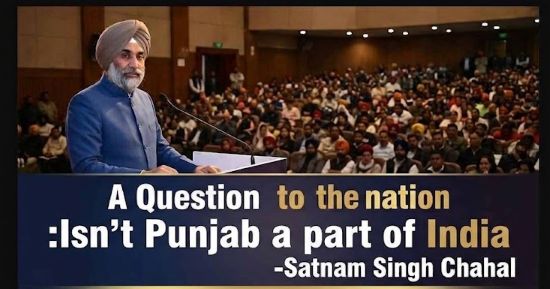
 Isn’t Punjab a part of India? Don’t the people of Punjab deserve the same constitutional rights, dignity, protection and justice as citizens living in any other state? These are questions that every conscientious Indian must ask when allegations of administrative high-handedness, police excesses and the mistreatment of ordinary people in Punjab arise. If injustice against citizens in one part of the country deserves nationwide condemnation, why should the suffering of people in Punjab receive anything less?
The Hathras incident in Uttar Pradesh in 2020 shook the national conscience. The case involving a young Dalit woman, who died after being assaulted, triggered widespread protests, intense media scrutiny and demands for accountability. Political leaders, civil society groups, human rights advocates and citizens across the country raised their voices. The incident became a national debate about women’s safety, caste discrimination, police conduct and the responsibility of the state administration. That public response demonstrated the importance of speaking up when the rights and dignity of vulnerable people are threatened.
But the question remains: does the same concern for justice extend to Punjab?
Whenever reports emerge of protesters being manhandled, people being detained during demonstrations, or vulnerable citizens allegedly facing excessive force while demanding their rights, the response from outside Punjab often appears limited. Whether the affected people are farmers, employees, teachers, persons with disabilities, unemployed youth or ordinary citizens seeking government accountability, their grievances deserve serious examination. Their voices should not be dismissed simply because the events are taking place in Punjab rather than in a state that dominates the national headlines.
A particularly troubling question arises when people with disabilities or other vulnerable groups allegedly face police force while peacefully demanding their legitimate rights. Such incidents, wherever they occur, demand scrutiny. A government that claims to represent ordinary people has a special responsibility to treat peaceful protesters with dignity, exercise restraint and ensure that grievances are heard. The administration must remember that a protest is not automatically a threat to public order merely because it creates political embarrassment.
The comparison with Hathras is not intended to suggest that every incident in Punjab is identical in its facts, severity or circumstances. Each case must be independently investigated, and allegations must be distinguished from established findings. However, the principle of justice cannot change from state to state. If the country demanded accountability in Hathras, it must also demand accountability whenever credible allegations of abuse of authority arise in Punjab.
Why does national outrage sometimes appear selective? Is it because certain incidents receive greater television coverage, attract more political attention or fit into a wider national political narrative? Or have repeated protests and confrontations in Punjab gradually become so familiar that people have stopped paying attention? These are uncomfortable questions, but they deserve honest answers.
Punjab has made enormous contributions to India. Its farmers have played a major role in strengthening the country’s food security. Its soldiers have served on the nation’s borders, and its people have contributed to industry, education, culture and the Indian diaspora around the world. The Sikh community, in particular, has a long history of service, sacrifice and standing up for the rights of others. Yet the value of Punjab cannot be measured only by its contribution to the country. The people of Punjab are citizens with constitutional rights, and those rights must be protected regardless of their political opinions, religion, caste, economic status or place of residence.
It is equally important that the media fulfil its responsibility. National news organisations cannot claim to speak for the entire country if the problems of some regions receive sustained attention while the concerns of others remain largely confined to local reporting. Punjab’s issues deserve independent journalism, factual investigation and fair coverage. The suffering of an ordinary Punjabi citizen should not require a national political controversy before it becomes worthy of public attention.
Opposition parties and political organisations also have a responsibility to rise above narrow calculations. Defending a citizen against alleged injustice should not depend on whether the person supports the ruling party or the opposition. Human rights are not the property of any political organisation. A person who demands justice today may disagree with us politically tomorrow, but that disagreement cannot become a reason to ignore their suffering.
At the same time, the Punjab government must understand that democratic authority comes with accountability. The police and administration are public institutions, not instruments for silencing criticism. Whenever allegations of excessive force or unlawful detention arise, the authorities should provide transparent explanations, preserve relevant evidence, investigate complaints impartially and take action where wrongdoing is established. Peaceful dissent must be protected, and legitimate grievances should be addressed through dialogue rather than intimidation.
The people of Punjab, too, must continue to demand justice peacefully, document alleged abuses, seek legal remedies and insist on accountability from elected representatives. Facts, evidence and constitutional methods are essential to ensuring that genuine grievances receive credibility and lasting solutions.
The question before the country is simple: if injustice against a citizen in Uttar Pradesh can become a national concern, why should alleged injustice against a citizen in Punjab be treated as a lesser issue? Is Punjab outside the national conscience? Are the rights of Punjabis less important? Does the value of a citizen’s dignity depend on the state in which that person lives?
India cannot build a stronger democracy by remaining silent about alleged abuses in any state. The test of national unity is not merely whether citizens celebrate together in moments of pride. It is whether they stand together when vulnerable people demand justice, when peaceful protesters seek to be heard and when public institutions are accused of exceeding their authority.
Punjab is an inseparable part of India, and the people of Punjab deserve the same justice, dignity and protection as every other Indian citizen. The demand is neither special treatment nor political favour. It is a demand for equal treatment under the Constitution.
The nation must answer this question with its actions, not merely with words: Isn’t Punjab a part of India, and don’t Punjabis deserve justice too?