
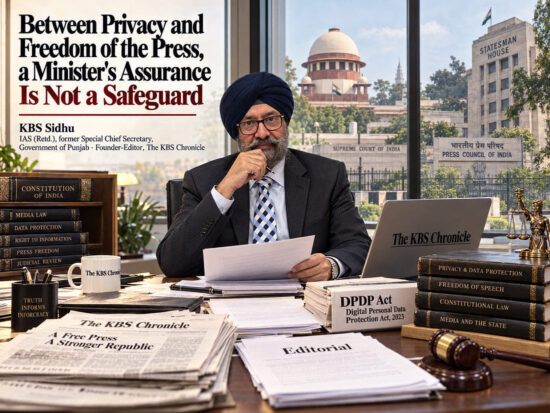
 The Government says the privacy law leaves press freedom untouched because the Constitution guarantees it. The Constitution guarantees less than the Minister thinks. This challenge should become the occasion to write a real press freedom into the Constitution.On Tuesday, 27 October 2026, the Supreme Court issued notice to the Union Government on a petition by the Digital News Publishers Association (DNPA). The association represents twenty-one of the country’s largest news organisations, and its petition challenges the Digital Personal Data Protection Act, 2023 and its Rules. The Bench of Chief Justice Surya Kant and Justices Joymalya Bagchi and V. Mohana tagged the petition with the other pending challenges and listed the batch for 17 November.
The very next day, today, the Government replied, but in the newspapers rather than in an affidavit. Ashwini Vaishnaw, who as Minister for Electronics and Information Technology administers the Act and as Minister for Information and Broadcasting deals with the press, said:
“The journalistic freedom is guaranteed by the Constitution of India. That freedom is absolutely available.”
“There is not even an intention to affect journalistic freedom.”
“Nowhere does the law infringe upon journalistic freedom.”
According to the news agency IANS, he also “clarified that the law does not require journalists to seek permission.” He invited editors to talks.
The reassurance is welcome. It also misses the point.
What Will Actually Govern
When a reporter is hauled before the Data Protection Board or a court in 2028, the adjudicator will not be reading a Minister’s remarks to the media. He will read the text of the Act, interpreted alongside the Constitution, and the Constitution protects the press far less than the Minister implies.
Article 19(1)(a) guarantees every citizen freedom of speech and expression. Article 19(2) then allows the State to impose “reasonable restrictions” on that freedom in the interests of the sovereignty and integrity of India, the security of the State, friendly relations with foreign States, public order, decency or morality, contempt of court, defamation, and incitement to an offence. A statute restricting speech is presumed valid until a court strikes it down. “The Constitution protects you” is therefore not something the Government can offer journalists as a defence. It is the argument the journalists have gone to court to establish.
A second problem is that the Minister’s assurance binds, at most, his own Ministry, and in practice not even that. The DPDP Act gives every individual whose data is processed the right to be notified, to withdraw consent and to demand erasure. A businessman exposed in a story, a politician caught on tape or a contractor whose shell companies have been traced will not check the Minister’s statement before complaining to the Data Protection Board. A Minister cannot take away, in a sentence to reporters, rights that a statute gives to third parties. If the law truly does not require journalists to seek permission, the Minister should cite the section that says so. If he cannot, the assurance is only a hope.
The publishers say they were given exactly this kind of comfort at a meeting in August, and it was never put in writing. A second oral assurance is worth no more than the first.
The Press Has No Special Rights of Its Own
The deeper issue is one most citizens, even journalists, are unaware of: the Indian Constitution does not mention the press at all.
The American Constitution does. Its First Amendment forbids Congress to make any law abridging “the freedom of speech, or of the press.” On that text American courts built New York Times v. Sullivan (1964), under which a public official cannot win a libel suit without proving the falsehood was published knowingly or recklessly.
India chose differently. In the Constituent Assembly in December 1948, Prof. K.T. Shah called the absence of press freedom from the draft a “very glaring omission.” Dr. B.R. Ambedkar replied that “the press is merely another way of stating an individual or a citizen.” In his view an editor or a reporter exercises the same freedom as any citizen, no more and no less, so no separate mention was needed.
The Supreme Court has since read press freedom into Article 19(1)(a), from Romesh Thappar and Sakal Papers to Bennett Coleman and Indian Express Newspapers. But a freedom that exists only as a reading of a general clause carries every restriction placed on that clause. The Indian journalist can be prosecuted for criminal defamation, which the Supreme Court upheld in Subramanian Swamy (2016) and which survives in Section 356 of the Bharatiya Nyaya Sanhita. He can be booked under the Official Secrets Act, under provisions on promoting enmity, and now, potentially, he can face proceedings under a data protection law that does not acknowledge he exists.
Constitutional amendments have mostly narrowed speech. Nehru’s First Amendment of 1951 added “public order” and “friendly relations with foreign States” to the permitted restrictions. The one exception is Article 361A, inserted in 1978 after the Emergency, which protects true reports of parliamentary proceedings. India has written a press protection into the Constitution once already.
Secrecy Was Meant to Be on the Retreat
In 2005 Parliament seemed to have settled the old contest between secrecy and the citizen. The Right to Information Act did not merely coexist with the colonial Official Secrets Act, 1923. It placed itself above it. Section 22 provides:
“The provisions of this Act shall have effect notwithstanding anything inconsistent therewith contained in the Official Secrets Act, 1923 (19 of 1923), and any other law for the time being in force or in any instrument having effect by virtue of any law other than this Act.”
Section 8(2) went further. Even where information falls within an exemption, “notwithstanding anything in the Official Secrets Act, 1923 … a public authority may allow access to information, if public interest in disclosure outweighs the harm to the protected interests.”
This mattered. The Official Secrets Act is so broadly worded that carrying almost any official paper home could be called an offence. A law under which everyone is technically guilty lets the State choose whom to prosecute, and it tends to choose those who embarrass it. The RTI Act reversed the presumption: disclosure became the rule and secrecy the exception that had to be justified.
That reversal has been worn down steadily since. The RTI (Amendment) Act, 2019 put the tenure and salaries of Information Commissioners at the Centre’s discretion. Commissions have been left without commissioners for long stretches and with growing backlogs. The proactive disclosures required by Section 4 are honoured more in the breach. Now Section 44(3) of the DPDP Act has rewritten Section 8(1)(j) of the RTI Act. That clause once allowed personal information to be disclosed where a larger public interest justified it, and it carried the proviso that information which cannot be denied to Parliament shall not be denied to any person. Both are gone. In their place is a flat exemption for “personal information,” a category wide enough to cover nearly everything the State knows about the people who run it.
Privacy for Whom?
This is being done in the name of privacy. Yet the personal data of ordinary Indians has been leaking on a vast scale, through no fault of any journalist. In October 2023, hackers advertised on the dark web what they claimed was the personal data of 81.5 crore Indians, reportedly linked to COVID-testing records held by the Indian Council of Medical Research. The CoWIN vaccination database had been reported compromised a few months earlier. The citizen’s data is exposed by professional hackers and lax custodians, and the remedy Parliament offers is a law under which the reporter who tells that citizen about it could be the one penalised.
The DPDP Act does not create criminal offences. Its penalties are financial, imposed by the Data Protection Board, and they reach up to ₹250 crore, enough to break a mid-sized news organisation. Nor do they stand alone. A subject unhappy with a story can complain to the Board, demand erasure under the Act and lodge a criminal defamation case, all over the same report. The process becomes the punishment, and ordinary journalism about a powerful person becomes a legal risk in itself.
We Have Been Here Before
The press has learnt before that assurances are not safeguards. In August 1988, at the height of the Bofors disclosures, the Rajiv Gandhi government took the Defamation Bill through the Lok Sabha in a day. The Bill was aimed at “scurrilous” writing carrying “criminal imputations.” It shifted the burden of proof onto the editor and allowed trials in camera. The Prime Minister called it a “prestige issue.” Journalists, lawyers and students took to the streets, and on 22 September 1988 the Bill was withdrawn unconditionally. Only then did Rajiv Gandhi declare that “a free Press is an integral part of the inner strength and dynamism of our democracy.” It took a nationwide protest to bring him to that conclusion.
The Specific Defects
The DNPA petition and the challenges already before the Court identify the defects plainly.
Consent before the story. Anyone processing personal data must notify the person concerned and seek consent. Applied to a newsroom, this warns the subject of an investigation in advance and gives him time to destroy evidence and pressure witnesses.
Erasure after the story. The right to withdraw consent and demand erasure can become a statutory route to unpublishing archived reports, so that the historical record is edited at the request of the person it embarrasses.
The requisition power. The Union Government may call for information from any “data fiduciary,” with no judicial warrant and no exception for a reporter’s notes or sources. The petition calls this power “nakedly unguided.” A whistleblower who fears his identity can be obtained by letter will not call the newsroom again.
The missing exemption. The Justice B.N. Srikrishna Committee’s 2018 draft exempted journalistic purposes, and the 2023 Act dropped that exemption. The European Union, the United Kingdom and Singapore all exempt journalism in one form or another.
The lopsided exemptions. The State has given itself wide exemptions in the name of sovereignty, security and public order, and has given the press none.
Sweet Are the Uses of Adversity
The exiled Duke in As You Like It found that “sweet are the uses of adversity.” This adversity can be put to use as well.
The immediate remedy is legislative, and it is simple. If the Minister means what he says, the Government should say so on affidavit before 17 November and then amend the Act. The amendment should provide a written exemption for journalistic purposes, require prior judicial authorisation before any requisition from a newsroom, protect archived reports from erasure, and restore the public-interest test in the RTI Act. An assurance that costs the Government nothing can be written into the statute for nothing too.
Statutes can be amended again, however, and this will not be the last such law. The larger remedy is constitutional. The time has come for a national conversation, across parties, on writing freedom of the press into Part III in its own right, with protection of journalistic sources, a bar on prior restraint except under narrowly defined judicial orders, and a hard look at whether criminal defamation still belongs in a mature democracy.
This Government has not been shy of amending the Constitution. Earlier this year it brought the Constitution (131st Amendment) Bill to enlarge the Lok Sabha and tie women’s reservation to delimitation. The Bill failed to win a two-thirds majority, the first such defeat for the Modi government. The lesson is that a constitutional amendment succeeds on consensus, not on majority. Press freedom is one of the few causes on which consensus ought to be possible, because every party in India has at some point been in opposition, and every opposition has needed a free press.
A Cause Beyond the Newsroom
This cause should not be left to the twenty-one corporations in the DNPA, some of which have shown little appetite for scrutinising the powerful. The right the press exercises is the citizen’s right to know. The voice must come from the Bar, the universities and civil society, and above all from a generation that has grown up online and knows that whoever controls data controls the story. Young people across South Asia have shown in the past year that they will not accept being told what they may know.
Privacy and freedom of the press need not be enemies. A good law can protect both. But the balance between them must be struck in the text of the law and of the Constitution, not in a Minister’s remarks to reporters. Until it is, his assurance is not a safeguard.