
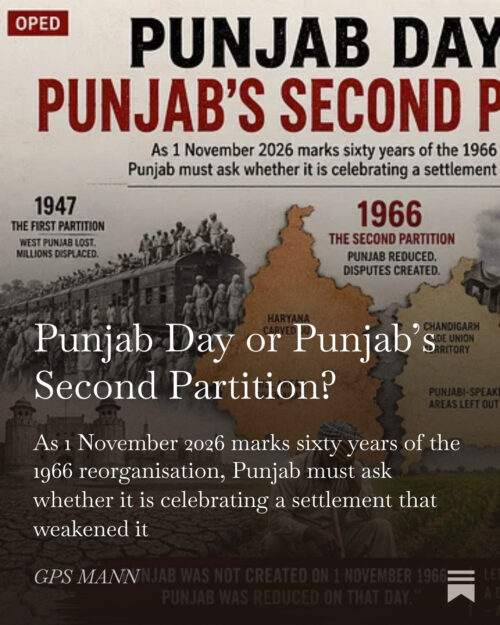
Image is AI Generated
On 1 November 2026, Punjab will complete sixty years of its reorganisation under the Punjab Reorganisation Act, 1966. Officially, the day is observed as Punjab Day. But after six decades, Punjab must ask a more uncomfortable question: was 1 November 1966 really Punjab Day, or was it Punjab’s second partition? Punjab was not born in 1966. Punjab existed long before that. What happened on 1 November 1966 was not creation; it was reduction.
The first partition of 1947 cut away West Punjab, including Lahore, and uprooted millions. The second partition of 1966 further reduced what remained. Haryana was carved out. Large hill regions were transferred to Himachal Pradesh. Chandigarh, built as Punjab’s new capital after the loss of Lahore, became a Union Territory and remains disputed to this day.
If 1947 wounded Punjab, 1966 institutionalised that wound.
The Akali Project and Its Cost
To understand the tragedy of 1966, one must revisit the Punjabi Suba movement honestly.
The Shiromani Akali Dal led the agitation for a Punjabi-speaking state after Independence. Publicly, it was presented as a struggle for Punjabi language, culture and identity. Thousands courted arrest. Agitations were launched. The demand dominated Punjab’s politics for nearly two decades.
But history must also record the political calculation behind the movement.
Punjabi Suba was not merely a linguistic demand. It also meant creating a smaller geographical unit where Sikhs would form a majority and where the Akali Dal could realistically hope to dominate politics. What was projected as a language movement also carried a clear political objective: a Punjab small enough for Akali politics to command.
That calculation proved to be Punjab’s double loss.
First, Punjab paid a heavy territorial and strategic price. It lost Haryana. It lost hill regions. It lost exclusive claim over Chandigarh. It inherited river-water disputes. Several Punjabi-speaking areas remained outside Punjab. The state lost geography, resources, bargaining power and strategic depth.
Second, even the political objective for which this price was paid was never fully achieved. The Akali Dal did not establish durable solo dominance in the smaller Punjab it had fought to create. Time and again, stable Akali power required alliances with the Jan Sangh and later the BJP.
Punjab was therefore cut in anticipation of Akali political advantage, but even that advantage remained incomplete. Punjab became smaller; the Akali Dal still could not consistently rule alone. The state paid the civilisational price, but the political dividend never truly arrived.
The Akalis won Punjabi Suba, but Punjab lost strategic depth and political strength.
Had the leadership of that time thought as Punjabis first, rather than through the narrower prism of Sikh-majority electoral arithmetic, Punjab may have sought a settlement that protected Punjabi language without dismembering Punjab’s territorial and economic strength.
When Language Became Religion
One of the most damaging consequences of the Punjabi Suba period was that language stopped being language.
During the census controversies of the 1950s and 1960s, sections of Punjabi Hindu opinion were encouraged to declare Hindi, rather than Punjabi, as their mother tongue. Lala Jagat Narain and his press became prominent voices in this wider Punjabi-Hindi controversy.
Punjabi Suba supporters saw this as a deliberate attempt to weaken the linguistic basis of their demand. Many Punjabi Hindus, on the other hand, feared that Punjabi Suba would become a Sikh-majority political state.
Thus, Punjabi came to be seen by many as a Sikh marker, and Hindi as a Hindu marker. This was a tragedy for both communities. A shared civilisational language became a communal boundary.
Punjab’s strength has always been Hindu-Sikh unity. Punjabi Suba politics damaged that unity by converting language into a test of identity. The mistrust created in those years did not disappear after 1966. It continued to influence Punjab’s politics for decades.
The Unresolved Questions of 1966
The strongest proof that 1966 was not a solution is that Punjab is still fighting the same questions sixty years later.
Chandigarh remains unresolved.
SYL remains unresolved.
River waters remain disputed.
Punjabi-speaking areas remain outside Punjab.
Centre-State relations remain a recurring source of tension.
These are not accidental issues. They are direct derivatives of the 1966 settlement.
Before 1966, there was no separate Haryana claiming river waters from Punjab. Before 1966, Chandigarh was built as Punjab’s capital. Before 1966, the issue of Punjabi-speaking areas had not become the unfinished wound that it remains today.
The settlement that was supposed to resolve Punjab’s language question created a permanent chain of political disputes.
Anandpur Sahib Resolution: The Aftershock
The Anandpur Sahib Resolution of 1973 must also be understood in this context. It was not an isolated document. It was the political aftershock of 1966.
The Resolution demanded the return or merger of areas which the Akali Dal believed had been taken away from Punjab, including Chandigarh and other Punjabi-speaking or Sikh-populated areas. It also sought to restrict the Centre’s jurisdiction largely to defence, foreign affairs, currency, communications and railways, leaving the rest to Punjab.
Supporters called it federalism. Critics saw it as separatism, or at least as a document capable of separatist interpretation. That debate itself proves the point. The same document could be read in two radically different ways because the unresolved contradictions of 1966 had never been settled.
If Punjabi Suba had truly satisfied Punjab’s aspirations, why was another major constitutional and political demand raised within a decade?
The answer is clear: 1966 did not settle Punjab’s question. It multiplied it.
The Road to Turmoil
The tragedy of Punjab in the 1980s and early 1990s had many causes. No serious person should reduce militancy, Operation Blue Star, the anti-Sikh massacres of 1984, or the decade of terrorism to one single event.
But it is equally dishonest to pretend that these tragedies emerged in a vacuum.
The politics of identity, the distrust between Punjab and the Centre, the disputes over Chandigarh and river waters, the Anandpur Sahib Resolution, the alienation created by unresolved federal questions, and the communal scars left by the Punjabi-Hindi divide all formed the background against which Punjab descended into turmoil.
The assassination of Lala Jagat Narain in 1981 became one of the early turning points in Punjab’s slide into militancy-era violence. His life and death symbolised how language, religion, politics and media had become dangerously intertwined in post-1966 Punjab.
The fault lines along which Punjab later burned were not all created in 1966. But many of them were sharpened, institutionalised or left unresolved by 1966.
The Economic Legacy
The cost was not only political. It was economic.
After 1966, Punjab became smaller, more landlocked and more agriculturally dependent. Its development model became increasingly tied to wheat and paddy procurement. That model gave India food security, but Punjab paid the price.
Over time, the wheat-paddy cycle produced groundwater depletion, ecological stress, power-subsidy burdens, farmer distress and fiscal pressure. Today, Punjab’s fiscal crisis has many causes: militancy-era disruption, weak industrialisation, accumulated debt, rising committed expenditure, salaries, pensions, interest payments, and power subsidies. Successive governments — Akali, Congress and AAP — have all contributed to the problem.
But the deeper structural issue remains: 1966 left Punjab smaller, narrower, more agrarian and less economically diversified. A larger Punjab, with a broader territorial and resource base, may have had a very different economic future.
This too is part of the cost of 1966.
Sixty Years Later
For six decades, Punjab has heard that 1 November is Punjab Day. But what exactly are we celebrating?
Are we celebrating the loss of Haryana? The loss of hill regions? Chandigarh becoming disputed? SYL? River-water conflict? The communalisation of language? A political settlement that still troubles Punjab sixty years later?
Punjab was not created on 1 November 1966. Punjab was reduced on that day.
This is not a call to divide people. It is the opposite. It is a call to rebuild a Punjabi identity larger than communal politics. Punjab’s future cannot be Sikh versus Hindu, Punjabi versus Hindi, rural versus urban, or state versus Centre. Punjab’s future depends on Hindu-Sikh unity, federal justice, economic revival and a shared Punjabi consciousness.
But unity cannot be built on false celebration. It must be built on truth.
Therefore, as 1 November 2026 approaches, Punjab should reconsider whether this day deserves ceremonial celebration. It should be observed as a Day of Reflection and Remembrance — if not formally as Punjab’s Black Day, then at least as a day of honest historical reckoning.
Let schools, colleges, universities and public institutions discuss what 1966 did to Punjab. Let the next generation understand how Chandigarh, SYL, river waters, Punjabi-speaking areas, Centre-State tensions, identity politics, agricultural distress and fiscal stress are connected to that historic rupture.
Punjab does not need another ceremony.
Punjab needs historical courage.