
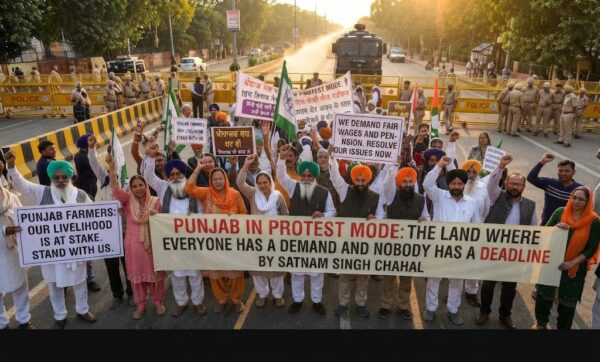
Punjab appears to have entered a new political season where the calendar is no longer divided into Monday, Tuesday and Wednesday. It is increasingly divided into protest day, bandh day and meeting-with-the-government day. Employees are protesting, pensioners are protesting, farmers are raising demands, sanitation workers are agitating, religious organisations are taking to the streets, and political parties are holding demonstrations. Punjab, it seems, has become a state where everybody has a demand, and nobody has a clear date for resolution.
The current unrest has an almost comic side, except that the issues behind it are extremely serious. Whenever a group raises a grievance, the standard government response often sounds familiar: “We are taking the matter seriously. A meeting will be held.” After the meeting, another meeting is announced. Then comes another assurance, followed by another deadline. Eventually, the protester begins wondering whether the government has created a new department called the Ministry of Meetings and Assurances.
The ongoing agitation by government employees and pensioners over pending financial demands has brought this issue into sharp focus. Employees want their dues, pensioners want their rightful payments, and the government wants the situation to remain peaceful. Unfortunately, everyone appears to agree on one thing—the money is important—but they do not appear to agree on when the money will actually reach the people who earned it.
There is a certain irony here. Government employees are protesting because their demands have not been resolved, and government functioning is being affected because employees are protesting. The public then suffers because government offices are disrupted. It is almost like calling the electrician because the electricity is out, only to discover that the electrician is also protesting because his electricity bill has not been paid.
Punjab’s streets are increasingly becoming the state’s unofficial grievance office. If you want your voice heard, you hold a dharna. If that does not work, you announce a bandh. If that does not work, you march towards Chandigarh. If barricades appear, you hold a press conference. And if water cannons arrive, you know that your complaint has finally reached the government’s attention.
The irony becomes even greater when political parties enter the picture. Every party claims to support the protesting citizens. Opposition leaders arrive with microphones, slogans and cameras. Government representatives arrive with assurances. Protesters arrive with placards. By the end of the day, everybody has spoken, everybody has promised to help, and the ordinary citizen is left asking the most important question: “But who is actually going to solve the problem?”
Punjab’s political landscape is also beginning to resemble a family wedding where relatives who stopped talking to each other years ago suddenly discover that they may have to sit at the same table. Former political allies are again being discussed as potential partners, while current political rivals accuse each other of betrayal. Everyone says they are doing it for Punjab. The people, meanwhile, are doing something much less glamorous they are trying to pay their bills.
Perhaps Punjab should now create a Department of Protests and Bandhs. It could have separate counters for employee protests, farmer protests, pensioner protests, sanitation-worker protests, religious protests and political protests. At the reception desk, one official could politely ask: “Please take a token. Your grievance will be heard after the previous twelve protests are completed.”
There is nothing wrong with democratic protest. Punjab has a proud history of public mobilisation, dissent and standing up for rights. Peaceful protest is an important part of democracy. The real concern begins when citizens feel that protest is the only language the government understands. A healthy democracy should not require thousands of people to stand in the streets before a government department responds to a legitimate grievance.
The situation also raises a larger question about governance. Why should an employee have to demonstrate to receive something that is already legally and administratively due? Why should a pensioner repeatedly visit government offices to ask for money that belongs to him or her? Why should farmers believe that blocking roads is necessary to get a hearing? Why should an NRI travel thousands of miles, attend an NRI Milni and return home with nothing more than another promise to “wait a few more days”?
The answer cannot always be another committee, another meeting or another assurance. Governance means decisions, implementation and accountability. A press conference can explain a policy, but it cannot substitute for implementation. A meeting can discuss a problem, but it cannot become the final destination of the problem.
The greatest danger is that people gradually lose faith in institutions. When citizens believe that files move only after protests, applications require political connections and grievances are resolved only after media attention, the system itself begins to lose credibility. That is far more serious than any individual protest.
Punjab does not need more slogans. It needs functioning institutions, fiscal discipline, employment opportunities, effective law enforcement, action against drugs, transparent administration and timely resolution of genuine grievances. Above all, it needs a system in which a citizen does not have to become a protester before becoming a priority.
There is also a lesson for Punjab’s political class. The public is watching. Elections come and go, governments change and political alliances are reshuffled, but the same unresolved issues keep returning. Promises made today become protests tomorrow. Protests today become election speeches tomorrow. And election speeches eventually become promises again.
Perhaps the most appropriate slogan for Punjab in 2026 would be: “Your grievance is very important to us. Please remain on protest until further notice.”
That would be hilarious if Punjab’s problems were not so serious.Punjab is not short of talent, resources or hardworking people. What Punjab desperately needs is trustworthy governance that listens before people are forced onto the streets. The people are not asking for miracles. They are asking for salaries, pensions, justice, security, jobs, dignity and accountability.And if the government really wants to know why Punjab is restless, there is no need for another survey, committee or high-level meeting.Just listen to the streets. Punjab’s people are already speaking.
Disclaimer: This article and accompanying images are for informational and illustrative purposes only. Some visuals may be AI-generated or digitally enhanced and may not depict actual events or persons.Views expressed are based on publicly available information and analysis